
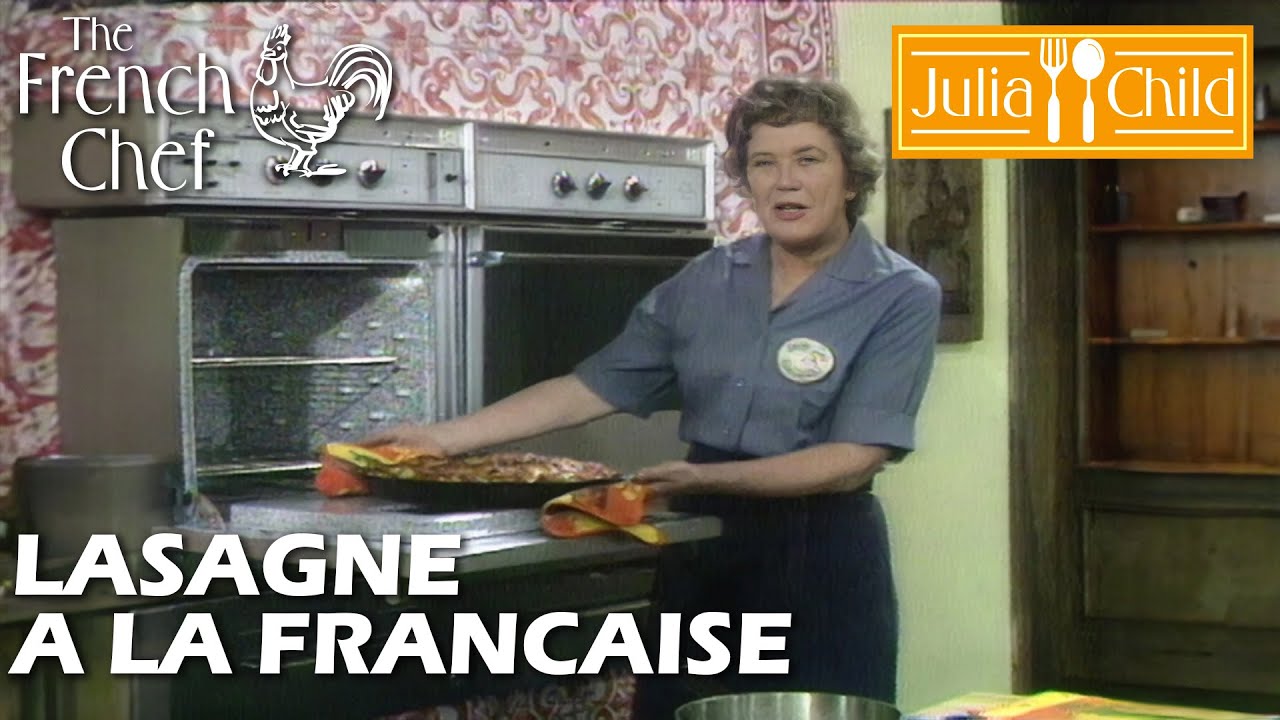
A great way to use yesterday’s roast, be it poultry, veal or pork. Julia Child’s French lasagne is a delicious concoction of pasta, Italian tomato sauce, saffron threads, dried orange peel, leftover turkey, veal or whatever, and an “inner sauce” that’s rich and velvety.
About the French Chef:
Cooking legend and cultural icon Julia Child, along with her pioneering public television series from the 1960s, The French Chef, introduced French cuisine to American kitchens. In her signature passionate way, Julia forever changed the way we cook, eat and think about food.
About Julia Child on PBS:
Spark some culinary inspiration by revisiting Julia Child’s groundbreaking cooking series, including The French Chef, Baking with Julia, Julia Child: Cooking with Master Chefs and much more. These episodes are filled with classic French dishes, curious retro recipes, talented guest chefs, bloopers, and Julia’s signature wit and kitchen wisdom. Discover for yourself how this beloved cultural icon introduced Americans to French cuisine, and how her light-hearted approach to cooking forever changed how we prepare, eat and think about food. Bon appétit!
— Managed by PBS Distribution
Get More Julia Child on PBS:
Twitter: https://twitter.com/pbsdistribution
Facebook: https://www.facebook.com/PBSDistribution.org
-Heavens! I’ve got so much to do today. We’ve having unexpected company today, on “The French Chef”! ♪♪ ♪♪ -“The French Chef” is made possible by a grant from the Polaroid Corporation. ♪♪ -Welcome to “The French Chef.” I’m Julia Child. What do you do when you have only a moment’s notice
And you’ve got unexpected company? Well, one of the great things to do is lasagna and this is lasagna à la française, which means “in the French manner,” and I should add that it should be also called à la française aux USA, meaning “in the [laughing] United States,”
Because I’m not a little, tiny French woman. Though I may look so, I am not. So, lasagna, as you all know what these are, and the great thing is to estimate, and I think one nice thing about lasagna is that you can pretty well estimate how much you need.
I usually find that I got three times too much pasta, usually, but, with lasagna, at least I’ve got the dish this size. And you want, say, four pieces for the bottom layer, four for the middle layer, and four for the top layer. And there are four extra
And I always think a little more is better than a little less, so I’m gonna use the whole box of lasagna and, if there’s anything left, I’ll make lasagna salade à l’américaine. And this is now to be boiled. And I’ve got a great, big pot of boiling water
And in it all goes and it’s big enough so it’ll fit. And somebody told me, once, that, if you put a little bit of olive oil in the water that sometimes that would keep it from boiling over. I’ve never had any problem boiling over, but some people do.
And I’m gonna have 3 tablespoons of coarse salt. You’re supposed to oversalt slightly and that’s just, I think, salted just about right. And then, on the box. And I’m not an Italian cook, so I follow the box. It’s 15 minutes, so I’m going to set the timer to 13
From the time it started boiling and, then, we can estimate it. I mean, look at it, see if it’s done. And, now, because this is an italia dish, we’ll have to have tomato sauce and I love tomatoes, anyway. And you have to have tomato sauce,
But you gotta have onions, so, I got some great, big onions ’cause I think they’re faster to peel than smaller ones. They said that these onions came from Peru ’cause it wasn’t the right season for them to come from Texas. And… I may not need all this onion, but,
I can wrap it up in plastic, if not. Cut her in half and I’ll use the bigger half. Chop, chop, chop. Very fast. Remember not to get your fingers into the knife because fingers are not part of this lasagna recipe. There. I think half of that’s gonna be enough
And I’ll chop them a little bit more. This is a somewhat peasant dish, so I don’t have to chop them very carefully. And, then, they’re gonna be cooked. I think, when you’re gonna do something in a hurry, you want to do things that are rather peasanty because it’s much faster.
In France, they’re very sensible about saying when things are roughly chopped, it’s peasant; and, when they’re a little better chopped, it’s bourgeois; and, when it’s very, very finely chopped and you’ve taken a long time over it, it is haute cuisine. [ Sizzling ] And, now, these onions are to cook
And to be stirred frequently. ♪♪ And then, they should probably cook about 10 or 15 minutes, until they’re translucent. [ Sizzling ] And you can cover them, if you want. I’m not gonna cover, at this point, and I’m gonna set them over on a little lower burner. [ Sizzling ]
Well, I don’t [indistinct] gonna cover them. If — [ Sizzling ] If you don’t cook them well enough, they don’t give out their flavor the way they should. And, now, we have tomatoes and I’m gonna make a tomato sauce that has half-fresh and half-canned tomatoes. And, first, they have to be blanched,
So they can be peeled, so that’s 1, 2, 3, 4, 5, 6, 7, 8, 9, 10 seconds exactly that they are to be in the water and, then, they’re ready to peel. I think that’s the nice thing [laughing] about having a big pan of water: You can do so many things with them.
But, now, we’ve done this a great many times. This is gonna be tomatoes concassé, which just means “peeled, seeded, and juiced” tomatoes. See? That skin comes off very nicely. They’re a little, tiny bit oily because of that olive oil in the water. Maybe, next time, when I’m gonna do tomatoes,
I won’t put olive oil in the water with the lasagna until after I’ve blanched the tomato. [ Sniffle ] There. Course, holding tomatoes over a gas flame works very nicely, too, but, if you have a lot of them, it’s much easier to drop them into boiling water. There. And, now,
These get cut in half. If you’re going to use tomatoes for salad, also, it’s a good idea to peel them this way because it doesn’t cook them. They’re not in long enough. Now, I’m going to — This is the juice part. You take your hand and squeeze the tomato
And you see all the juice coming out. And there’s those little seeds in there. And this is over a sieve, so that we won’t lose any of the juice and you see, if you’re gonna use the tomato for a salad or stuff it, this is the way you do it
And you do it rather gently. But the object is — in this case, this would not be good for a salad, but I got all the juice out, and the seeds. You don’t want to have to strain your tomato sauce. You want to —
And it’s no good if you have the seeds in it. This is a very — Seems to be so very typically French, that you always keep running into tomatoes peeled, seeded, and juiced. And, now, if you’re going to do them very carefully so that you’re gonna make a tomato fondue, you cut them,
Slice them carefully, so that they remain in nice, little slices like that. But, if you’re going to do them for sauce, they just need to be roughly chopped or, as they say, concassé, conca-concassed. There’s a little piece of skin in there. And these are two tomatoes and they will be about —
About 1 cup — medium-sized tomatoes — of tomato pulp. And, very often, you run into this in a recipe where they say that they want 2 cups of tomato pulp and that’s it. And, now, for the canned tomatoes, the Italian plum tomatoes are much the best
And it says on them, “Italian peeled tomatoes” and, then, on the other side, it’s all in Italian and it has this plum shape. And here it is opened. This is going to go into a food mill and, although they’ve peeled it, they haven’t seeded it,
So you have to put it through a strainer. I actually was planning to strain out some of the juice and use only the pulp, but, that would’ve been a little smarter, but that’s all right. [ Water boiling ] And, now, we have onions. I’ve already done the —
I have some other onions that are cooked. As you can see, these are not quite cooked. You’re not gonna get the proper — And here are some that are cooked and you can see the difference. And I’m going to divide these onions because I want [ Clattering ]
[laughing] half of them — half of them to go into the lasagna itself, so I’m just gonna take half of them out and set those aside ’cause what would an Italian dish be without onions? And, then, the tomatoes are going to go in with that.
Ideally, you would let them — put on the cover and let them cook for a little while to release their juices and, then, you would add your tomato, canned tomatoes. I’ve neglected to say that I prefer the whole canned tomato to the tomato purée because I find the canned tomato purée rather sweet
And I don’t really like the tomato sauce, if I have the time to make my own. And so this is just going to cook and I’m gonna keep — I’ll keep the rest of that under here, in case I need it. And I have Italian seasoning
And so this is gonna be Italian. I’m gonna put that in. This is a combination of a little bit of everything. That’s about 1/2 teaspoon. You want some salt and pepper. Then, that can cook away. You can add a little bit of saffron, if you like,
And you can add some dried orange peel. And that should cook for at least half an hour and I really think the longer — And, if you can allow it to cook for an hour, it’s gonna be even better and I think you’ll find that the combination of fresh tomato
And canned tomato is gonna give you a sauce that tastes really fresh. Now, we’re gonna have to see how the lasagna is. Gonna take out one piece and this should be somewhat al dente. So you cut off a piece and the best way to do is just to eat a piece
And, when it’s done, it’s ready to drain. That isn’t quite done, [ Ding ] but I’m [laughing] saying that’s done. This is mainly to show you how to do it. And, then, immediately it’s done, drain. It should be what they call al dente, meaning that — that it isn’t mushy.
You can still feel a little texture on your teeth. And then, on the box — [coughs] On the box, it says, “Rinse thoroughly in cold water,” which I’m going to do because I’m not an Italian-type cook, so, I’ll do exactly what they say.
Very often, I don’t do anything they say on the box, but, in this case, they’re probably right. And then let it drain off. [ Water gurgling ] And, if you’ve done it a little bit ahead, it’s a good idea to arrange it [laughing] like this. That looks like a spaghetti laundry, doesn’t it?
And be sure, when you buy any pasta or lasagna or anything, look carefully on the box and it should say, “No. 1 semolina durum wheat,” which means it’s made out of very hard wheat, the kind that the real Italians make their spaghetti out of, because it won’t be sticky,
If it’s made out of the proper stuff. And, now, for our lasagna, I think one of the great — Well, this is one of the great dishes for when you have leftovers and I think that it was somewhat plan on having leftovers. I have here some chicken that was poached in white wine
And I also have some spinach that’s just perfectly flavored and ready to go. In fact, when I did the spinach, I thought, “Well, it’s always useful for something like putting under poached eggs or poached fish or something like that,” and I also have some mushrooms.
I was having sautéed mushrooms, so I made a little extra. And I have cheeses and various other things. And then, we have to have an inner sauce. The tomato sauce is outer sauce and then, there’s an inner, unctuous sauce that is to bind all the ingredients in the lasagna together
And to give it a lovely taste. And this is a — I’ll show you what this is. This is a white sauce, which means it’s a milk sauce. This one happens to have a little bit of — of chicken stock in it and this is why I left these onions,
So that this sauce and these onions could be combined. And then you want — This should — You should let it simmer with the onions for a little while, so that they will blend flavors. And I always find, although I say, for a dish like that, which is rather large,
That 3 cups is gonna make sure that you have more sauce than you think you need. Then I would — This doesn’t have any wine in, so I think a little wine is nice and I’m just gonna add a littl bit of vermouth
Because that always would give it a little bit of that à la française taste. And then, have a taste of it and make sure that it is perfectly flavored. It’s very good. And, now, one thing, a capital, cardinal, special thing I forgot was to put garlic in the tomato sauce.
So I have a big take-apart garlicker and an enormous piece of Italian garlic. In she goes! This would’ve been a crucial error, if I hadn’t put that in. Tsk. Don’t want the skin in. There. And we have put salt and pepper in that. And in this, you just let the tomato sauce cook
As long as you possibly can, ’cause the longer it cooks, the better it will be, and it should cook long enough so the onions practically disappear in it. And then this. After this has carefully simmered and — and you feel that it’s exactly right, you can add some cheese to it
And I’m gonna smooth this all over here because we can begin assembling the lasagna and I’m gonna put the sauce over there. And… here is our lasagna plate. And I think this should always be started with a little oil in the dish, so that things won’t stick to it.
If you don’t like olive oil, you can use something else, but olive oil is much the best and you just have to try out various kinds and see what you like. And then, here is the lasagna, which should be laid in. Be interesting to see if my estimate was right.
And then a little bit of the sauce will go on first, as a bottom layer. What you want with the sauce is you want to be sure that you’re gonna have enough left for the top, so, be a little bit chintzy with it, unless you have an enormous amount.
And now I have this carefully and beautifully flavored spinach and I’m gonna put half of that on. I think you’ll see, when you see this served, that it’s very nice ’cause the spinach is — the colors are pretty. I haven’t any idea how Italians do it, but. It’s always fun with French people
’cause they take over somebody else’s recipe, like a moussaka, and they do it exactly the way they like. And, now, some cheese. This is a combination of a little bit of everything. I had some leftover provolone and some Swiss and I have some Parmesan, so, it’s a nice mixture. So that goes in.
And then, we have this chicken. And half of that goes on And then, a little more of the sauce. The mushrooms have already gone on and mushrooms are an important part, usually, because they do have natural MSG in them, which is interesting to know. And, now, there’s one layer,
So we put on a second layer of lasagna. Looks as though I might have enough lasagna for four layers, rather than three. It does seem to get bigger as it cooks. Well, that’s the way pasta is. And I’m gonna put on a little more sauce there.
You could, if you wanted, put on a little bit of the tomato sauce, at this point, but I don’t think I will. Then, I’m gonna put on some more mushroom. I mean, some more of the spinach. Don’t want to lose a bit of it. There. And then, we have —
I have some leftover cottage cheese and I’m just gonna put some of that on. That would take the place of that Italian-type cheese. I can’t remember what the name of it is. And we have mushrooms again. And I’m gonna put the chicken up on top of that
And we’ve just about gone through what we have and I’m gonna put a little more cheese. This was very good chicken. This was chicken that was simmered in a white-wine sauce with aromatic vegetables and it was very, very nice. So I’m gonna put on some more,
A little more, of the regular type of cheese. And I don’t have an enormous amount of sauce there left. I do have a little more in my sauce pan. Matter of fact, I think I’ll go back and get this little more here of this sauce… …and save that mother lode for the top.
What I think is nice about this dish is it doesn’t — I like a kind of a dish where you don’t have to have exact proportions all the time. And, now, we have — I’m gonna do — I think it’s safe to cut off a little bit of these overhanging edges
And they can go on top because I have found that, if you have overhanging edges, that sometimes they get a little brittle in the oven. And now, this is ready for the top layer. And… And this, also, I’m gonna put on rather carefully. And be sure that it’s tucked down.
[laughing] These lasagna look so funny, just hanging over this like that. Curving this around. There’s a little bit back here that has none, so I think probably the thing to do is to cut off some. And I am gonna have enough lasagna left for my lasagna salad.
I can see that I could’ve used four less, but it’s better to have too much than too little, I think. Now, this is time to have the top. Then these are gonna have the two sauces on, gonna have the — the white sauce, with its wine flavor.
[sniffle] I’m gonna put on my glasses, so I don’t miss any bit of it. So you want to get either tomato sauce or white sauce on every part of it. So you can see why it is you want to end up with more white sauce than you —
Than you might think you needed. Now. Spreading that. Tsk. And tuck that down a little bit. And now, we have our tomato sauce over here. [ Clanging ] And this doesn’t want to go all over it. I want to make somewhat of a design. Particularly, be sure that you cover all areas.
There’s also gonna be some cheese on, so, if you do miss something, that’s all right. I think about half the tomato sauce. And then, le fromage. And a good, heavy layer of that because that’s what’s going to give it its nice brown look to it.
And I’m gonna make things look nice and neat. It’s always a good idea, if you can, to practice being nice and neat and this is an impeccable towel and you should wipe that off, too. Because this will not look well. Now, into the oven.
And, this, you can get done all ahead of time and put in the ‘frigerator if you prefer, but in this case, I’m gonna put it into a 400° oven, in the upper third, and let it cook for about half an hour, until it’s nice and bubbling, like this,
And that the top has browned nicely. There you are. And it has a marvelous smell, [laughing] as it certainly should, with all of this in it. Now, this is all ready to serve and I do — I really think it is best to serve it as soon as possible
Because, with the spinach and so forth, it can — If you let it wait around too long or if you keep it warm, your chicken is going to overcook and the spinach is going to lose its beautiful, green color. So, I think you just have to watch it
And be somewhat informal about how long — I mean, whether your guests are going to have to wait or not. But I know I just think it’s much better if you serve it as soon as you can after it’s done. And I’m going to — Although I’m gonna serve it to these guests,
I’m gonna want you to see how it looks. I’m just gonna take out a piece. I want you to see the layers of it. This looks as though it will be enough to certainly serve eight people, I should think. The first one is always the hardest, isn’t it? Spillies.
Now, can you see — can you see how the layers look there? See? You’ve got the sauce and the mushrooms and there’s the green and there are bits of chicken. I don’t really think that you need to have tomato in it because you can pass some more tomato sauce separately,
But that’s entirely up to you and how you feel. And, as for wine, I would suggest that you serve just any nice, red, domestic wine, a nice, simple one like one in a half-gallon jug, a mountain red, or you could serve a Beaujolais. And, now, [laughing] here’s the trick,
Which I think we can pull off. I’m gonna put this serving back so that our guests will never know you had a look. And I think that, with a little more cheese and a little more tomato sauce, the will never know what happened at all,
And then I can just brown it in the oven again. And this is a good idea also for you, if you’re going to serve leftovers. You can put it in a smaller dish. And so, that’s all for today on “The French Chef.” I’m gonna have to brown this cheese before I serve it.
And this is Julia Child. Buon appetito! ♪♪ ♪♪ -This program was made possible by a grant from Polaroid Corporation. ♪♪ Julia Child is the author of “From Julia Child’s Kitchen,” which includes the recipes from this program.
38 Comments
"Ding" 11:40
Does that mean company is here?
Lasagna is a bad choice in a hurry.
Italians would never waste time skinning and seeding tomatoes.
Rather peasanty!
I like cooking “peasanty”. 😂
"and various other things…" Sounds like one of my recipes. Wine is most effective when it's inside the cook.
I am confused… combine this sauce,, that suuce, cottage cheese, tthis layer, thiat layer, cheese galore… lots of steps…wine… sorry Julia, killedthin.
I did not reveal all of my mother's recipe. It took me 7 years to master the sauce. It's about balance of items in the recipe. Italian food has regional recipes just like China has regional food. My mother's parents came from Messina, Sicily. I know bone soup, lasagne, spaghetti sauce. I only know this very, very well. So your regional food uses salt, fine. My mother taught me Angelina's lasagne. Antonio had vineyards in Sicily with his brothers. So that's all I have to say. As for my mom's lasagne this, I'm sure of.
I learned how to cook watching Julia Child and from her first cookbook which I still use. She is the greatest.
My mother told me garlic powder does not destroy the other items in the meat nor sauce. One example is basil. Garlic is over strong and will destroy the balance between the garlic and basil. The best lasagne is balanced, so when you eat a fork of lasagne or taste your sauce, you should always taste something differently. That is balanced. Too much of one taste distorted the lasagne, the sauce. It is the mix of tastes that makes the best lasagne, the best sauce. Always eat it the next day. Leave it in the fridge and warm it up the next day. Part of my ancestry comes from France. The best stews eat the next day. Cindy
She’s fantastic. I love Julia Childs
I have always loved Julia Child and remember watching this episode back in the day. Even then I was offended by her “lasagna” recipe. Thank goodness she called it French lasagna because it sure isn’t Italian! A proper lasagna is not a vehicle for leftovers, especially chicken, and certainly not cottage cheese! OMG, ricotta only! I have been making lasagna for 54 years and I have never encountered anyone who didn’t love it. Yes, everyone may make theirs a bit different but when you start adding a mish-mosh of leftovers it is hard for an Italian cook to take. The lasagna pasta looked over cooked also. Like someone said in the comments, Julia, stick to what you know! You were a food icon and taught America a new way of cooking and gave us so many ideas, but don’t mess with Italian food! Everyone is entitled to a mistake and I will always love Julia for the pioneer she was! Veronica 😊
Love You Julia ! ! !
Never saw this in France
Jajaja que cochinero es eso? Seguro se los dio al Staff y lo escupieron
Creo habia mas vino dentrs de Mrs Child que en la Lasaña 😅
I just made a tomato sauce for a chicken pizzaiolo. I used a 28 ounce can of peeled plum. I didn't puree them but instead, and admittedly, more effort, I used shears to snip up the tomatoes, making a very textured sauce. A food mill is something that I may incorporate one day.
I love making lasagna. Thanks Julia.
By that time (Season 7) she looked like a parody of herself. Hilarious.
I love Julia, but she cracks me up sometimes. Unexpected company? They’re getting tuna melts lol
No such thing as ITALIAN SEASONING. Basil and garlic SHOULD have been added instead of the AMERICAN "ITALIAN SEASONING". No oil in pasta water ! ! ! ! !
😅😅😅😅😅
Dedlfinitely a FRENCH VERSION. THIS DISH IS NO WAY CLOSE TO WHAT AN ITALIAN WOULD MAKE. IM A GRANDSON OF ITALIAN IMMIGRANTS. My NON AND NONNY( GRANDFATHER AND GRANDMOTHER WOULD LAUGH AT T H IS DISH. SORRY, I LOVE JULIA BUT SHE needs to stick to fremch cuisine.
"unexpected company" and you have to cook onions and tomatoes for 30 minutes?? And in the meantime, who's cleaning the bathrooms?
She wasn’t very pretty
What a heap of shine is this wtf
Jerks.
So enjoyable. I wish there was someplace to find Dinner at Julia's. I really liked that show.
The basciamella sauce or balsamella its not even French, its actually italian from Toscana called salsa bianca. Caterina di medici brought it to France among many other recipes when she married luy the forthteent. The french knew diddly squat about cooking and culture before that.
I love that woman so much, but she really should stick to French cuisine. My eyes kept bugging out at all the different things she was mixing together. Cottage cheese? When she said she had a mixture of cheese, I thought parmesan and romano, not Swiss cheese. Yikes!
OMG the lasagna cooking in the over salted water … doesn't need to reboiled for 15 minutes, even two. It cooks in the sauce. The raw garlic added at the end – not cooked before separately with the onions. The word "peasant" being thrown around. LOL I imagine when this came out it was groundbreaking.
Nevermind I'll do it live
I would never think of lasagna as an impromptu meal when guests show up unannounced.
This is so funny !
She sure does like talking about wine 😂
What a horror show
This has NOTHING to do with lasagna and NOTHING to do with French or Italian cuisine…..this is hysterically untalented-out of breath-comedy…..😂
Love her. Watched her as teen. Wonderful to watch these again. ❤
What is a Polaroid? /jk
Silly me … I would have thought "lasagne a la Francaise" would have gone with a bechemal sauce, and ditched the tomatoes.
I am Italian, and a great cook, and I am laughing at all this . Lasagna alla napoletana, Bolognese, Siciliana ,calabrese, alla Romana and many many more . No cottage cheese, ricotta, good mozzarella, parmiggiano reggiano or padano.