
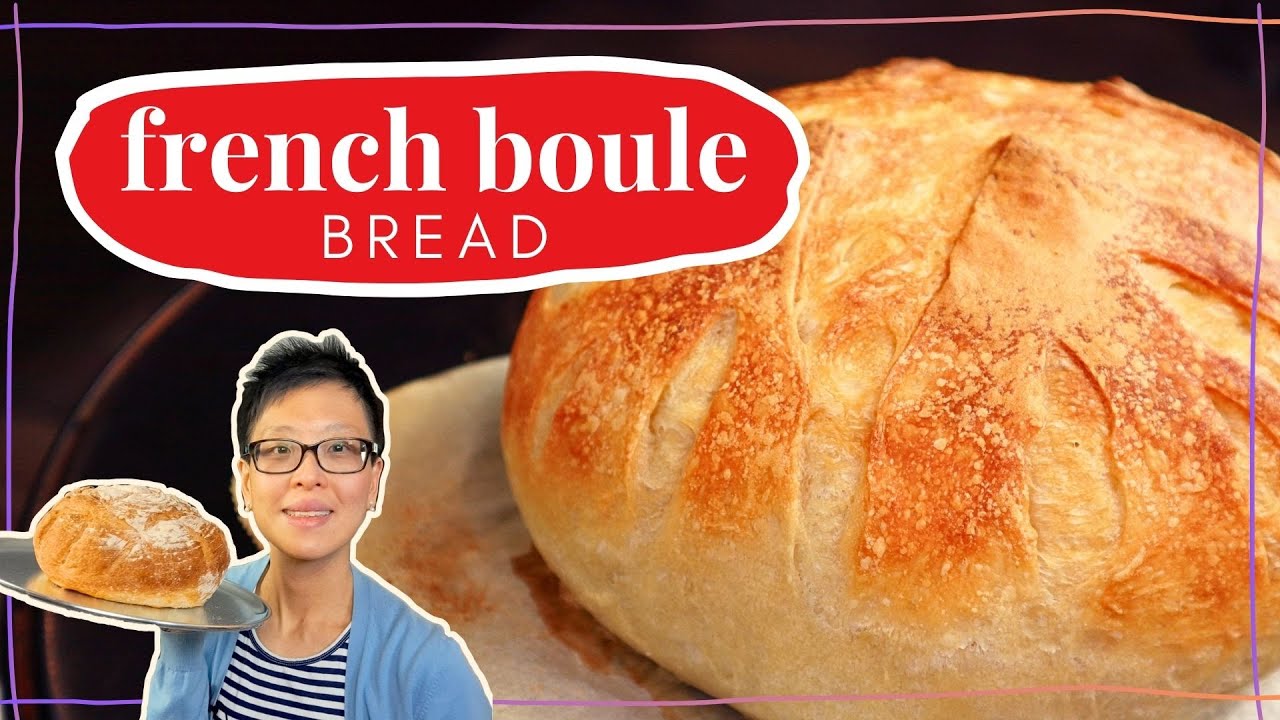
►blog post & printable recipes►► https://bit.ly/frenchboule
Save money & make your own homemade crusty, delicious, artisan french boule bread – only 5 ingredients:
► No experience required
► No kneading or dutch oven
► Stand mixer optional!
7-inch boule ingredients:
—————————————-
poolish:
– bread flour 95g [33%]
– water 95g [33%]
– instant yeast 0.4g [0.1%]
dough:
– bread flour 190g [67%]
– water 108g [38%]
– instant yeast 2g [0.7%]
– fine salt 4g [1.4%]
– poolish at peak activity
//2 – 3g of olive oil to glaze bowl for rising
EQUIPMENT & SUPPLES
—————————————-
*As an Amazon associate, I earn from qualifying purchases on the products sold on Amazon listed below.
► Digital Scale (1 decimal place) – https://amzn.to/48wA99a – USA
► Digital Scale (1 decimal place) – https://amzn.to/3wEEhqw – Canada
► IKEA 9″ Banneton Basket – https://www.ikea.com/us/en/p/jaesning-bread-basket-10480136/
► Instaferm Instant Yeast (in video) – https://amzn.to/3IidFhF – USA
► Instaferm Instant Yeast (in video) – https://amzn.to/42ZrdrD – Canada
► Fleischmann’s Dry Instant Yeast also works – https://amzn.to/3Tk8Nh9 – USA
► Fleischmann’s Dry Instant Yeast also works – https://amzn.to/3V0QcJf – Canada
► Costco Creative Baker’s Bread & Pizza Flour (in video)
► Walmart Great Value Best for Bread Flour also works
—
Freend Kat™ – World’s Most Comfortable Cold Weather Scarves:
► https://www.freendkat.com
► No more scratchy scarves!
► Comforts eczema, topical steroid withdrawal & sensitive skin
Connect:
► Blog: https://www.sensitiveskinlifestyle.com
► Instagram: https://www.instagram.com/sensitiveskinlifestyle
► Facebook: https://www.facebook.com/sensitiveskinlifestyle
► Twitter: https://www.twitter.com/senskinlife
#frenchbread #homemadebread #frenchboule #artisanbread
Hey my friends, today I’ll be showing you how I make French Boule Bread. It’s one of the most flavorful breads I’ve ever had. I’ve been making it almost every week for the past year and you can make this without a stand mixer. Use it for toast, sandwiches, or pair it with soup.
It’s versatile, easy, no preservatives freezable, incredibly affordable, and to those that care – this is vegan too. I hope you give this a try because I’m not a baker and if I can do this you can do
This too. Come! Follow me on my journey towards a happier, healthier and freer life. Subscribe to be notified on upcoming videos. Some of you may know I launched a collection of cold weather scarves especially designed to comfort those with sensitive skin so if you find scarves scratchy
Check out freendkat.com French Boule Bread – ‘Boule’ means ‘ball’ in French. This bread is shaped like a ball. Hence, its name. If you are a beginner wanting to make delicious artisan French bread use this recipe because it works. Baking beautiful and tasty bread requires lots of practice and there
Are many components to practice in order to make this bread beautiful. For example: the slap and fold method, the shaping of the dough, the scoring of the dough, the understanding of your environment and the oven that you’ll be working with. These all takes practice, to understand this
Bread. That is why we need this recipe: one that produces French bread that is so delicious that even if it doesn’t turn out looking perfect you are going to enjoy eating it. This recipe produces a 7-inch French boule. No kneading is required and you can make this without a stand
Mixer. We’re going to start off by adding 95 grams of cold water into a medium sized bowl. Then add 0.4 grams of instant yeast. If you don’t have a digital scale that could measure up to 1 decimal place, you
Can use slightly less than a quarter teaspoon. add 95 grams of bread flour. Using a spoon, we’re going to start mixing this into a cream. And as we mix this, the cream is going to thicken. Eventually, it’s going
To turn into a paste-like structure. The goal of this step is to ensure that every bit of flour is hydrated and there are no pockets of flour in the mixture. Once this is achieved, I will take a toothpick and scrape off any mixture from the spoon and the poolish is ready for fermentation.
Cover with cling wrap and let it ferment for 12 to to 16 hours. Sometimes I bake more than one type of bread at a time so I like to write down the flour and water content of this poolish
So when tomorrow comes along I can remember what size and type of bread I was intending to make. I also write down the fermentation start time to easily track how long this poolish has been
Fermenting. The next day if I see this, the poolish is at its peak activity and it’s ready. If I can’t start making the bread in 30 minutes, I will put the poolish into the fridge until I’m ready to start. This is to avoid over-fermentation. Over fermentation will cause the poolish to deflate
And it will start smelling like alcohol. We don’t want that. On the other hand, if we see this, it means the poolish needs more time. I would then move the poolish to a warmer part of the
Home and check back every 30 minutes or so until the poolish is at its peak activity. The time it takes for the poolish to be ready varies depending on your environment. Cooler temperatures may require longer fermentation time. If you want the poolish to ferment faster, next time add a
Little more instant yeast but cap the total amount of instant yeast to no more than a quarter teaspoon. The poolish gives our bread beautiful flavor and texture so try to let the poolish ferment for at least 12 hours. We want to be as precise as possible on the weight of the following ingredients:
Add 108 grams of water into your mixing bowl. Using a wet spatula, transfer the poolish into the water. A wet spatula has a non-stick effect. I find that it’s easier to scrape every bit of poolish off
Using a wet spatula. Add 2 grams of instant yeast. 190 grams of bread flour. 4 grams of salt on top of the bread flour; as direct contact of salt with yeast can slow down the yeast action. To those of you
That that need to watch your sodium intake, feel free to reduce the amount of salt to make a low sodium French Boule bread. You don’t have to use a stand mixer for this step. I will show you both ways.
On the lowest speed, mix to hydrate the flour and combine the ingredients. Increase the speed by one but no more than three notches to form a wet lumpy dough like this. Once this is achieved, stop mixing. Don’t over mix, it shouldn’t take more than 2 minutes. Then, we can put away our stand mixer.
If you don’t want to use a stand mixer. Use a spoon to combine all ingredients by making a cream starting from the middle. Hydrate every bit of flour. You can also change to a spatula to help grab every bit of flour until it turns into a wet lumpy dough like this one.
Transfer the wet lumpy dough onto a bench. Cover it with a bowl and let it rest for 25 minutes. When the dough relaxes, the gluten bonds are going to develop and we will see how this changes later. While waiting at 2 to 3 grams of extra virgin olive oil into a clean and dry bowl.
Lightly oil the inside of the bowl. This prevents the dough from sticking and also gives the bread a rich flavor. 25 minutes have passed: See how much gluten has developed? It’s a lot more relaxed and stretchy. Loosen the dough from the bench. Using wet hands, pick up the dough and slap and fold,
Turn the dough 90°, slap and fold, turn 90°, slap and fold. We’ll do this a few more times until the dough turns into a smooth, tight ball. Then pull the dough ball towards yourself like so for a few times to further tighten the dough ball. Two tips for slap and fold.
First: Always use wet hands so the sticky dough doesn’t stick to your hands. Second: Work smart. Here’s how: Slap and fold no more than 10 times. if after 10 times, you find your dough not turning turning into a smooth, tight
Ball. And it feels lumpy, wet, sticky, easily-ripping. Stop – Cover the dough with a bowl let it rest for another 15 to 20 minutes. Then repeat the slap and fold process again. It should work this time round. Transfer the smooth dough ball into the oiled bowl. Cover and let it rise for 60 minutes
In the warmest part of your home. After 60 minutes, with clean wet hands we’re going to loosen the dough. Gently stretch it and fold, turn 90° stretch and fold, turn 90° stretch and fold, turn 90° and fold. Four times. Then shape it into a smooth cap and back into the bowl
It goes. Cover and let it rise for another 60 minutes in the warmest part of your home. Using wet hands, transfer the dough to a bench, smooth side down. The dough is a little bit sticky so you can use a dough scraper to loosen the dough.
Very gently lightly stretch the dough. Pull one edge up and fold, pull and fold, pull and fold, around the parameter of the dough, until it forms a shape of a ball. Turn the dough ball over, and pull the dough towards yourself, turn it 90°, pull the dough
Ball towards yourself, turn 90° pull the dough ball towards yourself, until you get a smooth, not so sticky, dough ball. Cover the dough ball and let It rest for 25 minutes. After 25 minutes we are going to final shape the dough. We’ll do the same thing again.
Flip the dough smooth-side down. Gently and lightly stretch the dough. Then pull one edge up and fold, pull and fold, pull and fold, pull and fold, into a ball shape. Then flip the dough around and pull the dough towards yourself, turn 90°, pull the dough towards yourself. Do this
For a few more times until it turns into a smooth, tight ball. As you are final shaping the dough, you may notice air bubbles getting pressured out of the dough. Some air bubbles may come together and rise beneath the dough surface. I try my best to pressure them out
While shaping the dough but whatever is left behind I leave them as they are. Final shaping is done! This is my banneton basket. I bought it from IKEA. You can do the final rise directly on the
Banneton basket. But it takes effort to to wash and get all the flour out. so I line the banneton with the cloth liner that comes with it. Lightly dust bread flour over the banneton. If you’re doing
This directly on the basket you may need more flour to ensure the dough doesn’t stick to the basket. If you don’t have a banneton, you can use any pot or bowl that is 7½ to 8½ in
In diameter. Line it with a clean tea towel and dust it with bread flour. Transfer the dough ball to the banneton smooth-side down. Then cover it and let it rise for 60 minutes in the warmest part
Of your home. During this time, place a baking pan into the lower rack of the oven. Close and preheat the oven to 450° F or 230°C. 60 minutes have passed and our dough has doubled in size.
Place a small piece of parchment paper and a baking tray. Flip it over. Gently remove the banneton and we’re ready to score the dough. The main purpose of scoring the dough is to create create Pathways for
The steam to escape during baking. This allows for the bread to expand easily. Take a look at this bread that was not scored. There’s no easy pathways created for the steam to escape so it creates its own – which results in cracks on the top of the bread.
There are many ways to score dough. I’m going to show you my favorite because it’s simple and makes it easier to slice. You can use a baker’s lame or a sharp knife or even a pair of scissors to score the dough.
The main pathway I’m going to create for the steam is a cross. I envision the cross I’m going to score on the dough and do some practice strokes to prepare myself mentally and when I’m ready: just go for it!
Nice! It takes practice to gain confidence to do the scoring. The key I’ve learned is: don’t think too much about it and just go for it. I suggest picking a simple scoring design that you like and stick to it until you gain confidence. After the main pathway is scored
I like to give additional mini scores around the bread to allow the steam to escape. You can also add decorative mini designs with this. The mini scoring is optional but feel free to experiment! It’s baking time! Use a spray bottle filled with water and mist it generously over the dough to
Prevent the drying out of the surface. When the dough is moist, the bread can rise more. Open your preheated oven and carefully pour cold water into the hot preheated baking pan. Place the bread on the middle rack and generously mist more water on the bread. Close the oven and let
It bake for 10 minutes. The water in the hot baking pan and a pre-misting mimics the steam injection feature in commercial ovens. It delays the formation of the crust on the bread to allow the bread to rise to its potential during the first 10 minutes of baking. After 10 minutes,
Carefully remove the tray of water. Close the oven and turn down the temperature to 425° F and bake for another 15 minutes or until the bread turns golden brown. The French Boule is done! Check this out! It’s ready. It’s hot. I don’t know if you can hear the sound
Remove the parchment paper and allow the bread to cool on a rack for at least 2 hours before slicing. Slicing hot bread results in a gummy texture. Alright! The bread has cooled down. You ready for this? Check this out! Fresh bread without preservative stay fresh for about 18 hours at
Room temperature. You can freeze this! We wrap each slice individually to prevent freezer burns. Thaw it by leaving the wrap slices at room temperature for 1 hour or the night before. Let’s make sandwich! Lightly toasted French Boule slice. Half-the-fat mayo. Polish ham. Home-made pickled onions. Pickled hot pepper rings. Provolone Cheese.
Lunch sandwich done. Try this out let me know what you think. If you bake this bread, post it on Instagram. Tag me. I would love to see your wonderful creations. The printable recipe for this 7-inch French Boule is on my
Blog post. The link is in the description box below. And for those of you that try out this bread and enjoy it so much that you want to make a larger version, I have scaled up
This exact same recipe to produce an 8-inch, larger French Boule bread. The recipe is on the same blog post. You just take the amount of ingredients in the 8-inch recipe and follow the exact same steps in this video including the temperature of the oven and the time in the oven and you’ll
Produce an 8-inch French Boule bread! I baked this today to show you that the recipe works. I hope this helps. Thanks for watching and I hope you give this a try. I’ll see you next time!
25 Comments
Nice job
hey this is very helpful, I like how you show what is looks like if you do it wrong and how to fix it
Me encanto la manera que lo hiciste, gracias
Cool
have you got a English version of your recipe i keep getting Chinese thank you
Hi, your video look easy ,I’m interested to try your recipe, the bread flour is it unbleached bread flour ?
Thank you something I found easy way .👍🙏🙏
I used fresh milled flour and the poolish looked great but I think the dough needs more water, we'll see. either way, I love this process
Super detailed easy to follow instructions, great technique. I've seen hundreds of tutorials for making bread and I must say yours is very inspiring I'm excited to try out. I've just started using poolish to make a standard loaf and it really has so many benefits, especially the taste. I've learned a few new things from your tutorial. Thank you for positing, bless you!
Just subscribed. Love your instructions! ❤ Thank you!
Don't understand gram measurement.
Can I bake this in a Dutch oven?
Super easy instructions to follow. Thanks for all the tips especially the poolish part & am going to bake this bread & see how it turns out. Just subscribed & hope to see you do sourdough bread soon. Cheers 🥂
Arrgh! My dough is still REALLY sticky and soft and sticks like mad to the work surface – I followed the weights EXACTLY, and followed your instructions, including the second rest but nothing sems to help – my dough is a flat splat blob rather than a perky boule!!! I'm in Australia – so I'm betting it's got something to do with the flour. Should I use a bit more flour next time? I'm using bread flour – I'm determined to teach myself how to bake a decent loaf…….Thanks for your help!!
Thankyou going too try…lovely bread
Despite the best instructions in the world I am still having issues. Im not sure if its the yeast was too old, the flour too old, the house not hot enough but not much rising going on. I have got to the last part and am close to baking time. Not sure if it will rise in the oven and I'll get a loaf or if I'll be having a roll for tea 😅.
Will report back in a few hours.
Ps mine was quite sticky but i recall making a loaf when i was a teen that was soo sticky but in ended up being the best loaf i ever made.
Thank you for sharing…
Im in the philippines with ambient temp of 28 to 30 degrees C… Do i have to put my poolish mix inside the refrigerator for 12 to 14 hours? Thnx
Hello great recipe. THANKS . can you tell me what type of flour you use? in France there are T45, T55, T65. Thank you
Lovely
Very nice! very similar to a sourdough bread.
Thank you for detailed instructions, can’t wait to try! 😊
Thank you. One of the best tutorials to make bread at home.
Just after your slap and fold as you were pulling the ball toward you, you were fighting against your board. Try putting a damp cloth under there to help hold the board in place.
Looks amazing plus the crust. Thanks for sharing. Please do share more. ❤
That’s a beautiful loaf of bread. I will make this next weekend, thank you for a great tutorial.