
Julia Child begins this meal with oysters broiled on the half-shell and ends with Crepes Flambees, Sainte Claire. In between is a humble hamburger under a French disguise — Bifteck Hache, Saute Nature, or sauteed hamburger with a wine, cream and tomato sauce.
About the French Chef:
Cooking legend and cultural icon Julia Child, along with her pioneering public television series from the 1960s, The French Chef, introduced French cuisine to American kitchens. In her signature passionate way, Julia forever changed the way we cook, eat and think about food.
About Julia Child on PBS:
Spark some culinary inspiration by revisiting Julia Child’s groundbreaking cooking series, including The French Chef, Baking with Julia, Julia Child: Cooking with Master Chefs and much more. These episodes are filled with classic French dishes, curious retro recipes, talented guest chefs, bloopers, and Julia’s signature wit and kitchen wisdom. Discover for yourself how this beloved cultural icon introduced Americans to French cuisine, and how her light-hearted approach to cooking forever changed how we prepare, eat and think about food. Bon appétit!
— Managed by PBS Distribution
Get More Julia Child on PBS:
Twitter: https://twitter.com/pbsdistribution
Facebook: https://www.facebook.com/PBSDistribution.org
-How is this for a great menu? Huitres gratinées en coques, bifteck haché soubise, and crepe flambé Saint Claire. We’re doing hamburger dinner today on “The French Chef.” ♪♪ ♪♪ -“The French Chef” is made possible by a grant from the Polaroid Corporation. -Welcome to “The French Chef.” I’m Julia Child.
We’re doing a three-course dinner today, and it sounds awfully fancy in a foreign language, as it always does, but it really is just hamburger. It’s preceded by oysters, and it’s followed by flaming French pancakes. So we’re going to start with the oysters. You know, fresh oysters like these can be —
These happen to come from Long Island, but they can be shipped anywhere in the United States, from Cleveland to Santa Fe to deep down in the heart of Texas. It’s a question of demand, and if your market doesn’t carry oysters, it just means that maybe you and your friends haven’t screamed loud enough,
Because they can be shipped anywhere. And fresh, in the shell like this, they’re alive, and they will keep for several weeks in the refrigerator when they’re well-packed, and if you’re going to keep them for any length of time, be sure that you keep them so that they have two sides of the shell.
One is flatter, and one holds the juice, and you keep it the juice or the bombed side down so that the juice will stay into them, and you can also get them shucked, and that means that they — Here is an open oyster,
And there is the oyster itself, and all the little oyster meats are packed in ice, in a container. But be sure when you get oysters that you have a merchant that knows what he’s doing because every time oysters are shipped, they should have an inspection stamp because they’re very carefully controlled,
And these oysters can be bootlegged, but you want legal oysters, and they have an inspection stamp. It says who packed them, the date that it was packed, and then, certainly in Long Island, they’re terribly, terribly strict as to that it’s perfectly clear good water.
Now, we’re going to do oysters gratinéed in their shell, and when you have oysters that you’re going to do them hot, this is a good way of opening them, and then this, you’ll just put them on the burner with that rounded side down, and it’s going to make the muscle relax
So it makes it easier to open. I must admit that I am not a great oyster opener, but I found that this has been a great help, and if you have a gas oven, you just would put them on a gas stove on a simmer plaque,
Or you can put them in a baking pan in the oven for 5 to 6 minutes at 375, and the object of this is to relax the muscle that holds the shell together. And it begins to splatter and to steam a little bit,
And as soon as it’s done that, it is ready to open, and the muscle has relaxed. Now this one is making a little noise. Or it’s that one. I’ll just try this one now, see if that will open up, and I’ve got a stout, little knife. This is an oyster knife.
And I’ve come in right from the back of the shell, where the hinge is. There, that did come off very nicely, and then you scrape right down. You have to because it’s very hot. You have to hold onto it. You open it up. There you are.
See, that’s that muscle that was causing all the trouble, and there is your oyster, and sometimes when people open them up, they’ll turn the oyster over because they feel that it looks better. That would be when they’re doing it raw, and I’ll open up one more. There’s that hinge end,
And I’m putting my knife in it right in there. Some people can open them up at the side of an oyster. [ Grunts ] Nope, that isn’t going to open. Which I have never been able to do. Now, if you’re going to serve the oysters cold…
This one seems to be a recalcitrant one. [ Grunts ] Maybe I’ll have to put that in the oven. If they’re going to — There! If you’re going to serve the oysters cold, you can put them in the freezer — this is what the Bureau of Fisheries told us —
For about 3 or 4 minutes, and that also relaxes the muscles. And we have a friend who is going to serve them cold, and he puts them just in hot water, which doesn’t do too much. It doesn’t do any harm to them, really. There. Now, these are going to be a first course,
And I think three oysters per person is enough for a first course, and they’re going to be… I’m going to make a little butter and shallot sauce for them, and these are for 12 oysters. I think 2 or 3 tablespoons of butter is enough, and then in goes my shallots. These are shallots.
These are little members of the onion family. I have a friend called Mary Shallot who sends me some every year from her garden. And now we put in some lemon juice, and that’s about the juice of half a lemon. And a little salt and pepper.
There’s a little bit of salt and a little bit of pepper. I don’t like too much fancy flavor in the oysters because I think they have such a lovely taste all of their own that, if you put a snail butter with a lot of garlic and so forth on it, you are…
The oysters really are too delicate. And now, a little bit of fresh bread crumbs, and be sure that you get a homemade-type bread that isn’t sweetened, and these are fresh, and then I always do them in the electric blender.
I cube up the bread and then do about a half a cup at a time, and then you can keep them in the freezer. This is just about 1/2 teaspoon of this butter sauce going over each one. This is such a simple recipe, which you’d be amazed at how terribly good it is,
And these you can do ahead of time. Put in the refrigerator, and then you can gratinée them. Just stick them onto the broiler for about 2 or 3 minutes just before you’re ready to serve them. Now, another item that we’re going to have for this dinner is… a lovely rice and onion dish
Called a soubise. And this starts out with 2 cups of sliced onions, which you cook in 2 tablespoons of oil until they — Look. They’re nice and limp. About 10 minutes, and they look like that. They look particularly nice on a purple spoon, I think.
And then you have 3/4 cup of plain old American rice, and this you stir around over heat. And the rice is terribly easy to cook, and this is plain. This is untreated, plain American rice which probably grew in the heart of Texas. And one of the tricks of cooking it like this is,
Like braised rice, is to stir it around for a minute or two, until the rice turns milky in color, and then put in, if you’d like, put in 1/4 of a cup of wine, just dry white wine. You can omit the wine if you want. I always think it makes it much nicer.
And then 1 1/3 cups of hot water. The proportions of water to rice are about, say, 1 cup of… It’s 1 cup of rice to every 2 cups of water. So this worked out just about right. Now, we want 1/2 teaspoon — about — of salt and half a bay leaf.
That’s an imported bay leaf. And that’s to just be covered and cooked for about 15 or 20 minutes, until it’s done, and after it starts simmering, you don’t stir it at all until you’re ready to — until it’s done. So we’ll look at it again later on,
And in the meantime, we can get ready our dessert. It takes a long time to get to the main course, the hamburgers, but I think, when you’re doing a three-course dinner, do anything that you can ahead. Ahead. Now, this is going to be crepe batter,
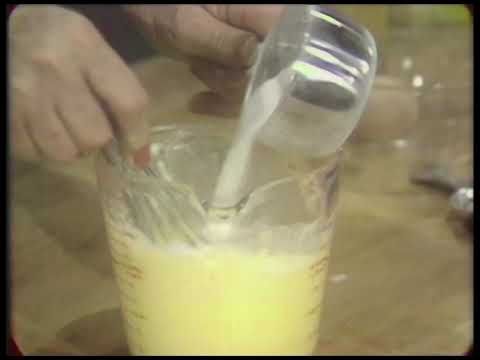
And we want two eggs and two egg yolks. And then, crepe batter, this is for a dessert, when you want it to be very delicate, so you don’t want too many egg whites in it. And then, if you are very careful and don’t get any yolk in your white,
You can make meringues or souffles with it, and then beat up the eggs a little bit. And we want 1/2 cup of cold water. Hmm. That was a dribbly dribble de drib. And 1/2 cup of milk, and again, the water is to keep it light. There goes that.
And we want 1 cup of flour. You can use regular all-purpose flour, but I like to use this instant blend because you don’t get any lumps. And that’s instant blend, that sort of sandy flour put out by both of the big flour companies that’s sometimes called instantized or instant flour.
Just look on the label, and I think it’s a tremendously good product, and I don’t really think the flour companies know what a useful product they have, because with crepes, you can make them right away. Now I’ll have 3 tablespoons of oil. There’s one, two, and I’ll measure the third.
Let me know it’s exactly right. And the oil is so that the… You can use melted butter, if you like, but I’m going to use oil instead and then about 1/4 cup of kirsch. If you like kirsch, even if you do like it, it’s awfully expensive,
And you could use a bit of orange juice instead. And 1/4 cup of sugar. Now, it’s going to have a little pinch of salt because that brings out the flavor. And then if, by chance, you have any lumps — but you shouldn’t have any lumps —
You can put it all through a strainer. And if you don’t have instant flour, you can use regular flour. But what I like about the instant flour is that you can cook the crepes right away. I have found that if you let it rest,
Oh, say, 2 hours, the crepes are sometimes brown a little easier. But what I like particularly about the instant flour is that, you can, if you’re in a hurry, as soon as you’ve made the batter, you can cook the crepes, and that is something that you cannot do with regular all-purpose flour.
Remember, when you measure your flour, 1 cup is the same whether it is the instant or whether it is… whether it is regular. Now we’re going to cook the crepes, and I like these no-stick-’em pans. This is one that’s about 6 inches in the bottom diameter,
And I’m just going to put a little bit of butter on, just to make sure nothing is going to stick, and then… we’re going to try the first crepe and see how it works. Just pour it in, and then tilt the pan around in all directions. And we’ll just see what happens.
I think that — And if your batter is too thick, you can always put in a little more milk or a little water into it, and usually the first crepe is a frost. Once in a while, it isn’t, and I think this one is a little bit thick.
I’m going to hold on to this with my towel. The first results test the pan. That looks a little pale, but it will be usable, but it’s not going to be one of our better examples of crepes. So I think I’ll take it out and say good-bye and try another one
Because I think the pan ought to be better. There, I think that is looking nicer. What you should be able to see are little things that look like clam holes that appear. There, they’re appearing. That shows that this is behaving better, and what you can do with the crepes, which is —
This makes a very nice dessert — you can make them way ahead of time as long as you’re going to make them anyway. I usually make double the amount I need. I think two per person for this recipe is enough. If you have terribly, terribly hungry people, three.
There, now that’s looking much nicer, and just turn it over. Well, this is an example of some crepes made with batter that had sat for about 2 hours, and it’s really a little bit… They’re a little smoother looking. But once you get it all covered with sauce and a lot of flames,
It’s not going to show that much. That just depends on if you’re a perfectionist. Now see that turning around. The only thing I’m going to show you — I’m going to put in a little bit too much and show you what happens. If you’ve got a little bit too much in,
Just turn it all around the edges of the pan. That will make you a slightly bigger crepe. And also, if you have put in too much, you can cut around the edge of it, or you can take, if you’ve got too much,
You can take it and pour it back into your crepe mixture and then cut off a little piece because they’re going to be folded anyway. So little troubles that you might have made are not going to show. There, it’s another one.
So these you can make way ahead, and you can even freeze them. If you’re going to freeze them, I think it’s a good idea to put them between sheets of wax paper, and then you can always be sure that you can get them off. Now clear the decks, and we are… We are…
I’m going to put this sauce because this you can get done ahead of time, too, and this is made out of… This is a very simple sauce. It’s made out of about 1/2 cup of apricot nectar… and some grated orange peel and 2 tablespoons of butter,
And this part you can also get done ahead of time. And you want to be sure that, when you fold them, you always fold them in the sauce because that’s what gives them the flavor. There, you can fold them just in half, if you want, or you can roll them.
We’re going to serve four people, so that these would be 12 crepes. We’ll move that over onto another burner. Now, I’m going to set these aside, but you see you just continue doing that until you have enough, and in the meantime, we’re finally going to get onto our main course,
The hamburgers, which of course have to be done the last minute, so that’s why I have waited until now. And these are beautiful great big hamburgers about 1/2 pound each, and I’m cooking them in a great big no-stick skillet, and while they’re cooking, I want to show you something about hamburgers
Because I had a long heart-to-heart talk with my butcher about what’s the best hamburger. In French, hamburger is called bifteck haché. You know, this is what… I think one of the best hamburgers is made out of neck, and the neck is the chuck, and the chuck is the shoulder part of you,
Is your neck up here. And the beef carcass is hanging, hanging down, and the neck is at the bottom, and so all the blood comes down into the neck, and that makes it a sweet, fine piece of meat. And if you have a good butcher
And they know what they’re doing, they trim it off. They take the extra fat off, and it’s just a fine lean piece of meat with very good flavor, and this is always called ground chuck. And it should have about 12 to 15 percent fat in it
And no more, and then here’s another thing. When you see something in the meat counter that just says hamburger, it’s made out of various scraps and trimmings like this, which can be more or less good, depending on your market. And then you have ground round,
Which is made out of the heel of the round, and that is the outside of the leg just above the knee. And a good butcher, they take all this extra fat off, and then they just cut it up like this and stick it through the grinder, and this makes a very good hamburger.
It’s a little bit more than… It’s a little bit more than chuck. and then you also have the more expensive, which is called — I need to look for my turners — which is called ground sirloin, and that’s usually the most expensive of all, but it isn’t actually sirloin at all.
What it is, is usually just the skirt of the steak and a lot of scraps that are somewhere near the sirloin, but they have nothing to do with sirloin, so you’re better off with ground chuck or ground round, and if the hamburger isn’t good, it shows that your butcher isn’t any good.
Now these are just absolutely plain, very good ground neck mixed with salt and pepper, and my friend Jim Beard always puts a little bit of cream in, so I put in a teaspoon of cream per hamburger. Now we have the soubise, which is done.
I’m going to show you some that is actually done, and you see, there are those little clam holes, and there’s the bay leaf, which I could throw out if I could see it. Well, I’ll throw it out over here. And this you can put some cheese and cream in it
If you’d like to make it richer, but I think it’s perfectly delicious just as it is because that onion flavor is so good. So put that on your hot platter, and then the hamburgers, when they’re done, go right on top. And then you always want to deglaze your pan. Pour out extra fat.
As long as we didn’t use any cream on anything else, I’ll just deglaze with a little, tiny bit of cream, and I’ll put in a little tiny bit of tomato. And that makes a very simple nice sauce. And that just goes over the hamburgers. And that — It’s all ready.
I should have a little parsley, which I don’t have. So what I’ll do to make it a little more… attractive, I’ll put on just a little tiny bit of some fresh tomato sauce I happen to have, luckily. But a little green parsley there would be very nice.
As you see, what a very nice and simple dinner, and actually, oysters are not so terribly expensive anymore. It’s not only Rockefeller fare anymore. That you can afford if you have guests or family that you like very much to serve them some oysters if it’s only three. Now, when this is…
I’m getting this hot and ready. These are our pancakes. This would be — Before — After you’ve had your main course, and you have your pancakes all ready, you want to be sure that you’re going to have them good and hot, unless you want to —
You can either heat them up in the dining room, or you can heat them before, which I think is a rather good idea because then you won’t have to wait so long with a chafing dish, which might not work very well, and they’re not going to flame unless they’re good and hot. So…
This is third course, and now see that’s hot and bubbly, and you always must be sure to put a little bit of sugar on because the sugar helps things to flame, and then the cognac, and you have to be sure that the cognac is good and hot, too,
Or you won’t get a flame. Now, there. The thing is, you see, you get the cognac hot, and then you tip it into the flames. This is a minor version of Crêpes Suzette, and I call it Crepe Saint Claire because apricots are grown in the Santa Clara Valley of California.
This makes a very pleasant and simple and very nice dessert. It’s light, and it’s something that people always enjoy very much, and I think the fact, too, that you can make the crepes way ahead of time and even freeze them means that you can have a dessert like this very frequently
And with very little effort, and certainly nothing but a little bit of apricot juice and orange is… You’ll be surprised when you try it what a very nice dessert it is. Now, this really is a lovely menu. You have there your hamburgers and the soubise. You have your oysters Rockefeller.
I mean, not Rockefeller, the oysters that are not Rockefeller’s anymore but just oysters. You can even call them hoi polloi. And with the hamburgers, I think that a puree of green beans is very nice. This is a puree of green beans with a little bit of spinach in it,
Which gives you a nice green vegetable along with the hamburgers. And I see that our crepes are still working nicely. So I can give one more. I think I should sit down and enjoy some myself. I think I’ll have actually three. See how nicely they cut? And with this,
You could certainly very well serve a champagne. There’s nothing wrong ever with serving champagne with a flaming dessert. In particular, I think, hamburger dinner followed by champagne is fine. So that’s all for today on “The French Chef.” This is Julia Child. Bon appétit! ♪♪ ♪♪ -This program was made possible by a grant
From Polaroid Corporation. ♪♪ ♪♪ Julia Child is the author of “From Julia Child’s Kitchen,” which includes the recipes from this program.
9 Comments
"It sounds awfully fancy in a foreign language." It does indeed and Julia brings it back down to earth beautifully.
For the VERY first time in over 50 years of enjoying Julia Child and all her fabulous shows/recipes, I'm actually going to say "OH YUK, OYSTERS!!"
Stand up Strong Island for being strict about oysters 😊 Leave it to Julia to make hamburgers a special meal
I wouldn't flame it, as I dont drink. It's just as good by itself.
Great food and the fabric on the dining room chairs is rather special!
Bon appetit! ❤
They can be bootleg oysters 😂
This vid is shadow band bro
The first crepe is the hardest