
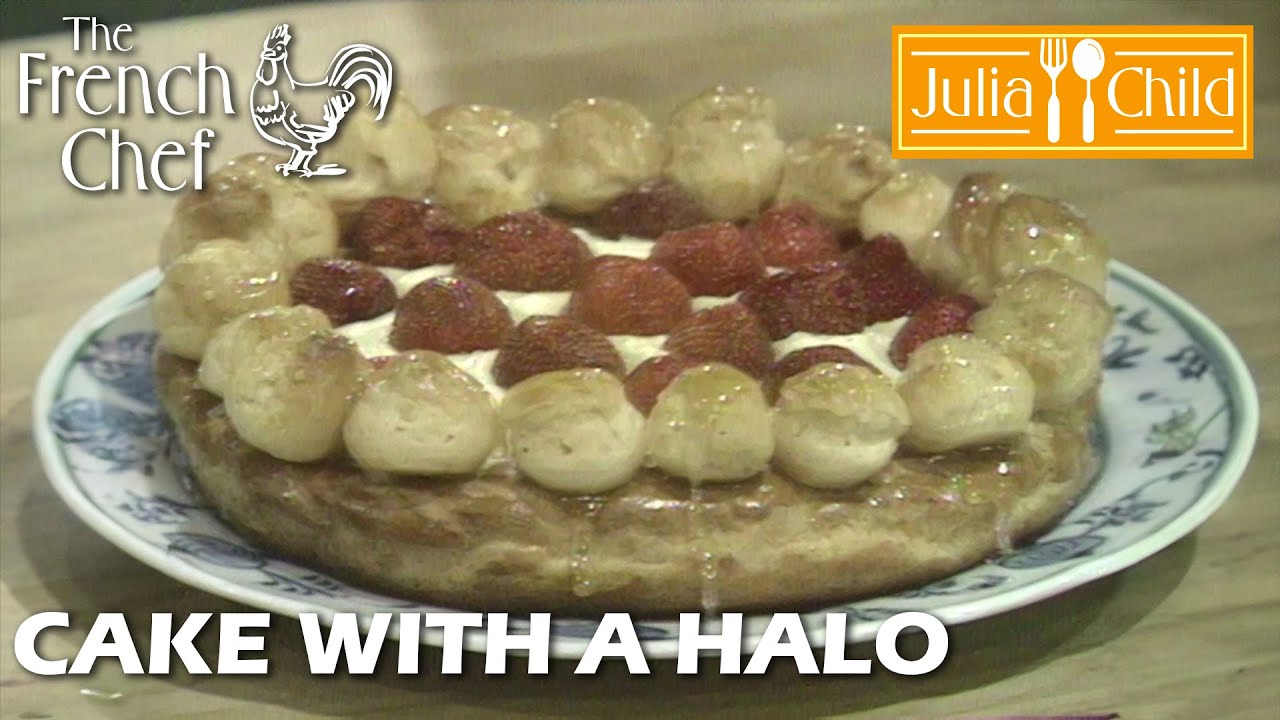
Julia Child makes a complex, but delicious, Gateau Saint-Honore, with a pie crust base, a pate a choux halo and tiny pate a choux puffs fixed upon the halo with sugar syrup. This glistening pastry shell is then filled with creme Saint-Honore, a delicious mixture of gelatin, beaten egg whites, whipped cream and liqueur, and then topped with strawberries or any other fruit in season.
About the French Chef:
Cooking legend and cultural icon Julia Child, along with her pioneering public television series from the 1960s, The French Chef, introduced French cuisine to American kitchens. In her signature passionate way, Julia forever changed the way we cook, eat and think about food.
About Julia Child on PBS:
Spark some culinary inspiration by revisiting Julia Child’s groundbreaking cooking series, including The French Chef, Baking with Julia, Julia Child: Cooking with Master Chefs and much more. These episodes are filled with classic French dishes, curious retro recipes, talented guest chefs, bloopers, and Julia’s signature wit and kitchen wisdom. Discover for yourself how this beloved cultural icon introduced Americans to French cuisine, and how her light-hearted approach to cooking forever changed how we prepare, eat and think about food. Bon appétit!
— Managed by PBS Distribution
Get More Julia Child on PBS:
Twitter: https://twitter.com/pbsdistribution
Facebook: https://www.facebook.com/PBSDistribution.org
-This is a very special dessert, a gateau St. Honoré. It’s a halo of pastry filled with delicious pastry cream, topped with strawberries and crowned with cream puffs. All you need is cream puff pastry and a suitable pastry bag. I’m making the halos for cake with a halo, today on “The French Chef.” ♪♪
♪♪ -“The French Chef” is made possible by a grant from the Polaroid Corporation. -Welcome to “The French Chef.” I’m Julia Child. We’re doing gateau St. Honoré today, and this is the finished dessert, and as you can see, it’s a shell of pastry with a filling.
And what we’re concerned with today is how to make the shell, and this is it. I’m going to move this finished one out of the way because we’re going to concentrate on the shell. As you see, it has a — Hmm. It has a bottom, and it has a halo, or a ring,
And these little puffs, one of which has just fallen off, but will come back on again later, and that’s what the shell looks like. And here are the pieces. You have the bottom, and you have the halo, and then you have little puffs that fit onto it.
And we’re going to start from the bottom up, and the bottom is very simply just a… just a circle of dough, and this can be any dough that you like for pie dough, and then you prick the bottom of it. If you have one of these wonderful rolling prickers,
It makes a very fast job of it, and then you let it rest in the refrigerator until you’re ready to make the rest of it, and you can make it any size you want. The traditional size is round. And then you have your halo and the puffs, which are made out of
Pate à choux pastry, cream puff pastry, and let’s get to that because the pie dough is something very simple that we’ve done a great deal of. And we’re going to start out with 2 cups of water — that’s more than 2 cups — which is brought to the boil with some butter,
And this is a pate à choux fin, or very fine, delicious pate à choux, and it has 1 stick of butter for 2 cups of water, and 1/2 stick of butter. And these should be sort of squished up a little bit so that by the time the water comes to the boil,
The butter is all melted. And then it has 1/4 teaspoon of salt, about like that, just a little salt for taste, and 1 tablespoon of sugar. And when that comes to the boil, it gets some flour beaten into it. And if your butter is chilled, cut it up into small pieces
So that it will melt easily. I’ll just stir this up to help… with things. Heavens, I think I’ve put in too much butter. That should have been 1 1/4 sticks. Oh, I’ll be able to take it out, 2 tablespoons extra. That sometimes happens, doesn’t it?
I didn’t have on my glasses when I was thinking. I think that made the difference. So 1 1/4 sticks is for 6 — 6 ounces of butter, and then it is also going to have 1 1/2 cups of flour, which I shall now measure out. Now that has come to the boil,
And so I’m going to have 1 1/2 cups of flour. And this, the flour is measured just by dipping into your flour container and leveling off, and then your water comes off heat. In goes the flour, and you can beat this either with a wooden spoon,
Which this is the classic way of doing it, or you can use a handheld electric beater, and I think this works out beautifully. You have to get one that’s quite tough and has blades that are rather like wires. As you see, it’s beginning to beat itself up nicely.
You want it to get smooth and thick. And it does splatter around a little bit sometimes. And then finish it off with the beater. But, you see, that’s very much faster than just by hand. And now it’s to be finished off on heat, and the reason that you do this
Is to evaporate any water moisture because you want to have just as thick a paste as you possibly can. And this is to evaporate as much water as possible because you want to be able to beat in as many eggs as you can, and it’s the eggs that’s going to make it puff.
Because you notice it — Now, look at that. It’s lovely, lovely and smooth, and it’s beginning to film the bottom, and that’s what you want. See that bottom, which is filmed with the dough. So you should beat it about a minute or 2.
You naturally don’t want to burn it, and then look at it. That’s a lovely smooth thick beautiful paste, and I think doing it with the beater makes it just about twice as fast. I think that’s the interesting thing in a lot of these classic recipes, where the hand beating
And the hand work takes so terribly long, and most of these recipes were made years and years ago before electricity was even invented. And now you have the eggs being beaten in, and these are going to — We’re going to have about 6 eggs in here and, again,
You can beat them in the classic manner. As you can see, it takes a bit of time, and it’s sort of the pastry all gets… It sort of separates, but look at how easy this is. There’s 1 egg, 2 eggs. You beat them in almost as fast as you can count them. Three.
And you want to beat until the eggs have been absorbed into the pastry. There was 3, and now 4. And now we have 5. And now 6. Oh! Well, luckily I have a whole box of them. Six. I’m going to have to reconstitute this. I was getting too pleased with my beater.
There, now that was 6, and that isn’t quite… There. Now that’s lovely and smooth, and you now… have one of those terrible decisions that one is faced with in life, as to whether to beat in the eggs 7 and eggs 8, and these are large eggs,
And the whole thing depends on the consistency of the pastry. And I think maybe I could beat in maybe 1/2 of an egg. But not much more because if you get the pastry too soft, you’re not going to be able… you’re not going to be able to form it.
So I will put about half that egg in, and anything that’s left over I can use for glazing. There, now look at this consistency. It’s got to be smooth and lovely, and it’s got to hold itself like that, because when you’re forming puff shells,
It has to be able to hold, as you form it, hold its shape because if it flattens out, you’re just going to have a flat puff. So that is now finished pastry and ready to use. So… this I have… have here, I think it’s much easiest to work with a pastry bag,
And I just don’t bother with anything else. In it goes, and I think you’ll find, if you have the pastry bag in a cup, it often fills a little easier. But it is never — it never goes particularly fast. And with this puff pastry for the creme St. Honoré,
The recipe for which you can find in any good cookbook, it is a pastry cream that has egg whites and whipped cream in it, and you can use — you can save about 1/4. You can save about this much of your pate à choux paste and mix
And beat in some milk and a little bit of cream in it, and heat it up until it is softened, and then you can use that as the pastry cream and put the rest of your ingredients in. It also has some gelatin. So that’s done, and we’re going to —
There are two methods of forming the halos. There is the detached halo and the attached halo, and I’m going to do the detached halo, which is less classic. And what you have to do, you have to have the halo the same size as the bottom of your pastry, whatever that happens to be,
And I happened to cut my pastry with this upside-down bowl. And you have to mark the pastry plaque in some way. You can’t butter and flour it… because the butter and flour, which you can do with cakes and other things on a pastry plaque, burn in the oven. So this works moderately well.
At least it gives you enough of a mark so that you can squeeze out your halo on your baking sheet. And now there’s a baking sheet that’s a no-stick one, and on goes the bowl. [ Laughs ] Very faintly shows, I think I can see enough of that,
If I put on my glasses. Anyway, it’s better than no mark at all. So I think that’s maybe some of the problems of the detached halo. But it’s really not much of a one because I can just see it, and I’m going to form this just inside — ooh! — that faint mark.
There. Now, this is not particularly neat, and it doesn’t make too much difference because you could smooth it out with a rubber spatula dipped in water, which I shall do a little bit of. It’s better to do it with a rubber spatula dipped in water than with a past–
Than with your egg glaze because the egg glaze might hold it down and prevent it from — prevent it from rising. Now you have it formed, and it now has its glaze, and here’s this 1/2 egg. Let me put a little bit of —
Tiny bit of water in that and stir it up… and then paint it with the glaze. And extra smoothing can be done along the top and along the sides, but it’s better not to let it drip down because that might prevent the halo from rising.
There, so that is glazed and ready to go. And now I want to show you the method for the detached halo. Oh. I mean, the attached halo, which is you just form that on top of your ring of dough, and then, to keep it down, you make a little W, or googly.
And that’s W, which stands for St. Honoré, and that is also glazed. And then you want to make some puffs, and these are the little puffs that make the crown. Whether it’s detached or not, you make the little puffs. And these are just little tiny ones.
And this, again, you always have that little tail that comes out. I’m not going to make a great many of them, but you can make — For this size, that’s about 9 inches you probably need, about 10 or 12 puffs, and you can make extra puffs,
And you space them about 1 inch apart. And the extra ones you can freeze. And then those get, again, get glazed. And the glaze is always 1 egg beaten with about a 1/2 teaspoon of water. And the nice thing about the glaze
Is that you can push the puffs in shape with your brush. And if you form the puffs with a spoon, you do very much the same thing. And that, again, shouldn’t drip down too much. I’ll reglaze this, and you want to use the pate à choux pastry
While it’s still warm or at room temperature, simply because, if it gets cold, it is — you can’t squeeze it out of the bag. I’m going to bake all three of these things because I’ve got two ovens. And let’s see where I’m going to put everything here and here.
Now, these go in an oven at 425 degrees, in the upper- and lower-middle racks of the oven, and then they bake about 15 to 20 minutes, and if you have two plaques like this, you switch the plaques. And when they’ve puffed and browned nicely,
Then you turn the oven down for about another 10 or 15 minutes until you feel that they’re nice and that the puffs are nice and crisp, and that they brown nicely, and then you turn off the oven and leave it ajar because you have to have them dry out.
Otherwise, they will be limp and collapse. And now here is our single, of just the plain piece of dough here. And to keep it down in the oven, put a buttered pan on it. And that, again, is in a 425 oven, for about 15 to 20 minutes.
And by putting the pan on it, that keeps it from rising up. And now we have… I’d like you to see the difference between the two methods, between the attached halo and the detached halo. Because this is the classic method here. And the problem that you have is that you’re sort of stuck.
You can’t — This ends up very often to be somewhat soggy because you find that the bottom is already cooked through, and I don’t think it’s a very satisfactory method, though it’s a classic one, and it’s easy to do. I really like this one much better,
In which the halo you bake separately and you control and you can do it just exactly — cook it just exactly as long as you want and let it really get crisp, and that bottom of the pastry is exactly done and done just the way you want to.
And I think this is, by far, the best method, but you can do whichever one you want. With this one here, the attached halo, this you just leave right on, and the filling goes right on over it. But it’s — I think it’s fun to —
I don’t think one should ever be bossed around by classic methods just because some old chef way back in 1820 did it some way, that doesn’t mean that you have to do it the same way. Now we have — we’ve got to glue these pieces together, and the glue is sugar syrup.
So I’m just going to clear the decks a little bit, so we’ll have room for everything. Get rid of some of these things here. There. Now, the sugar syrup, which we have done many times. You remember when we did the croquembouche? It’s just boiling sugar.
Put that over there, where it’s good and hot. And for this, you don’t need a great deal. I’m going to do 1/2 a cup of sugar, and we have to have a little bit of water. The proportions for boiling sugar are 1/3 cup of water to 1 cup of sugar.
So that was just a few little drops in there, about 3 tablespoons, and the trick always in this — we have done this numerous times, but I think it’s good to remind you again — that you never stir the sugar with a spoon. You just swirl the pan by its handle,
And you have to allow the sugar to completely dissolve before you really begin the serious boiling. The only thing is just to keep swishing a little bit and keep watching it. And then take it off the heat, look at it, and as soon as the syrup is —
The sooner the syrup is clear, you just keep right on boiling. And now here is a picture of St. Honoré himself, who was the patron saint of the pastry chefs and of boulangers, bread makers, and he was a 17th century Benedictine bishop. And the man who invented the St. Honoré, Mr. Chiboust,
Lived on the Rue St. Honoré in Paris. That’s rather fun, isn’t it? Now back to our sugar syrup. That was in the 7th century, not the 17th, that St. Honoré lived. Now look at these bubbles. They’re getting big and thick, and that means that it’s just about ready.
We want this just to be boiled to the crack stage. In other words, it has to be thick enough so that it’ll be like glue, and dumping some in some water, that’s it. But you can take it on to caramel. You can see that it’s just about at the crack stage,
And always with sugar boil, you can tell because it’s big thick bubbles. And by this time, I can do a little bit of spoon work, and it won’t hurt it. And if you want, you can let it boil to a light caramel. But you want to be sure
That it has really boiled enough, or it’s not going to stick, like that little puff that came off the shell that I showed you. As you see, that’s just about at the crack stage. I really think that, if you were in a hurry, it would be enough.
So I’m going to say that is enough, and we shall get to our gluing now. There you put… There’s the bottom. And put a little bit of this sugar syrup on that. On goes the halo, and then the classic method — I seem to be very unclassic today —
Is to take a fork, and you dip it. Let me get this spoon out of here. Dip it into the syrup so that the top is covered, and then set it on. Then you have the problem of getting it off. I think it’s much easier to dip the puffs
Into the syrup two at a time and then pour the rest of the syrup over the puffs, and it’s a much quicker business. And I think, with the other, the fork-dipping method, you can often burn your hands. I’ve almost burned myself a little bit there. Well, every method has its problems. Now…
We could have made a little more syrup, but I didn’t want to take that much time. But you get the idea of that, of the… This, if you had more syrup, you could just do this around and around and around with your spoon. And now notice, also, that this is crystallizing
Because that’s why I was doing everything in a hurry because I wanted you to see everything. So I have another one that looks better, and so that’s the one that we’re going to fill. So pretend that this is the one that you saw. Now, as for the filling,
I’m going to use the creme St. Honoré, or the pastry cream, and you just have your pastry cream well-chilled and beautiful, and you put the filling in, and then you top it. I was going to do that much and put on one strawberry,
And then I want you to see some pictures of other ones, and you keep on filling. You can keep on covering that with strawberries. But I want you to see some pictures that I’ve brought of some classical chef-type St. Honorés. Now, this one is from “The Art of French Cooking.”
This is a French book that has been translated into English, and look at that. Isn’t that lovely? Those soft floats of whipped cream that have been put on top of the pastry cream. I think this is a particularly beautiful one, and this is… This book has beautiful illustrations in it.
It’s called “The Art of French Cooking.” And now we have another one from the Time Life “Foods of the World” series. This is called “Classic French Cooking,” and in this one, the St. Honoré is used as a birthday cake. That’s a charming idea, isn’t it?
And then a final one is “Modern French Culinary Art,” and this is by — recipes from old Henri Pellaprat, who was the original chef of the Cordon Bleu in Paris, and he died at 85 years old, just after World War II. He was a wonderful old man.
So that is the kind of thing that you can do, and I’m going to take my original great one, and we’re going to take that into the dining room and see how it looks when it’s served. But, as you can see, you have so many possibilities, and in any good cookbook,
You can find the recipe for the pastry cream. I’d like to have done the pastry cream, too, but I thought that making the shell was much more important. And now to serve it, I’ve got a serrated knife here, and I’ve got to cut down through. The first cut is always the worst.
Mm, mm, mm. There. That’s how it looks, and I think a very nice idea also is to serve — you can serve some strawberries with it. But whatever the filling, I really think this is an absolutely beautiful dessert. It’s a classic example of the whole is much more than its parts,
And I bestow upon it a permanent halo. So that’s all for today on “The French Chef.” This is Julia Child. Bon appétit, and let’s open the champagne and celebrate. ♪♪ ♪♪ -“The French Chef” has been made possible by a grant from the Polaroid Corporation. ♪♪ Julia Child is coauthor of
“Mastering the Art of French Cooking” Volumes One and Two. ♪♪
17 Comments
first! I love Julia!
Julia really cracks me up
I love Julia. This whole channel and sponsor commercials remind me of when I was a little girl watching TV after school or on the couch, on a sick day home from school. This one, from scratch, is too fussy for me. However, for i.e., NYE, I would "cheat" and make it, but with COSTCO's cream puffs from their frozen food section. (Ducking Julia's tossed pots and pans – and the kitchen sink!- at me.)
Pass the champagne!
I have made this cake from scratch several times before. It was from Graham Kerr’s book “the Gourmet Chef” – I was a teen at the time I was given his books. I didn’t realise that Julia was most likely first. It looks complex but really not difficult. It’s an amazing celebration cake guaranteed to wow everyone around the table and if yoúre a fan of French custard cream, everyone will be licking their fingers and asking for more. ❤
i like how she just throws whatever that yellow thing is out of the way, not a care in the world
Looks like a LOT of bother to me! I'd rather just cheat and use boxed pudding that you prepare using less milk and mix that with Cool Whip for the filling instead of real pastry cream! LOL!!
The best way to predict the future is to create it. – Peter Drucker
3:45 or so – how cute – she gets the butter amount wrong, twice! 😁 1 & 1/4 U.S. sticks would be only 5 oz., or 10 T.
Challenge accepted.
There is no substitute for the glorious Julia Child 💙
7:54 No one could make a comeback from a slip-up like Julia Child! 🥰
A very interesting episode. 😊
She’s a tornado in this episode! 😂👏🏼👏🏼👏🏼 And despite what one may think, pâte à choux and it’s filling are very easy to make.
I'm not going to lie at first I thought it was a deep dish pizza with cheezy balls on top but Julia would never make that.
Love her!
What would happen if she didn't have another egg? Guess they'd have to edited it. Hopefully not start all over.