
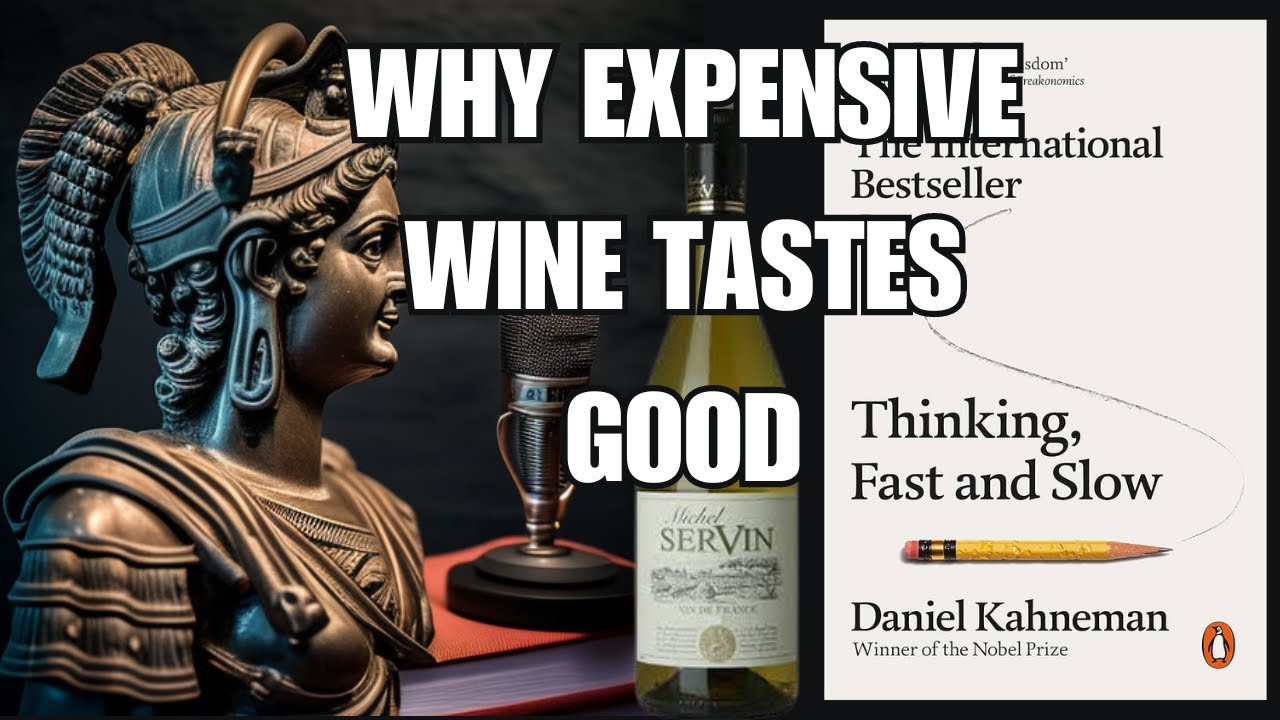
Ever pondered why a wine’s taste can change based on its label? Or why we’re drawn to certain habits? Our latest podcast episode pairs the subtleties of wine with the complexities of the human mind. Join us as we sip on a Michel Servin white wine and delve into the cognitive biases that Daniel Kahneman reveals in his Nobel Prize-winning work, “Thinking, Fast and Slow.” Discover how your brain’s autopilot influences your decisions and learn how to harness the power of priming for positive change. It’s time to challenge your perceptions and uncork the hidden depths of psychology. Listen now and transform the way you think about thinking!
(00:00) The more vague a wine label is about where it came from, lower quality
(02:36) Wine is very interesting to look at from a psychological perspective
(03:38) Daniel Kahneman argues that we have two systems of thinking
(07:26) There’s an effect known as priming where our brain makes associations
(16:58) We will often perceive information as more credible if it’s easier to read
(18:20) Part of cognitive ease is also exposure. Kahneman says we seek familiarity
The more vague a wine label is about where it came from, lower quality >> Speaker A: Hello, everyone, and welcome to episode five of the Spoken Greats podcast. Today I will be drinking a Michel Servan white wine. It’s a blend of. Wait, let me check this for a second.
What have we got? It’s a blend of Colombard uni blanc and sauvignon blanc. Now, on the label here, it says van de France. And I’m going to give you a little tip here. When you’ve got a french
Wine that says van der France, which just means wine of France, it’s much more likely to be of a lower quality. As a general rule with wine, the more vague it is about where the wine is from, the lower the quality of production, because it means they’ve taken grapes from everywhere
And they’ve not followed the quality controls necessary to get an appellation like Bordeaux or chateau nerfe de pap. And so you don’t know where the grapes have come from. Other than that, they’ve come from France. and so you’d expect this to be cheaper, and it is. With that said,
It doesn’t mean that just because a wine doesn’t have an appellation doesn’t mean it can’t be good. It’s just a general rule of thumb. it’s not a hard and fast rule. please let me know what you will be
Drinking today in the comments along with me. I’m, just going to try this now. given a little whiff, it definitely smells like sauvignon blanc. I don’t really know much about Colombar or blanc to tell the difference, to be honest, but it’s got that wet grass characteristic typical of
Sauvignon blanc. So, no surprises there. That is not bad. It’s a little bit sweeter than, your usual sauvignon blanc. it’s not as crisp. It’s got a little bit of sweetness to it. I can just feel my mouth kind of filling up with saliva now, which tells me it’s very acidic. So this
Would go fantastic with some kind of creamy pasta or some salmon, perhaps, but, yeah, personally, I would happily knock this back with a carbonara. Um, so why have I started off with wine tasting this? I mean, other than the fact that I like to share a little bit of knowledge about wine each
Time we do this talk, just because it’s a hobby of mine and, uh, it’s a fun one to talk about. Wine is very interesting to look at from a psychological perspective Wine is very interesting to look at from a psychological perspective, because at face value,
Ultimately, wine is fermented grape juice. Yet there’s so many psychological factors that go into the perceived value of, one bottle of grape juice versus another. And one of the interesting ones. Even just looking at this tasting I just went through. Now, if I go to the back of the bottle,
It tells me to expect aromas of apples and citrus fruits on the nose, leading to juicy melon and lemon fruit on the palate. Now, part of that might just be the objective characteristics of the wine, if there is not really such a thing. Because taste is subjective, you merely have overlap
In what people commonly agree on how, ah, a wine tastes. But another psychological phenomenon going on there is priming, which leads me on to the topic of today’s podcast. Daniel Carneman argues that we have two systems of thinking
Today I’m going to be talking about thinking fast and slow by Daniel Carneman. Now, if you’ve never heard of the book before, Daniel Carneman won the Nobel Prize in economics for this book. Essentially, it’s the bible for psychological phenomena and cognitive biases and fallacies,
Which the human brain makes on a consistent basis. The overall premise of the book is that we have two systems of thinking, system one and, system two. System two is what you commonly associate with thinking, the rational brain looking at things objectively and making
Deductions and coming up to a rational decision. And then there’s system one, which makes snap judgments, assumptions. It’s kind of like the autopilot of our brain, and it’s kind of going on in the background at all times, whether we realize it or not. It’s not
That one system is better than the other. You may be thinking, well, why do we have this irrational system for thinking? What’s the, possible utility of it? Surely it’s just a pitfall. Well, it serves a perfectly functional purpose in that in order to be able to do anything, our brain has
To make constant assumptions about the world we’re operating in. So when I’m walking along, I have to assume that the ground beneath me won’t fall through. If I was constantly analyzing the strength of the floor, then I would never move because I would be paralyzed with not being able
To make these assumptions. And the interesting way about how the human brain perceives things, how we actually see, is quite similar to a JPEG file on a computer. So, a JPEG file is a compressed version of a photo. It is not the original raw data. And, what it does is
It makes predictions on the expected color of the pixel next to another pixel. And where there is a differentiation in that prediction, it accordingly assigns a new pixel. And so from doing that, it’s able to compress a file to a much smaller, amount of data, because it can predict ultimately
How the image will appear. And our brain does the same thing. When we perceive things, we have more inputs internally than we do externally. Our brain makes predictions on what we are expecting to see. It then tests those assumptions with external inputs, things coming into our eyes,
And it adapts the differences accordingly. If it didn’t do this, our brains would be overwhelmed by sensory input. And this is something that people on the autistic spectrum unable to do to lesser or greater degrees, is ignore their sensory inputs, so they’re constantly aware of
The feeling of their clothes on their skin, the sound of conditioner fan. So we need this system, one, in order to function. We can’t process everything with our system. Two, of thinking, because we’d be overwhelmed very quickly with the sheer, amount of information coming
Into us. With that said, though, it also has its pitfalls, and we’re going to get into that today. There’s an effect known as priming where our brain makes associations So I started off talking about wine. There’s an effect known as priming, where our brain
Makes associations with certain things. If I mention wheels, you may think of a car or a bike. You’re not going to think of skiing, for example. If I start talking about skiing, you may then think of the Alps or Switzerland. There’s a beautiful example of this with wine, in that,
Many restaurants you go into, they already have empty wine glasses on the table. So immediately your brain is starting to make associations with wine. And then you’re not given a drinks menu, you’re given a wine list, which then primed you even further, towards ordering, ordering a wine.
And if the waiter asks you if you want red wine or white wine, then he’s now framed your decision completely. It’s not what would you like to drink, it’s we’ve already established you’re going to drink wine. Now, will you drink red or white? Now, part of the reason behind this is that restaurants
Often charge seven times the cost of a wine bottle. No one really knows how much wine is worth because it’s opaque. Everyone knows what a can of Coca Cola costs. You can’t charge ten pound for,
A can of coke, whereas there is no upward limit for wine. It could be twelve pound, it could be ten grand. Nobody knows, especially if it’s, especially if it’s from somewhere like France, where for the average consumer, there’s a perception of sophistication, or that it must
Be from some fancy chateau, because the name is unpronounceable and you don’t have a clue what it is, and you don’t want to seem like an idiot, so it must be of value. Let me go into that further.
So I was reading out the characteristics of the Michel Savan that I’m drinking at the minute. And that’s an example of priming, because you’re being told what to expect in advance. This is a big problem with wine, in that you can be gaslit into experiencing certain tastes because someone
Has told you before what to expect from tasting it. and it’s very difficult to overrule that initial input. If someone tells you, this is a very nice wine, or that tastes like shit, that frames your expectations for the coming thing, and you’ve already prepped your mind to experience
Things one way or another. That is a huge aspect in psychology, is that our, expectations frame how we experience something. This is why I recommend, first of all, trying a wine and then reading the
Label. Because half the time you’ll read the label of what kind of aromas or taste to expect, and you think, how the fuck did they come to this? And so you kind of taste the wine a bit more objectively,
Without putting any biases in. In the same way that if you’re told that wine is more expensive, you’re being primed to expect that the wine will taste better. In many blind tastings, often wine experts have failed to identify which wine was the most expensive beyond a certain control of
Quality. If you’re buying a free pound bottle of wine, you can generally detect that, but once you get above a certain price point, anything above 30 pound, you’re going to struggle to notice the nuances in difference in quality. Most people at least. And so not only would they fail to detect
The more expensive wine when given free glasses of exactly the same wine, and they were told, this wine is priced at this point, and, this wine is priced at another. They weren’t able to identify that they were exactly the same wine because their expectations were primed that this wine must
Be better because it is more expensive. And so these cognitive biases play massively into how we perceive the world. adding on to this prime effect is the framing of something. Wine is typically perceived as a more sophisticated, more cultured drink. Someone who is a wine drinker may be
Perceived as more sophisticated, more intelligent from a higher social, economic status from that, that then primes how people respond to them. So if I take a friend of mine on a train journey with a bottle of port and some beautiful crystal glass tumblers, the other passengers might look around
And think, oh, isn’t that incredibly charming? And yet, if me and the same friend were to get on that train with a six pack of stellar artois, the passengers may think, oh, for fuck’s sake, why
Are these scumbags on the same journey? And yet, at the face of it, we are doing exactly the same thing. We are ingesting alcohol. But because beer has the perception of having a, being from a lower economic status or being from a less cultured background, it’s considered undesirable behavior
In public. I work a second job in a wine shop and I spend a lot of time at work tasting wines. Now, if I say to people I taste wines at work, they think that’s great fun and they may be quite
Envious of me. And yet, in my office job, if I was to tell people that I take a hip flask of vodka to work every day, they would probably take pity on me and tell me to go to an alcoholics anonymous
Meeting or something. So the framing of things is very important to our, perceptions of them. So how can we use priming to our, advantage? Now that we know that this effect is present in us, it’s very effective for changing our outlook on things. The way we feel influences the way we act
And the way we act influences the way we feel. So you can improve your mood simply by straightening up your posture or smiling. Smiling for 30 seconds can prime your body towards positive emotion in the same way that frowning for 30 seconds can prime your body for negative emotion. This is why
Comedians will have a warmer pact before they come on stage is to get you into the habit of laughing before they’ve even got onto the stage. And so they’re not starting from a baseline emotion. They’ve already primed you into being put into laughing mode. But let’s say they were to put
On some 32nd appeal from the Red Cross of some starving child in a war zone. Right before you come on stage, the mood is dead, isn’t it? You’ve been primed towards negative emotion before you’ve even got into the show. And so you are predisposed towards laughing less or not finding it because
You’ve already been primed to be negative. So the one you can try is when you have a phone call with someone before you pick up the phone, try smiling for a little bit before you talk to
Them. what you’ll find is that you’ll probably be more, friendly towards them and you’ll have a more amicable interaction. And it’s an interesting one, because we often have our default faces, and you suddenly realize, like, shit, I’ve been resting bitch face for the past 20 minutes.
And that influences your mood, and it also influences the mood around the people around you, because they see someone frowning. So their instinct is they’re primed by your emotion, so they frown back at you, and then so it perpetuates the negativity. So smiling more and improving your
Posture is an easy body hack to improve your mood through priming. You can also use it in taking up a new habit or quitting a bad one. Let’s say you’re trying to improve your sleep routine.
Many people set an alarm clock to help them wake up. But another thing you can do is set an alarm clock for when to go to bed. That alarm will then prime you to know that it’s time to go to bed,
Stop what you’re doing, brush your teeth, and go get ready for bed. It’s just a simple cue, which then, your brain will associate with going to bed. And likewise, let’s say you want to go to
The gym. If you set out your gym clothes the day before, and you put them in a spot that’s easily visible, or you even put it right by your bedroom door, so you have to physically move it before you
Can get out your door, then when you see that item, you’ll get that cue to, act on it again, which then is a prime in itself, because you associate gym clothes with exercise. So I am now
In my gym clothes. This is where I do exercise. You don’t put on your gym clothes and think, right, time to write a report. You think it’s time to go for a run. And so setting up your environment in a way that primes you towards certain actions can, be very beneficial.
We will often perceive information as more credible if it’s easier to read So the next thing I want to talk about here is cognitive ease. Cognitive ease is where our system, ah, one takes the path of least resistance. It picks out the easiest route
To the solution, and it takes it. So, an example of this is we will often perceive information as more credible if it’s easier to read. If you have two sentences which are both factually incorrect, but one is in bold writing, most people will perceive the one in bold,
Clear writing as, more truthful, even though objectively they are both completely false, because your brain has had to do less work in order to find the answer. Alternatively, we’re much more likely to use our system two and apply much more scrutiny to something when it’s
More difficult to read. this is because we have to pay attention. And we have to scrutinize the text more just to be able to physically read it. And so we’re actually a lot more likely to spot the pitfalls. Something which is difficult to read versus something which is very easy. So if you’re
Looking for honest feedback, maybe make the text a bit smaller. And don’t put it in comic sands. Part of cognitive ease is also exposure. Kahneman says we seek familiarity Part of cognitive ease is also exposure. so our brains, as they operate on predictions,
Are constantly looking for things we have seen before, things we recognize. And in the book, Kahneman talks about studies, where they’ve exposed people to chinese characters or made up words which they’ve never seen before. They just asked them, which one do you prefer? And
What they found was that the ones which they’d displayed to them with more frequency, they preferred. And this is a built in bias towards, we seek familiarity. We are more comfortable with people of the same culture, the same background as us, because they are operating in our prediction,
Model. And in the same way, this is why we like celebrities, because we recognize them. It’s a familiar face. Godwin’s law is a great example of this. If you’ve not heard of it before, Godwin’s law states that any argument on the Internet will eventually revert to the Nazis.
Someone will go, oh, yeah, well, that’s just what the Nazis did, or Hitler fought the same thing, or you’re a bunch of fascists. Now, the reason for this isn’t that there is, well, at least I hope not, a high prevalence of Nazism throughout the world. What’s much more likely is that people are
Referencing the only piece of history that they know. common knowledge of history is so incredibly poor. And one of the few examples that the general population, know is World War II. And so they use the only point of reference that they have. And so this is why so many references are made to
World War II. It is not that every scenario has similarities to the Holocaust or fighting fascism, but rather people don’t have any other point of reference. And so I would argue that if you were to expose people to another historical example and expose them to that over and over again, they
Would make just as many references to the English Civil War or, I don’t know, the peasants revolt. This can be used in advertising quite powerfully. A company which is able to increase their exposure and how well known as a brand they are is able to capitalise on that familiarity and cognitive ease
Because people go for the thing that they know rather than the thing that they don’t know. This is why people often go to McDonald’s when they don’t have time to cook. It’s not that McDonald’s offers, an amazing meal, but you know what you’re going to get. It’s familiar, and McDonald’s is
Pretty consistent. And at the other end of the spectrum, there’s value and familiarity, because the familiarity brings a certain status to something. So in wine, it is more prestigious to spend a lot of money on a luxury champagne such as Don Perignon or Bollinger, because people know
These brands. And so there’s an inherent value in there because people then know that what you are drinking is expensive, whereas you could spend 1000 pounds on a castor journey, 1999 Brunello de Montelcino. But to most people, that doesn’t mean anything. And so it’s not sending the same signal,
Because there isn’t that familiarity. And so, on the face of it, you are spending more money. And to people who know about wine, it may have a more perceived value, but in layman’s terms, it doesn’t project the same value to people because it’s not known or it’s something like Bollinger Tattinger,
Everyone knows these things. And so there’s an inherent value in its recognition. because this is happening at a subliminal level, we can often identify this in other people we see, oh, yeah, they’ve fallen for the advertising, but it works just as effectively on you. No one is an
Exception to these rules. And it may be through subliminal exposure over and over again that it is that you actually choose to buy something, but you, post rationalize it in another way. And so this opens up a whole pathway of discussion about why it is that we do the things we do,
Because there’s the reason, we think why we’ve done something, and then there’s the real reason, the hidden reason. And it’s very easy to think of our actions as rational. And so, the first plausible explanation that we find for why we’ve done something is usually the one that wins out.
So it’s one to bear in mind, for it’s harder to get out of these thinking systems because we naturally try and conserve our energy and we take the path of least resistance. And so to prevent cognitive ease, we have to challenge ourselves. And especially if we’ve arrived at, ah, a
Conclusion very easily or something seems incredibly simple, I would treat that as maybe, a sign to pause and take, a second consideration. Thank you for listening to the Spoken greats podcast. That’s all we’ve got time for today, please let me know in the comments what you
Think about cognitive biases. If you enjoyed this episode, please like and hit the subscribe button. And, look forward to me doing future analysis on great ideas from great books. See you soon. Bye.
3 Comments
This is that racist that got banned from TikTok
Polar premium seltzer
🍷🍾