
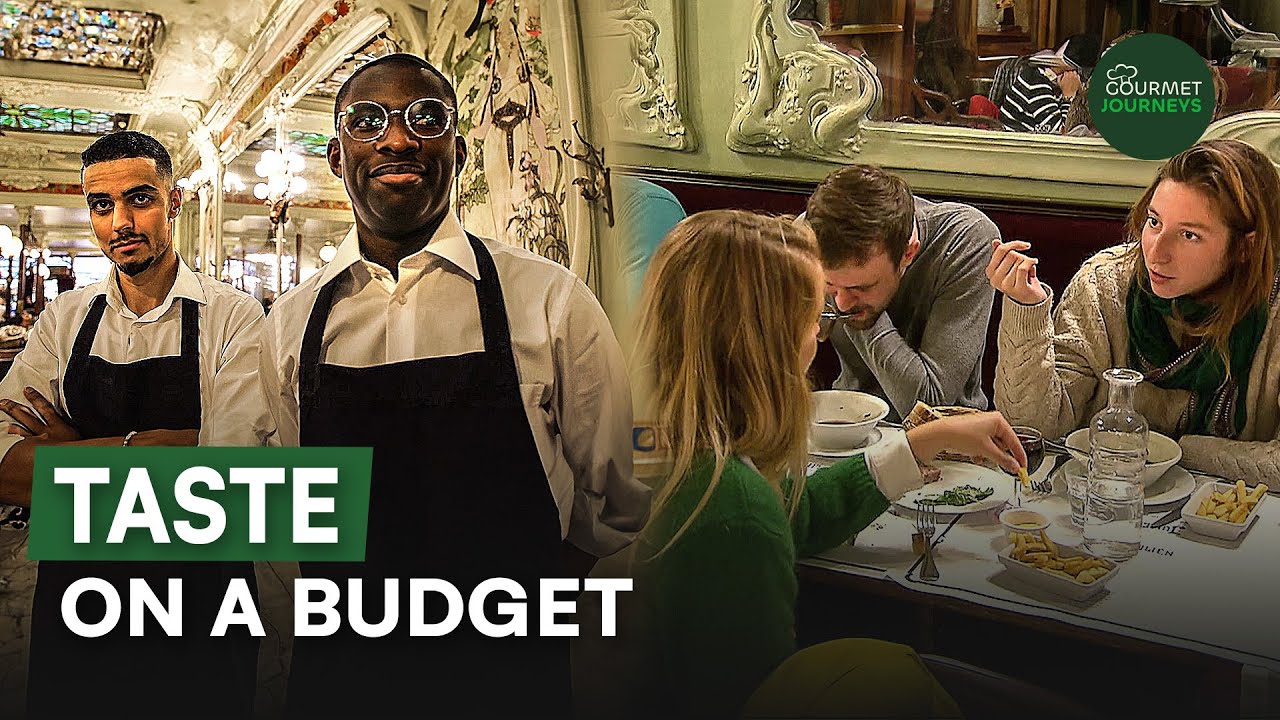
Explore the dynamics of Bouillon Julien, an iconic Parisian restaurant that offers a unique experience. Set in an Art Nouveau setting, Bouillon Julien attracts patrons with its ambiance and affordable traditional French cuisine. Master of Ceremonies, optimizing space to accommodate up to eight hundred people per day. Chef Christophe Moisan implements a rigorous economic approach, closely monitoring costs to maintain low prices without compromising quality. The documentary highlights the history of Bouillon, dating back to the 1850s, and underscores its recent revival under the leadership of Jean-Noël Dron. By delving into the restaurant’s inner workings, the documentary provides insight into the successful marriage of tradition, conviviality, and profitability at Bouillon Julien.
More gourmet journeys over there 👉 https://www.youtube.com/channel/UCUjSNc0amb3zvP553AsgK0w?sub_confirmation=1
—
© All Rights Reserved
#budget #food #money
Friday evening, in the heart of Paris, you’d think you were in front of a concert venue. How many are you? Good evening gentlemen, how many are you ? Nine people. In fact, we’re queuing up to eat. Good evening, how many are you? Sajit Jellahorloo, forty-two, is the maître d’ of this venue.
Here, you can’t book a table after seven thirty in the evening. Customers can wait up to forty minutes. Good evening, four people. Five minutes, I’ll get everyone settled in, okay? There, very good, okay. People line up for this magnificent setting. Art Nouveau style, from the nineteen hundreds. Three here, guys, three.
Three, three, three. Thomas, table of four, here. But also for what’s on the plate. Bouillon Julien’s motto: beautiful, good and cheap. Very basic, traditional French cuisine. Egg mayonnaise for three and a half euros. Leeks with vinaigrette for three eighty. Veal head for ten eighty.
Average lunchtime bill: seventeen euros. Twenty-four in the evening, starter, main course, dessert and wine. Half the price of a classic brasserie. There’ll be eight there, boys. Guys, eight. For the formula to work, the one hundred and seventy seats have to be filled. So Sajit, the restaurant’s top man,
All right, did they come? No, we’re going to break the table. But the problem is… turns tables up to three courses a night. A war machine. I put five people on a table of four. That’s the whole point of the game,
Really. It’s to get people fucking tight. Tight. Well, they are tight. But they’re comfortable. They’re tight. You have to make the most of it, you have to optimize the space. As much as possible. Optimization. Whose birthday is it? Is it you? How old are you? Thirty?
A well-honed technique for fitting in customers. But also to get them to leave. Sajit does up to eight hundred covers a day. With the gesture, we make it clear that people waiting. You have to clear the space and everything. We make them understand, but… With gestures. But they have to go. Exactly.
Customers know they’ll be under a bit of pressure. But the atmosphere is relaxed. With Sajit and all his waiters as room entertainers. That’s the spirit of bouillon too. Striped shirt over there. That’s the spirit of bouillon too. Happy birthday to you! Happy birthday to you!
Le bouillon is a convivial canteen, a melting pot of generations and social classes. And an invitation to go back in time. Edith Piaf frequented the establishment in the fifties. She had her own legendary table, number 24, now a icon.
This is Edith Piaf’s table, you know, the one that sings, “Non, rien de rien!” Well, that’s her. Well, she ate where you are seated, here you go. Personally, I’m Belgian, so that means I’ll get the full Parisian experience. So what does the place, the setting, evoke in you?
It’s like stepping back in time to the twenties, but in two thousand and twenty-one? it’s pretty cool. Like this establishment, Parisian bouillons are back in vogue. Young people are crazy about them, attracted by the low prices. Inspired by the model of the famous maison Chartier, bouillons are springing up
Like mushrooms. The latest opened a month ago, in place of an Alsatian brasserie. The concept is the same everywhere: to offer popular cuisine for modest prices, usually in historic settings. But how can you do good and cheap food? Nothing is left to chance in the Bouillon business model.
At Bouillon Julien, profitability begins at dawn. As soon as the fresh products arrive. We’ll start by removing the plastic. Every morning, Christophe Moisan, the restaurant’s chef, makes sure he hasn’t been cheated by his wholesalers on quantities. Most of the fruit and vegetables come from small producers only two hundred kilometers around Paris.
Here we go. Leeks. I think I ordered forty kilos of leeks. One, two, three, four cases. They look good this morning too. They’re all the same size, which is great. In fact, what I’m doing here is quality control. and there’s nothing missing compared to the order.
Then, downstairs, we weigh a few products. We don’t weigh everything because we don’t have much time, but the reason why we also weigh the products is to show the suppliers that we’re in control. If, for example, a kilo of leeks is missing
Every day, at the end of the year, three hundred kilos of leeks is a lot. Not a penny must be lost if we are to offer attractive à la carte prices, while maintaining a certain level of quality. Four, eight twelve, that’s what I ordered yesterday. The tomatoes are really
Nice and everything. When you see the stem like that, sticking up, it means they’re fresh. It’s a guarantee of quality. If the stem falls, it means they’ve been picked for a long time. Fruit, vegetables, meat, fish, the merchandise never stays in cold storage for
More than forty-eight hours. There’s virtually no waste here. Everything is streamlined. Bouillon is all about low prices, right? So with low prices, you win on quantity, on volume. That’s what’s important. So if we have a loss, if we’re missing something, that’s where we lose out. It’s the volume that makes the establishment profitable.
The grill always heats up more at the top. So the first ones up there are always more marked than those down below. Christophe arrived here three years ago. After seventeen years as head chef of a Michelin-starred Parisian restaurant. He used to make lobster. Today, it’s deviled eggs.
A new world and a new technique, which he’s taking as a challenge. I wanted to try something different. It’s the big brasseries, the bouillons. Afterwards, they’re going to say, yeah, he’s gone downmarket, lowered his standards and all that. No, I’m happy as I am. Doing so much volume. Today, we
May do over eight hundred covers. But I’m not getting any plate sent back. Customers are happy. Under Christophe’s command, a brigade of eleven cooks, all multi-skilled, able to go from roasted potatoes to choux pastry. Le Bouillon thus saves a pastry chef’s salary, which is higher than that of an ordinary cook.
Everything is made on site and preheated three hours in advance, so that it can be served faster in the dining room. And above all, to keep costs under control, every ingredient is measured to the gram, like these fish fillets.
In terms of profitability, when we draw up a technical sheet, the portion has to be between one hundred and twenty-five and one hundred and forty grams. Here, it’s one hundred and forty-one grams. The same goes for the bouillon recipe, the restaurant’s signature dish.
So here, I put sixty-six grams, sixty-five grams of frigola. Twenty-five grams of carrots. Then I add the meat. And then I go up to about a hundred grams, a hundred and twenty grams. And then, when it’s time to serve, we reheat the
Plate. All that’s left to do is pour the hot broth over the plate. We know that the plate costs us so much when we do it this way. So we know it costs us so much, so we sell it so much. So there are no surprises.
An economic logic at the very origin of the recipe’s creation. Because broth is first and foremost, a meal for the poor. In the one thousand, eighteen fifties, a butcher offered workers at Les Halles a unique, hearty and inexpensive dish, based on low-quality cuts of meat such as
Oxtail or beef cheek, which had been abandoned by the bourgeoisie, and cooked in hot water. The Chartier brothers picked up the concept. At the beginning of the twentieth century, Le bouillon restaurants became trendy. And that’s where everyone had to be. In Paris, bouillons were the place
To be. It was a setting, an atmosphere, inexpensive cuisine. So people liked to meet up. And it became more famous. And after that, it’s history. It was this spirit that Jean-Noël Dron discovered when he bought the bouillon. Nearly three million euros in two thousand and eighteen.
He has an appointment with John Whelan, the English architect who supervised the renovation, to check if it’s ageing well. You can see the yellowed color. Owner of sixteen restaurants in France, Jean-Noël fell in love with this Art Nouveau location, listed as a historic monument.
Julien, since the seventies, it’s been a brasserie with a luxury brasserie model. So that’s what we had in mind when we entered this institution. But when we discovered the specific history of Bouillon Julien, it became obvious that we had to do it again, simply, as they had done back then.
Opened in nineteen o six, Le Bouillon was one of the finest restaurants in Paris. Bought out by the company Flo in the seventies, the establishment has lost some of its spark. The walls are getting darker with cigarette smoke. The menu is too expensive for this working-class neighborhood.
In two thousand and eighteen, Jean-Noël invested seven hundred thousand euros in the reburbishment. The bouillon will be restored to its original color and shine. We scraped the wall and revealed all the layers of paint over the years. At the very bottom was celadon green. Celadon is a type of
Oriental pottery made in Korea, Japan and China. Art Nouveau designers in Paris and Nancy were obsessed with orientalism. The bright, pop color of Celadon green revived the establishment. The place is back on trend. The canteen spirit contributes a lot to it. Embodied by the good humor of
François Paris, the fifty-seven year-old head waiter at lunchtime. Does that suit you? Yes, perfect. Beautiful table under the glass roof. Enjoy your meal. This figure of the house is paid three thousand euros after tax per month. What a pleasure to be here. Happy for you to be here too.
In front of you madam or in front of you sir? You madam? I knew that! And a calf’s head. A calf’s head velouté. Thank you and bon appétit. We’ve known each other for about twenty years, so he’s part of the family. It’s a big family, so…
And François knows what he’s doing, even when it comes to breaking bad news. That day, one of the restaurant’s bestsellers was out of stock. Excuse me, I’ve got a little problem! With the calf’s head, there’s none left, so… I just had a small problem, it’ll be taken care of. If there’s anything else
You’d like, no problem. I’ll give you a hug, I’ll give you a hug ma’am, after. Don’t worry about a thing. What’s the technique to make them swallow the pill? Well, the smile, the smile. You can’t see it too well with the mask, but then,
The eyes… My eyes betray me, so there’s no problem. Well, it’ll give you a chance to come back. At noon, the doors open, it’s a play actually. We just walk on stage, so… We do the show. Can the surfer look bother?
No, not at all, we have to stay natural. If we were at Fouquet’s or the Carlton, it would be a problem. And then, from the moment we… we work in a bouillon, a local restaurant, there’s no problem. But François has not forgotten the Bouillon’s tight business model.
My Lord, Your Highness, have you chosen? Ah, well, when we’re called like this… Bernard, would you mind if I brought you a pine tree? Because, my lord… Okay, that’s the way it’s done. The pine tree, in fact, is a free cup.
It’s to differentiate it from a crémant that the customer pays. So that the bartender realizes that we don’t give the… So that he knows the difference, quite simply. Is that code between you? Yes, it’s a code, it’s a code, yes.
A tad below though. Way off even. Yes, way less. A tad below yes. Here, making small savings is a constant challenge. Particularly at each the menu changes, four times a year. On this particular day, between services, Jean-Noël and chef Christophe are
Meeting with restaurant manager Pascal Le Bihan to draw up the next Christmas menu, three months in advance. We’re going to redetermine Christophe’s offer. We have all the material costs and theoretical selling prices. I’ll be rolling out the starters (we’ve planned eight), the menus…
They will validate the dishes according to their profitability. The aim is to stick to the rule of good value for money, even for a Christmas Eve menu. It’s a different kind of offer. Avocado, crabmeat, cocktail sauce, duck foie gras. It’s so festive, you need one. Salmon duo, rillette and smoked salmon.
Binis and assiduous cream, so it’s all the same, we’ve got it under control. Scallop tartar in shell, vinaigrette. We’re downgrading the margin a little here. Degrading means reducing the restaurant’s margin. With truffle oil. Scallops are really a seasonal product, a festive product. It’s a seasonal
Product, even if we’re getting a little worse for wear. It’s just that the price for us can’t be right, we need to manage the costs, and that’s the material price, obviously. But at the end of the day, it has to remain a very affordable price, a stock
Price. In concrete terms, to make any sense, we’d have to raise the price by three euros, but that would mean a starter at fifteen euros, which is no longer a Bouillon rate. For the moment, they’re planning to sell Christmas scallops at twelve euros.
There’s one starter we’re a bit stuck on. But there are seven others on which we’re doing pretty well. So we won’t be selling just scallops that evening either. So, with the balance of our other sales, we’ll be able to smooth out this margin, which is a little down.
Demonstration of their economic logic with two of their emblematic desserts. The chou chantilly, sold for two euros ninety, and the tarte au citron, six euros. Bouillon makes money with the former, hardly at all with the latter. But here, it doesn’t matter.
We have one that costs us sixty-three cents. This one costs us one euro thirty. The production cost of a chou chantilly is much lower than the lemon tart. Because then you have to make the dough. So there’s butter. In the lemon curd
Well there’s lemon. But it’s expensive. So you have to extract the juice. There’s also butter and cream. So all that costs a lot more. It’s the communicating vases principle. We have products with slightly lower margins, and products with slightly higher margins, and it’s the average of the
Two that brings us to the margin we’ve targeted. So you have to sell a lot of cabbage to make up for the low margin on the lemon tart. Jean-Noël, what you’ve been doing for a while now is when a… It’s a trade. We negociate to the dime.
We negociate to the dime. It’s a gradual process, but in the end, it’s interesting because it’s busy, because there’s renewal, because it’s bubbling. It’s the eight hundred covers a day that make him money. Over two hundred thousand euros in profits on four million euros in sales in two thousand and nine, excluding Covid.
That’s at the top end of the Parisian brasserie market. To ensure the viability of its model, the restaurant also needs a stable staff. A rarity in the restaurant landscape that’s short of manpower. So this morning, we’re here to make the broth. What do you say? So broth is the
Signature dish of Bouillon Julien. In the kitchen, Christophe has chosen to develop the loyalty of his new recruits, whom he hires very young. You actually have to crush the lemongrass. 19-year-old Kevin was offered a permanent contract when he arrived last August, at minimum wage. He had just left school with no experience.
Leeks in vinaigrette. Two pieces. OK? Just like this. All the same size. And when we take one like that, we take the piece and put it on top. That way, we get two exactly alike. Just like that. RIGHT? We’re have the exact same like this.
We keep this piece. We take another tray next to it for the calf’s head. I’m happy to be in a kitchen where we can do this kind of thing. There’s action here, yes. And here you are well paid? For your first salary?
Yes, I’ve been about eleven thousand one hundred and forty-eight euros this month. I’m good. Yes, it’s fine. I live with my parents, so it’s fine for now. But all I want is to have a job that I enjoy. Because if you don’t like your job, there’s no point in staying.
You have no motivation if you don’t like your job. That’s good, Kévin. When you’re working, what’s important, when you’re doing big volumes like that, is also to set yourself a rhythm. I’d rather take on a young person with no experience, and train them in my own
Way, than often take on a young person, or older people with long CVs who think they’re good, but aren’t, and don’t really want to work. I could see it in Kévin’s eyes. In fact, he has no experience. He’s got nothing. But what I see is motivation. And that’s what interests me.
All thirty-four employees have permanent contracts. Yassine, has been working at the restaurant for three and a half years. He started out as a barman, then as a tray porter. Today, at the age of twenty-two, he is already a waiter and head waiter.
Every morning, he spends thirty minutes polishing his shoes before his shift. Whether in a bouillon or a high-end brasserie, the most important thing is presentation. When customers enter a restaurant, the first thing they see is the décor and the waiters. Catering is in Yassine’s blood.
Since the age of twelve, he’s dreamed of doing what his father did. But his father didn’t want this career for his son. Yassine took a scientific baccalaureate, which led him to an engineering school. His hopes were dashed and he got depression.
During my burnout, I went to see my doctor, because he had asked me to talk about it. I started to get a little lump in my throat and let out a few little tears. And I pounded my fist on the table in front of the doctor. And I said to my father,
Listen, I’m going to tell you the truth, what I’ve always wanted to do is work in the restaurant business. The studies were for you, to please you, because I wanted you to see your son succeed in life, quite simply.
From now on, I get up in the morning, I go to a restaurant, I go home, and the next day I get up again and go to a restaurant. I don’t go to school anymore. Yassine went on to complete a BTS in hotel and catering in a co-op program.
At twenty-two, he’s an ambitious young man. He’d see himself, one day, running ten restaurants. As a waiter, he is paid one thousand six hundred euros net, not including tips. Seven hundred euros a month on average. Hello everyone! Hi Saoud, how are you? Five o’clock, time for duty.
Good evening everyone. First of all, congratulations on yesterday’s work. Briefing from Sajit, the evening’s maître d’, crucial to the smooth running of the evening. In the end, we ended up with a good score. So, tonight, we have fewer groups
Than yesterday. We’ve got lots of tables of two and four. In other words, there will be a lot more rotations. Anifa, you take row three. By the way, you did a great job yesterday on your row. And I expect the same from you tonight.
Yassine, in front like yesterday. And Abdel, row five. Good service. Thank you. On this Saturday, to know where the neighborhood’s at and anticipate the number of customers, Sajit has his technique. He does the rounds of the theaters. The restaurant is located right next to the Grand Boulevards, the capital’s main theatre place.
Hello ! How are you? I noticed you have some posters up? Yeah, yeah. And what’s the occupancy rate like these days? Well, it works well. we’re back in business. People are happy to come back. Do you have people who sometimes ask for restaurants for a bit, so they can have a quick dinner?
We often get requests. Don’t hesitate. I’ll offer him a little glass of champagne, a little something. If you want to drop by afterwards, we’re here. Shall we go for a drink? OK. OK, bye, ciao. Sajit’s plan for the evening is to attract ten percent more customers, which means forty extra covers.
Hello Thérèse. Hello, Élise. How are you? You work every day, don’t you? I came by on Tuesday and you were here. Yesterday too, today. You work a lot, don’t you? How is business going? Yeah it’s alright. Yeah? We’re good. Well, don’t hesitate, if you have a group, then people who are
Going to look for the restaurant. Don’t hesitate. Tonight, I’m busy, but I can find seats. They’re my friends. We have to keep in touch often. We get together after work too, for a drink. It changes a lot. We’re very business-minded. It’s important. That’s all there is to it. Thank you and goodbye.
Two salmon, one sea bream, one broth. Nine o’clock, the kitchen is on fire. Two calves’ heads, one broth, one bawd. In a bouillon, it has to go even faster than elsewhere. Two calves’ heads are called for. Meat, garnish, sauce, never more than three manipulations.
Meanwhile, Yassine, the young waiter, is in the middle of a marathon. Yassine. Table ten, I straightened it. You don’t have to clear the table. You just have to put down the dessert menu. Very good. And the table here needs straightening too. Very good, sir. So, sir…
He covers fifteen kilometers per shift, twice as much as a soccer player during a game. Yassine has his own technique for dribbling between the tables. When we have a few customers getting up to go to the toilet or to have a smoke,
We inevitably bump into each other. And what do we do? We try to cross our legs to reduce the space. When there’s one, it’s fine, when there’s ten, it’s even better, because you’re having fun hop, hop, hop.
It’s the same thing as if I had a soccer ball and I was bouncing around between blocks. In this grueling world that more and more young people are fleeing, Yassine is like a fish in water. How did it go? It went fine. Very good. Very good. Will we see you again soon?
Very soon. Thank you, sir. Thank you very much. In France, I think the restaurant business has lost its value. Waiters used to be highly respected. It was a profession that was highly regarded. Today, perhaps a little less so. Some do it out of spite. It’s hard work,
Physically and even mentally. It’s a job where there’s a lot of stress. We’re pushed to go fast, especially in a Bouillon, for example. But in the end, when you settle down at the end of the evening, it’s really pleasant. That evening, the service will finish after midnight. Outside, the last customers linger.
Before heading home, Yassine still has to set the tables for the next day. Each waiter makes his cash register. For Sajit, it’s accounting time. That day, they had a good time, they “tapped”, as they say in brasserie jargon. So, it’s, it’s, it’s, it’s, it’s a beautiful day, we’re about, we’re in seven…
Seven hundred and eighty covers. Lunch and dinner. It’s true that it’s a very tiring day. Yeah, it is. It’s going to be a good night. Yeah, too bad I’ve got the day off. Yes, it’s… Seven hundred and eighty covers, that’s fifteen thousand six hundred euros in
The day’s takings. Sales in line with the establishment’s average. Le Bouillon plans to hire eight more waiters and cooks by the end of the year.