
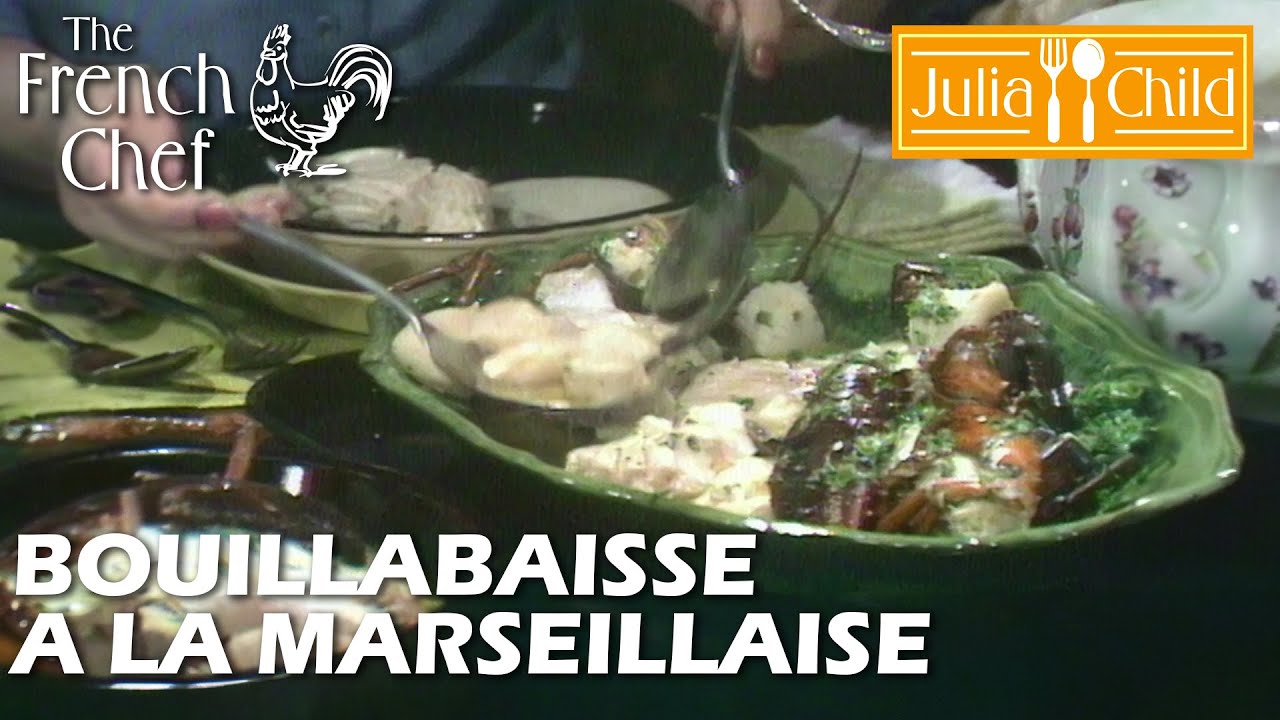
See the color and gaiety of Marseilles with Julia Child, and learn how to make this famous fish chowder.
About the French Chef:
Cooking legend and cultural icon Julia Child, along with her pioneering public television series from the 1960s, The French Chef, introduced French cuisine to American kitchens. In her signature passionate way, Julia forever changed the way we cook, eat and think about food.
About Julia Child on PBS:
Spark some culinary inspiration by revisiting Julia Child’s groundbreaking cooking series, including The French Chef, Baking with Julia, Julia Child: Cooking with Master Chefs and much more. These episodes are filled with classic French dishes, curious retro recipes, talented guest chefs, bloopers, and Julia’s signature wit and kitchen wisdom. Discover for yourself how this beloved cultural icon introduced Americans to French cuisine, and how her light-hearted approach to cooking forever changed how we prepare, eat and think about food. Bon appétit!
— Managed by PBS Distribution
Get More Julia Child on PBS:
Twitter: https://twitter.com/pbsdistribution
Facebook: https://www.facebook.com/PBSDistribution.org
-[ Speaking French ] -This is Marseille in full cry. This is where bouillabaisse began and is still going strong. We’re cooking bouillabaisse a la Marseillaise today on “The French Chef.” ♪♪ ♪♪ -“The French Chef” is made possible by a grant from the Polaroid Corporation. ♪♪ -Welcome to “The French Chef.” I’m Julia Child.
Bouillabaisse is a French fish chowder, and it originated on the Mediterranean in Provence, and it has those typical French Provencal ingredients of onions and leeks and tomatoes and garlic and olive oil and herbs and fish. It’s a loud, colorful, authoritative, flavorful brew, just like the Marseillaise themselves.
And it’s made from a great collection of fish that are very, very, very fresh, and they come into Marseille every day in the early morning. This is the Old Port. This is where the fish come in. These are the little boats that you see coming in the harbor in the early morning.
They’re called chalut, C-H-A-L-U-T. The fishermen who run them are called les chalutiers, and they have a separate market where their fish are sold. That’s probably one of their wives. And they unload the fish right on the Old Port itself. What’s fascinating about Marseille is, it’s a very modern city with modern facilities
And a great big new port and then right next to the new port and coexisting with it is the Old Port, Old Port, where the fish are. [ Whirring ] [ Indistinct talking ] -I always feel that part of Marseille itself is cooked right into the bouillabaisse.
You can somehow just taste the flavor and the color and the excitement of that Old Port. And when you eat it there in one of those little open restaurants, and you’re watching the boats coming in and out, you really know you’re having the real thing. It’s called bouillabaisse a la Mar–
It’s bouillabaisse Marseillaise. But if you’re making it elsewhere, as we are making it here, it’s called bouillabaisse a la Marseillaise, which means, “in the manner of.” In other words, if you’re there, it’s bouillabaisse Marseillaise, and if you’re here, it’s a la Marseillaise. And the bouillabaisse starts out with the very typical
Marseille flavors of the onions and the leeks. And if you don’t have leeks, which are these wonderful things, you can use onions, and we have — It starts out with olive oil, a good fruity olive oil, about 1/2 cup into a great big kettle. And then in go 2 cups of sliced onions
And 2 cups of sliced leeks, or if you don’t have leeks, 2 more cups of onions. And then you cover the pot and let the onions and leeks cook slowly together for about five minutes because cooking them allows their full flavor to escape into the broth.
And then after that, you have 6 cups of fresh tomatoes, and if you don’t have fresh tomatoes, which are always the best, but naturally you can’t get them in season, use 3 cups of fresh tomatoes and then about 1 cup of tomato puree. And that — But just having the fresh —
Having the fresh gives you a lot more flavor, but the combination is good, too. And then we have garlic. You want a lot of garlic, so it’s about 4 or 5 cloves chopped up, and you don’t even need to peel them. And then we have herbs.
You can use fresh basil if you have it, but otherwise you want to use some parsley and fennel. We’d like about 6 or 8 parsley sprigs and 1/2 teaspoon of thyme. And of course, if you’re living down in the Mediterranean, most of these would be fresh. And then fennel is very important
Because that gives a particularly Marseille flavor, a Mediterranean flavor, a bay leaf, and this should be an imported bay leaf if possible, and then a piece of dry orange peel or some bottled dried orange, and then very important is saffron. And these are called saffron threads, and they’re made —
They come — They’re the stigma of the little bulb that looks as it’s part of the Iris family. You just want to use a little bit, two big pinches. It’s a very — Two or three big pinches. It’s a very strong herb.
And if you put in too much, it’s going to taste medicinal. So, what we had in there — we had 2 cups of onions and 2 cups of leeks, or 4 of onions. And now, if you have very, very fresh fish, you can just put in plain water because you’re going to flavor
The rest of this stock with fish trimmings, and you want about 2 1/2 quarts of water here. Then that’s to come up to a rapid boil, and 1 tablespoon of salt. And that’s going to — And that will then — And then will then be completed with fish trimmings.
But if you have no fresh fish, you can still do very well indeed because you can use bottled or canned clam juice, and in that case, use 1 quart of clam juice and 1 1/2 quarts of water and no salt because you have the salt in your clam juice.
And then all of this is to cook at a fairly rapid boil because what you want to do is to have all of the olive oil and all of the flavors just work right into the soup. So, you don’t need to cover it.
You can cover it first until it comes up to the boil, so things will go a little more rapidly, in other words, about 40 minutes in all, after you get your fish trimmings in. And if you don’t — Of course, if you don’t have fresh fish, and you have the clam juice,
You still cook it for 40 minutes, but we have fresh fish for our bouillabaisse. And we have a beautiful striped bass. And — But the great fun to do is, if you’re in Marseille, get up at dawn and go down to the wholesale fish market
That’s on the Old Port, and you can find it very easily. It’s on the left-hand side of the port opposite the Marie, and you can hear it and see it. And this is called the Criée aux Poissons, and the fish sellers are wonderful women which are called… -[ Speaking French ]
-…which are fishwives, the peculiar pride of Marseille, the Marseille fishwives and fish sellers. [ Indistinct talking in French ] [ Continues speaking French ] [ Screams, laughter ] -Being stiff like this means that it’s very fresh. -[ Speaking French ] -Oui. -[ Continues speaking French ] -This one is the freshest.
And this one, because it’s soft, is not as fresh. But this stiff one is rigor mortis. -[ Speaking French ] -I thought it was so funny when I said, “That’s rigor mortis,” and he said, “No. It’s mackerel.” Well, this isn’t rigor mortis either. This is a great big pollock.
This is a fish you’re going to see a lot more of because it’s a fine ocean fish, and it’s the kind of fish that you’re going to find all over the country more and more because, unfortunately, haddock and cod are getting scarcer. Now, what we’re going to do is to —
I’m going to give you some of the ideal. Ideally, we’d have six or eight varieties of fish. You could have something like hake, and you want them to be hake and just six or eight varieties, but you want them to smell extremely fresh. Whether they’re fresh or frozen, smell them.
And it really, literally does have a really fresh, sweet smell, and that’s terribly important in something like a bouillabaisse, and frozen fish can be excellent, too, if they’re properly taken care of, and these can be — You can have either saltwater fish or freshwater fish. And you don’t want oily fish.
These are supposed to be lean fish. In other words, no mackerel and no tuna fish, and if you’re a fisherman, over here you might find this little baby called a sculpin, and the sculpin is a cousin of the Mediterranean rascasse, which is one of the most important fish
That they use in Marseille for the bouillabaisse. And you can have shellfish, also. You can have — There are scallops, which are just fine, or you can have lobster. I’ve been keeping this one in the shade because he’s nice and alive. And make sure that he does that. Bup, bup, bup! Gitchy, gitchy!
He’s got to be really live. And what you want also is a variety of fish. You want some flimsy fish like flounder. And then you want some firm-fleshed flish — firm-flesh fish like halibut, and the halibut is also gelatinous, and some of the other fish are gelatinous,
And that is what you very much need because that gives quality and body to the soup. And this is why this variety is awfully good because the flimsy fish break up while the soup is boiling, and the firm-fleshed fish, like the halibut, stay together and also give another quality.
These are ideal conditions, but not everyone — You’re not always going to have them, and it doesn’t make really any difference because you have such a wonderful flavor just in the onions and garlic and everything that’s cooking that you could use — See, here’s a pollock fillet.
And you could just make a whole fine bouillabaisse just out of pollock. And if you want, you can add that Mediterranean sauce which you find in most cookbooks called a rouille — R-O-U-I-L-L-E — which will thicken your sauce a little bit. But I think — I thought it would be fun
For you to see the ideal conditions. So if you have a bass, here’s a great, big, fresh striper, and if you had a trout, too, you would just take a big knife, and you’d just cut it up. You’ve cleaned it, and you’ve taken out the gills,
And I’ll take off that tail piece there. But if you’re doing it a la Marseillaise, you don’t take the bones out, and you don’t take the skin off either. Remember, this is a peasant soup, and that’s what’s so much fun about it. It also makes it a very easy soup to do.
So there you’d have that little group of striped bass there, and then you still have the head, which you can use for fish stock. As you can see, the gills have been taken out, and it’s all been washed and clean. So, save anything like that for the fish stock.
And then when you cut it up, the idea is, you see, when you serve it, that you want to have nice big pieces. And now if you have a halibut steak there, you just take it and cut it in about four serving pieces. You can take the skin off or leave it on.
I always leave it. Well, I’ll leave some of it on, take some of it off. That was a messy piece of work. There, this one I’ll keep on, but you just cut it in half, and I have found, when we were living in Norway, I did a bouillabaisse using halibut,
And it was extremely good — just halibut and cod. And now, if you’re going to use scallops, sea scallops, that’s not what they use very much in France, but they’re reasonably priced here, usually, and they’re awfully good in a bouillabaisse. And then here, a pollock fillet, a great, big, thick one.
Just cut that into big serving pieces. And that’s very nice. I think you notice that — what the difference between pollock — Here’s the difference between pollock and cod. Did you notice the pollock, the flesh of it, it’s slightly — It’s pinkier, and the cod is fairly white. But when it’s cooked,
The pollock becomes just as white. I think some people in America are always thinking that white is best and so forth, which is silly. Now for the lobster, cut it up into pieces, and it goes just like that into the bouillabaisse, and you can prepare all of the fish ahead of time.
I’m going to put this over here. You can prepare it all ahead of time and then refrigerate it. So in other words, when you’re ready to go, everything is all ready to go into the pot. And now… this is called a fish frame. When you’ve taken the fillet off the fish,
You have what’s known as the frame, which is the bones and the head, left. And this is what you’re going to use to make your fish stock out of. And this is the kind of thing that a lot of people throw away, and that’s just nutty
Because this is where you get your absolutely lovely flavor. Now, this has to be chopped up. This is a big French knife called a bat. You could get your fishman to do this for you, but I think it’s rather fun because I think it gets rid of aggressions
If people have aggressions against fish. Oh, I don’t think I’m going to chop the head. I don’t think it really needs chopping, but the gills should be out, and then that is all ready to go into the fish soup. Pretend I took the gills out of that.
It doesn’t really make too terribly much difference if I didn’t. Now, your fish stock is at a rapid boil, but you can put them in when it isn’t at a rapid boil. It doesn’t really make any difference, but in goes the fish frame right into that soup, and the head.
And then this you want to let cook for about 30 or 40 minutes, and that gives it a marvelous flavor. But, you know, it’s such wonderful fun shopping in Marseille because the fish are just so fresh, and the fishwives are great fun. -[ Speaking French ] [ Continues speaking French ]
-[ Speaking French ] -Must not forget garlic and parsley. [ Conversing in French ] Merci, monsieur. Merci, madame. Merci, madame. Okay. [ Conversing in French ] [ Conversing in French ] -That’s a great big rockfish, and you have to have it. Look at these. -These are big.
Very prickly things. -[ Speaking French ] [ Conversing in French ] -I don’t know what that is in American. It’s a rockfish. -[ Speaking French ] -That’s fine. [ Conversing in French ] -[ Speaking French ] -Isn’t that a wonderful old girl? Some of these women look so fierce,
But they’re just terribly nice, and they just love to kid around. Now, here’s the fish for our bouillabaisse, and after you have your base here that’s cooked down and cooked for 40 minutes, you strain it out, and there it is, ready to have the fish go in.
And now what it is is what is known as a soupe du poisson, in the Marseille accent. It’s all strained out, and it has a marvelous flavor, and it’s a very popular soup, just like this with some diced potatoes or pasta cooked in it, and then you serve it with French bread.
And the way to turn it into a bouillabaisse is just to put the fish in. So I’m going to put the firm-fleshed fish in. I don’t know why that’s always so hard. Firm-fleshed fish. And that was the bass, and here is the — Well, I hope that that is the halibut.
That’s one reason for leaving the skin on. You can tell what it is. There’s another piece of bass. And in goes the lobster. That was just one whole lobster cut up. This is going to serve about six to eight people, and then you want to bring that fast up to boil
For just about 5 minutes because you don’t want to overcook, and you don’t want to start cooking the bouillabaisse until just the last minute because you’ve got your soup all made so that you can have that made ahead of time when your fish is in the refrigerator.
So, 20 minutes before you’re ready to serve, in goes your fish. And then after this has all cooked for 20 minutes, you then put in your less-firm-fleshed fish, which will be your pollock and flounders and whole fish, if you have them, and the scallops. And if you have mussels and clams,
You’d put them in also. And then again, let it cook fast for 20 minutes — I mean for 5 minutes, and it is ready to serve. There. You want to have a big platter ready and a soup tureen. And then the fish goes out onto the platter.
And here comes some of that lobster. It’s always a very colorful-looking dish. Ah, there’s some of our striped bass. There’s more lobster. And you can see why you want to do this just at the very last minute. Because you would never be able to keep it warm on your platter otherwise. There.
And then the soup goes into the tureen. I don’t think I have all of the fish out there, but this is to give you the main idea. Then your soup into the tureen. That has a wonderful, wonderful smell. That goes onto there. You want to put a little parsley,
Roughly chopped parsley, over the fish, and then you want to put some, if I can find it — Oh, another. You want to pour a little bit of the — Moisten that with a little bit of your soup. And then that is all ready to serve. As you can see —
Of course, you don’t do it as quickly as I did, but 20 minutes before you’re ready to serve, you start putting the fish in, and then you’re right ready to cook it. And now for serving it, you put two pieces of French bread into a great big deep platter,
And then you put some fish on the bread, and you want to try and give people a little bit of each type of fish. There’s a bit of striped bass and a nice piece of lobster. And then you pour some soup over all.
And then you eat the whole thing with a spoon and a — a big soup and a fork. And you just find that it’s absolutely a delicious meal. It certainly is a full-course meal. I mean, it’s a full main course. Oh, I didn’t put that in the right thing there.
And with this, as a wine. I think that a Riesling is a very nice wine, one of these Alsatians because it’s dry, and it’s good. Now, this is a great bouillabaisse, but if you want to see the real recipe, you’ll have to go to Marseille and get it from our old friend
In the fish market who gave it to me. [ Conversing in French ] She’s going to tell me how to make the bouillabaisse. -[ Speaking French ] -Oh, the marinade. Let it marinade. [ Conversing in French ] [ Conversing in French continues ] How long does it cook? -[ Speaking French ]
-40 minutes. Merci, madame. Bonne journée. Au revoir. That’s all for today on “The French Chef.” This is Julia Child. Bon appétit! [ Conversing in French ] ♪♪ ♪♪ -“The French Chef” has been made possible by a grant from the Polaroid Corporation. ♪♪
Julia Child is coauthor of “Mastering the Art of French Cooking Volumes One and Two.” ♪♪
23 Comments
First French chef episode in color on this channel
LOL there's no WAY there'd be someone smoking over the fresh fish in THIS day and age of cry baby snowflakes!
Didn't cook then, don't cook now. I absolutely am mesmerized by her ❤
It's not always about the dish. I now know where the term "fish wife" comes from & why! Love it!
The only fish dish that my granny and I loved was Fin & Haddie. And we're Norwegian 😂
This is from Season 7 – not Season 6 and aired in late 1970. New kitchen, new theme music and Julia Child a breast cancer survivor! – one reason the show was off-air for 4 years.
What a treat! I love making bouillabaisse.
Probably the 1st episode with films shot in France.
I was told by 1 YT commenter that the early episodes had a very tight budget which was probably the reason they didn't have these films.
She is a TREASURE.
They're all great but this is one of the classic episodes
I remember watching this episode as a kid and getting hungry because I grew up eating fish and going fishing with mom, dad, and my big brother.
And now in technicolor!
As a newlywed I first saw her on PBS and was absolutely in awe. Watched her for many years.
Personally, I think this is her best episode in The French Chef.
As a child, I watched Julia followed by the original Star Trek. It was a good childhood.
It’s nice to hear her speak French . She was such a gem to watch
Looks delicious but expensive.
❤I like how she cut the onion and look at the camera man !!!❤😅😅
I have been watching Julia for 50 years now. I so miss her…
That's fantastic seeing Julia in the fish market. Great way to advertise the fishmongers at the time, no doubt about it!
Yes!! More color episodes please!
When I was a kid. I would eat fish sticks, but fish soup or anything that came from the sea. I would not eat. To me it was gross. I would go fishing and I would have the person take the fish off from my hook.😄
Love Julia! To duplicate all the fish,lobster,scallops she used in this recipe today in the US wld take a bank loan!😮😮 .Fun watching this though!
Je l’adore! ❤
disgusting leaving the fish skin on.