
Personalized 1-on-1 language lessons with native teachers on italki🎉Buy $10 get $5 for free for your first lesson using my code JONES2024:
Web: https://go.italki.com/languagejonesjan24
App: https://italki.app.link/languagejonesjan24
I speak French, but couldn’t make heads or tails of it in Canada. Time to set things straight, and master Canadian French.
#canadianfrench #learningfrench #french #canada #quebec #montreal #languagelearning
Can I convincingly learn Canadian French has always messed me up. But rather than be vanquished by those maple hording, poutine guzzling, toque wearing toboggan enthusiasts up north, I decided to turn the tableaux, so to speak. That’s right, I set out to learn Canadian
French. But not just learn to understand it. No, to defeat a formidable (formidABLE?) opponent, obviously, one must BECOME the opponent. In this video, in going to discuss what makes Canadian French so unique. I’m also going to put my money where my mouth is — or my
Mouth where my bouche is — and speak Canadian French. And in a later video, I plan to attempt to pass for a real Canadian in their nation’s Capitol. This is going to be a fun one. I’m going to dispel some myths about a controversial
Language variety AND since I’ve criticized YouTube polyglots but I haven’t filmed in other languages, I’ll put up, not shut up, and speak a foreign language. In at least two accents. I’m doctor Taylor Jones, and this is adzikté u laing. Uh…this is Language Jones. [Music] Bon, j’ai critiqué les soi-disant polyglottes sur YouTube, mais, je n’ai pas fait un vidéo en parlant, vraiment, des langues étrangères. Donc, permettez-moi de saisir l’opportunité. Je vais vous raconter une petite histoire personnelle. J’ai famille en France. En fait ma grand-mère a passé son enfance et sa jeunesse en France jusqu’à 1939. Et
Alors, on a de la famille encore en France, en particulier dans le sud de la France. J’ai étudier le français au lycée, mais par ailleurs j’ai passé deux semaines ou un mois en France de temps en temps. J’sais que j’ai un accent, évidement, quelque
Chose comme américain avec un soupçon de vieux niçard (bonne nuit!). Mais je parle français. Quand je suis allé à l’université, je suis allé à l’université de Toronto. Et quand j’y suis arrivé j’ai allumer la télé et … j’pensais que je faisait
Un AVC. Des gens parlaient en français, mais…c’était impossible, pour moi, de déterminer le sens de leur paroles. Même de distinguer entre leurs mots. J’ai vécu au Canada pendant quatre ans, et j’ai évité systématiquement de parler français avec les canadiens. Après être revenu aux États Unis j’ai passer l’examen B2 en français, et j’ai
Réussi. Il y a dix ans. J’ai continué à étudier le français, donc je suppose que je sois à niveau C2 maintenant. Mais j’ai visiter Montréal, et là j’avais des difficultés, et un ami est déménagé à un village francophone, et alors j’ai décidé que la prochain fois que je serai
Au Canada je parlerai le vrai français canadien. Et puis on se trouve ici. stick around to the end to hear my attempt at a Canadian accent by the way and leave me a comment and let me know what CEFR level you think I’m at should I sit the C2 exam
This year before I continue I should say a word about today’s sponsor I talkie without them I could not have gotten here so quickly iTalki is an online platform that allows language Learners to learn from real life native speakers for teachers and tutors they have their own
Video conferencing platform and a mobile app with all the bells and whistles you could ask for and they have a ton of real speakers to choose from starting from $5 I’m supposed to tell you that they have over 150 languages but I told them they’re selling themselves
Short they have real speakers of under-resourced languages they don’t just have Arabic they have Moroccan Arabic I’ve actually taken lessons in it on it talky before they don’t just have French they have Canadian French I love II and I’m honestly so hype about them that I
Tell people about them off YouTube IRL so to speak and I have to give people a heads up when I’m going to be doing a sponsored video with a promo code so they can snatch them all up they offer lessons that are personalized and one-on-one and you can learn with real
Native teachers one benefit is that you can improve your listening and speaking skills which is exactly what I was working on and why I’m so addicted to italki they have more than 30,000 teachers worldwide including for under resource languages and
You can pay per lesson with no subscription and learn basically anytime anywhere including on your app which by the way I just realized has uh an audio recording feature so in the messaging in the app uh I got to record some of my pronunciation for my tutor and he sent
Me back his pronunciation and I had a lot that I learned that way so click through the link below in the description to start your uh language learning Journey with it talkie if you buy $10 you will get
An additional $5 with my exclusive code Jones 2024 that’s J O N E S 2024 and the discounts are of course only available to the first 50 users so make sure you snatch those up I’ve already told people I’m going to release this video so you are racing against my friends
In real life every single teacher or tutor has been kind patient and Incredibly helpful for this video I worked with Lambert Girardin who really helped me get a handle on what’s going on in Canadian French and why I thought I was having a stroke. So what IS going on?
Canadian French is not just 17th century French, trapped in time, frozen in Canadian ice, and preserved like a museum piece. It’s a sister or maybe estranged cousin of hexagonal French. BOTH have developed since the early days of New France, and they developed differently.
So Canadian French preserves some archaicisms, yes, but also has its own innovations. So in no particular order, here are the top 10 differences between Metropolitan French and Canadian French. 1. Lenition that conforms to the sonority hierarchy Canadian French simplifies some cononant clusters that happen in syllable codas, that is, at
The end of syllables. Instead of TABLE, you’ll hear TAB. Instead of Formidable, as I said at the beginning, you’ll hear FormiDAB. And it happens in loanwords. Got two of something? Congrats, you’ve got a coup’. This is not, contrary to popular belief, a product
Of the cold. Rather, it’s a simplification of language that affects L and R sounds (commonly known as liquids) and it makes the syllable conform better to what is called the “sonority hierarchy” — basically an observation that languages prefer syllables that go from
More “sonorous” to less. In that scale, liquids are more sonorous than obstruents like /b/. Technically the scale is vowels > glides > liquids > nasals > obstruents. Words like TABLE violate the cross linguistic tendency. Quebec French corrects that by expelling them to the colonies. Too soon for a French-Indian war joke?
2. Other common lenition patterns kekchose, matnant That is, normal reductions, but note ones that other French has. The big one that stands out to me is kekchose instead of quelque chose. Or, another example: maybe because of my Nicard connection, matnant really stands out to me, since I’m used to maintenant — 3 syllables.
3. DIFFERENT PRONOUNS. Canadian French has entirely DIFFERENT PRONOUNS Quebec French doesn’t just reduce je to sh like in my other video about Geometric French, and spirantize tu to tsu. No, they’ve got a ton of other pronouns. Some are older variants, like nous aut’ which is like Spanish Nosotros (and notice how autre has become
Aut’ from the bit I explained about the sonority hierarchy!). Of course, you’re more likely to hear on than any version of nous. But on top of that, the word il has lost its L, as has ils. They’re both y. Y a kekchose a dire. The plural has no liaison!
Y ONT kekchose. Elle becomes A. If you don’t know these changes, then by the second sentence you hear, you’re going to be lost! 4. VOWELS. SO MANY VOWELS. Just as a wine can be fruit forward, Canadian French is vowel forward. It’s the result
Of the same process as gives rise to a southern American accent, or how, you know, Spanish, happened. That is, diphthongization chance sounds like shince, fete sounds like fight. And Frankly, to imitate it, you’d do well to just pronounce the words MORE Like how they’re written. FAIM. 5. VOWEL SHIFTS
One of the first things I noticed is just how English speaking Canadians say NOT with long open o, (awwww), French canadians say words like pas or Canada with that vowel. Similarly, o has moved to u in some circumstances, like aujourd’ui or beaucoup. If that sounds
Familiar to African American English Buku, that’s because they’re the same word. The Acadian expulsion that gave rise to, you know cajuns, means that Quebec French and AAE share a words that’s effectively a cognate. There’s too many vowel shifts to get into,
And too many for me to effectively imitate them all, but two that particularly stand out are æ in words like finalement and accent, and eur in things like un peu or Pierre Bordieu. Oh, and listen to how “trois” and “toi” don’t have the same vowel!
6. LAX VOWELS It has lax vowels in closed syllables! Lax vowels are the counterparts to “tense vowels” and they are pronounced slightly less front or less back than their counterparts. So ee is a tense vowel, it’s lax counterpart is
Ih. Last time I was in Canada I heard a broadcast about people’s favorite tarts, and I couldn’t figure out what Kish was until I heard the ingredients. I thought it was from Central Asia or something. This is also why people say it sounds like an English accent (électrique, pratique, quiche)
7. Different words (OLD TIMEY EDITION) It retains words that were common in the 1700s, for instance ‘blonde’ for girlfriend. You may know this from Jean-Luc Picard singing ‘Aupres de ma blonde’ to remind himself ofhis roots and what makes him human. Or maybe you’ve just read l’histoire de la France
En chansons. They also call cars CHAR like chariot, and your friends are your CHUMS. Both Old timey and Englishy. That brings me to: 8. Code switching There IS influence from English, especially among educated bilinguals. So you might hear borrowed words like CHUM, or entire noun phrases, or even switching into English for clauses
Or sentences. 9. Different words (basic words edition) Literally words like “AND” are different. Just like how the pronouns were. If you know Old World French, you know that you can say “et puis” for “and then.” Well Imagine
It changed to et pis — that’s a normal change — and then you drop the et. That’s right, the word for “and” you’re most likely to hear is “pis”. Donc? Fek. 10. Affrication This one is my favorite. Coronal stops,
That’s your ts and ds, affricate so you get these deligtfully buzzy words like covidzzzzneuf or institutionale. Tsu comprand cke jdzis? Put it all together and what do you get? Something like this: Le francais de Canada est un dialect qui n’est pas forcement aussi different qu’on suppose.
Y n’est pas plus historique ou folklorique que les aut’ gen’ de la langue. Mais en même temps, cette langue, a qui est parlé par beaucoup de gens, Ala ses prop’ reg’ pis sa prop’ histoire. Y faut l’approcher avec une attitude respectueuse si on veut faire des chums a Montreal ou ville de Quebec.
I learned a ton making this video, and I’m grateful to now be able to understand almost everything I hear on Canadian radio, after only a few sessions with a great teacher on italki. Shout out to the Learn Quebec French podcast. Sometime this year, I’m going to
Level up my Canadian French IRL. Actually, should I attempt to sit the C2 exam with a Quebec accent in the oral examination? Leave me a comment below and let me know. Shout out to all my patrons. If you want to support the channel, you can become a patron.
If you liked this video or my other videos, why not send them to a friend or ten and encourage them to subscribe? I have a goal of a million subscribers and world linguistic domination, and I think part of that is doable. If you liked this video, you’ll probably like this one.
30 Comments
French Québec make Canada culture unique otherwise it would ressembles a lot like the US culture…
As a Franco-Brit with an English mother and a French father, and fluent in both languages, your introduction in French sounds just like a Brit mastering the French language with a slight Brit accent. Canadian French is a very different language, as it evolved from pioneers back in the centuries. In a few hundred years, it will be very totally different from France's French, as Latin has derived into Spanish, Catalan, Portuguese, Italian, French, Romanian etc, and also all the French speaking nations in Africa or other colonies. You read the newspapers, you might understand. You hear it? You understand bugger all 😀
The guy in this video speaks beautiful French, Bravo!
De la même façon qu'aux États-Unis, un vaste territoire même en ne s'en tenant qu'aux 48 états contigus, on peut entendre l'anglais parlé dans une multitude d'accents, tant en France qu'au Canada, on entendra différents accents selon les régions.
C'est un exercice intéressant auquel s'est prêté notre serviteur le docteur. En bout de piste, peu importe comment on s'exprime, au-delà de l'imitation et du parcours d'apprentissage d'une autre langue, l'objectif reste de comprendre et de se faire comprendre.
Tente d'apprendre le joual
Parle comme au Nouveau-Brunswick😆
Mon ancêtre français est débarqué à Québec en 1671, il venait de St-Ouin Maugé, je crois en Normandie. Je suis 100% québécois, une affirmation identitaire catégorique et mes origines normandes ajoutent à ma fierté française.
I have such an odd mix of French Canadian and Metropolitan French traits in my French. I was in Frnch Immersion from Kindergarten to Grade 12 and different teachers all had different dialects. I have a hard time telling what's what. Interesting that a few things that I thought were me just making mistakes are actually French Canadian traits! Strangely I find Belgian French easier to understand than either Quebec or "Hexagonal" French. And I only ever had one Belgian teacher, though I had her both in Grade 5 and Grade 7.
This video gets a lot right but there's a lot thats wrong with it too. And the problem is, is that someone like this guy who is an American with only a laudable but nonetheless passing familiarity with Québécois French sets himself up as an authority and makes a YouTube video which people with little or no knowledge themselves "prendre pour du cash." There is a whole lot of overgeneralization happening here. He is treating 'Canadian French' as one monolithic and uniform dialect. Already this is absurd because Quebec French and Acadian French (just to give one exemple ) are mutual comprehensible but quite different. But it goes beyond that. He has completely paved over the fact that even in Quebec, there is much diversity in the way that French is spoken. There have always been regional, generational and class differences in how people speak here. As in France itself, there are levels of language; here in Quebec most people can move up or down from a more 'correct' and more or less formal French to the 'joualised' French that is so often parodied in the rest of Canada as a rude 'patois' and not French at all. He falls into this trap when he makes the completely incorrect claim that Quebec French uses different pronouns. It does not. Depending on set and setting (where you are and who you are talking too) Quebec French speakers ill pronounce the same pronouns all French speakers use…differently. It is true that here we say 'Ya' in place of 'Il a'…but it is merely a compression of the pronoun 'il' and the verb 'a' (avoir) into one sound. It is not a different pronoun and to say that it is is to perpetuate the stereotype that Quebec French is different to the point of being 'not French' or a bastardized version of French. Having said that, there is a lot that is true and accurate in your video. Je penses seulement que tu devrais garder un petit gène quandmême, avant de te poser en tant qu'autorité sur la langue. Passe un peu plus de temps ici d'abord, afin d'être bien certain que tu sais réellement de quoi tu parles…
Très bon vidéo! C'est plaisant voir une perspective de l'extérieur.
MDR, l'anglais pense qu'il est C2
I understood 100% of what you said (family story, etc.) in Canadian French. I find Canadian French much easier to understand than Metropolitan French.
The comment by @Kaletar is bang on.
I am an Acadian from the Maritime provinces and we have many different accents in our version of French. I think that being exposed to different accents is the key to understanding the language. But one must be open to the difference. There is a concept called ''linguistic Insecurity'' which is basically the feeling of being somewhat inferior because of the accent with which you speak your language. Although I felt it at one time, I don't anymore. Maybe it's because I am now very fluent in English and my French accent is still there when I speak so I became immune to criticism in some way. But my main goal remains successful communication, not trying to impress, in French or English.
As a kid, I was exposed to French TV shows from Quebec and French movies from France. Because of this, I never had difficulties understanding people from these areas. I went to France in the mid-90's and had no problems communicating with people. I also adjusted my language a little to make sure they understood me but I didn't try to hide my Canadian accent. Your situation was different because you were not really exposed in the same way so it was obviously difficult to understand.
Kudos for learning to understand Quebec French. But, honestly, you don't have to try to talk like this as it sometimes sounds a little fake and people will pick it up fast.
There are those who will try to make fun of an accent but it's because of their own ignorance of the variety of the language. It could be frustrating but once they realize that all you want is to communicate, most will stop. Those who persist are not worth your time.
I was afraid when I first saw your video that it was going to be another condescending speech about French Canadian French. Very interesting and well done. Merci Je suis Montréalais et ma famille est au Canada depuis 1662.
If you're an American and want to learn French. Learn the Canadian French. It's more suited for North American. Bit like U.S. vs U.K. English.
I don't know anything about C2 and levels but right now. In the introduction. You definitely have a French accent. Not Canadian. In the top ten it's really good and I can hear an almost Montréal accent. Other part of Québec dont diphtongue. Not even in English! lol Other parts of Canada do but not quite the same.
Instead of the capital, Québec. Try Montréal, again. Practice with English natives. It'll be easy to sound like a Québec native English speaker. Much more than a French native.
It isnt Canadian French as that doesn’t exist. We have Quebecois french, Acadian French (which has several dialects including 1 in louisiana)
ton français est super bon !
Tu expliques et comprends mieux les différences entre le français Québécois et le français de France que la majorité des youtubeurs français qui tentent de faire des vidéos du genre. Good job, mon chum!
French Canadian is not a dialect. It’s the same vocabulary and grammar. Accent is different thing (and there are many accent in France as well). So are the accents in the US and the UK.
I speak English. When I’m drunk, funny enough, people think I’m Irish.
I also speak Italian and recently started learning Spanish. Funny enough, while in Mexico, people told me I had a Spanish accent, even though I started learning less than 3 months ago… already have an accent just by listening to Radio Intereconomia Valencia…
So, yes, French Canadian has accents. There are many (Joliette, Quebec, Beauce, Iles de la Nadeksine and… Montreal).
I worked for French Banks overseas. My French is the same, they barely noticed my canadian accent. Same language.
Dont assume because dome French Canadians speak s bad French that is therefore a dialect.
Quebec french is very fast. Loads of contraction. Easy when you are used to it. But a huge pain to learn if you are not in that environment to absorb it.
Ton français est compréhensible, meilleur que plusieurs Québécois anglophone.
tu n'sembles pas canadien. you sound like a spanish speaker, speaking canadian french. quand même facile a comprendre, i don't think you'd fool anyone in ottawa.
Très bien!
As a French from the " Old Country", the Québécois accent is torture to my ears.
Sorry, cousins.
Je suis français et je peux vous dire que votre prononciation est nettement meilleure que le français des Québécois que je comprends à 70% !.
Je me fiche des accents et sais que les français se moquent des différents accents, personnellement lorsque une personne dit que j'ai un accent,ma réponse est toujours : moi.. un accent ?.
Non C vous !, et là ! mais si votre accent Marseillais !!
Pourtant natif de la basse vallée du Rhône 😂😂!!!
Le "charme" de la langue française
Velomo ( au revoir en malgache)🎉
Intéressant, merci de votre ouverture aux différences.
Ahah, great little video. Itvwas a missed opportunity, un rendez-vous manqué. First, if you go to Quebec City and you speak French the way you do, people will go from « ch’t’allé » to « j’suis allé « . From « y’ont » to « izont ». A bit like I’m instead of I am. But yes we adjust, if I speak with my friends or with clients there is a difference in the contractions. But anyhow, way back you would have ad a lot of success speaking French. Also the news on Radio Can is closer to interational French than at other channels. Less nowadays. Thanks gor sharing your viision.
Je suis un Québécois francophone et les premières minutes de votre vidéo révèlent que votre français est très bon. Très compréhensible. En fait, prendre une bière en français avec vous doit être le fun : )
Your French in definitely C2, however don't say 'je suis Niçard', it doesn't exist, you must say 'je suis Niçois''! I don't want to sound like a pompous prick but 'ça fait un peu tâche, et c'est dommage'! Anyway you're fab!
Merci d'avoir posté un clip si divertissement et amusant. De quoi s'agissent-ils ces examens "B2" et "C2"? Il me faut le savoir avant de me prononcer sur ta question. J'ai du partager ton vidéo sur Facebook pour amuser mes anciens collègues au Parlement.
Having watched your video, I see that you appear to be using "Canadian French" for what I would describe as "Quebec French" or "Québécois." That's not wrong, but it's not as clear as "Québécois." There is a whole palette of French accents: Franco-Albertain, Fransaskois, Franco-Manitobain, Franco-Ontarien, and that of the Acadiens, le chiac! (I believe this last is a corruption of the place name "Shediac" from the Acadian Shore.) Most of these are easily placed and are mutually intelligible; Franco-Ontarien is difficult to distinguish from Québécois. Acadien predates Québécois and is much trickier to get the hang of. Purists would say it is too contaminated by anglicismes — the Acadians don't care. The French-teaching wife — une québéquoise — of my boss on the Miramichi collected chiac expressions like "j'ai fait la hem de ma dress, mais j'aime pas la way qu'e hang." Note the preservation of the French gender for the English nouns and the same minimisation of the pronoun you noted in Québécois. Just for fun, here's an indication from proceedings in the House of Commons of how proud Canadians are of the way they speak their mother tongue: https://www.noscommunes.ca/documentviewer/fr/44-1/LANG/rapport-3. I would suggest you listen to the proceedings for the participants various accents. Warning: the chair and M. Samson are Acadians.
I am an Anglo of Quebecker descent, born and raised in Ottawa — "un vrai bloke." I learned French pronunciation from my parents; my father was a civil servant receiving a bilingualism bonus and my mother taught French and English at the secondary level. I learned useful French as a soldier in 5e Régiment d'artillerie légère du Canada at Valcartier. There's nothing like two weeks under canvas or in an armoured vehicle to cement your comprehension skills, and reporting in writing on soldiers' performance in their "langue maternelle" to nail down your spelling, grammar and, in particular, the use of the subjunctive. My experience living in and around "la Belle Province" for over 60 years has been that no Canadian Francophone really gives a fig about your accent if you try to express yourself in French. They only ask that, if they switch to English on you because you're not clear enough, you not take offence at their English. They generally approach French from the same standpoint as Anglophones take on English: it is their mother tongue and it is up to them to decide how to use it — l’Académie française peut aller en enfer!
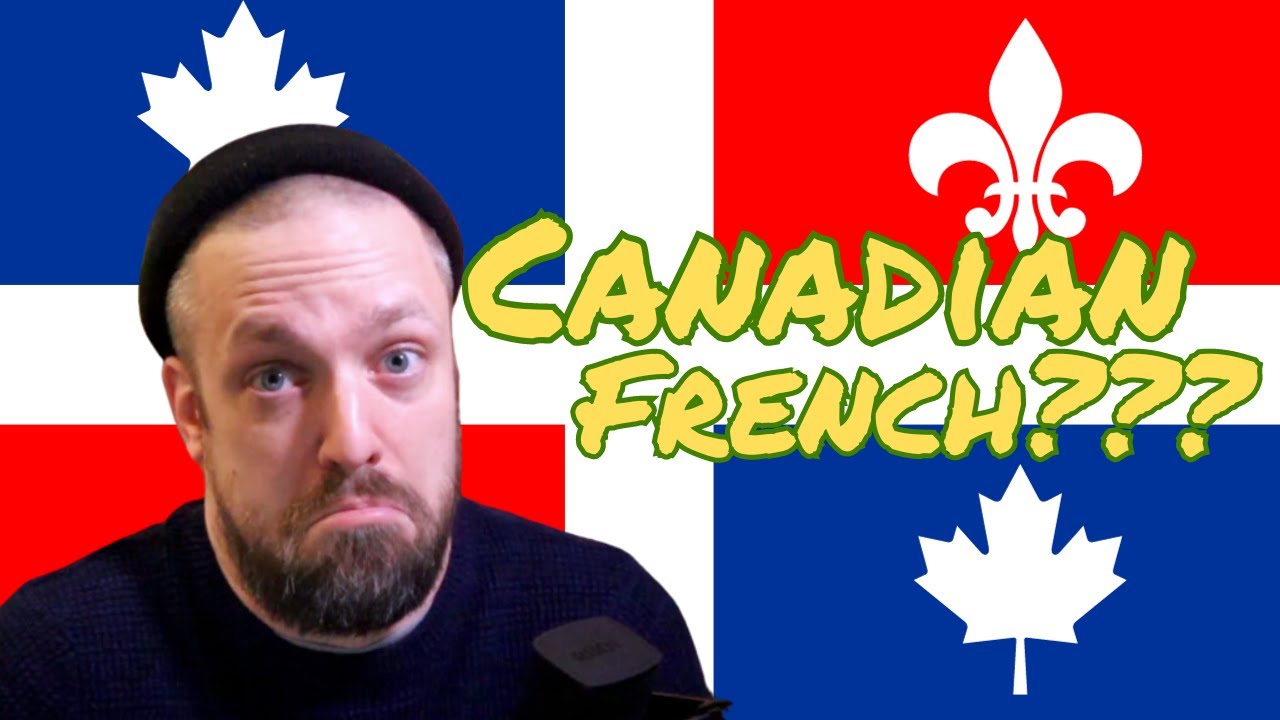
Finally, I noted with interest the vexillogical/heraldic title card you used, it is reminiscent of regimental colours of units of the Ancien Régime — le Régiment Royal Roussillon in particular, I think. It was, in fact, what got me to click on the link the algorithm fed me. Rather than a maple leaf on the blue fields, I would have placed the gold star of Acadia; to reflect the influence of English Canada, in the centre of the flag lapping into each quarter, a maple leaf slipped counter-changed to signify the pervasiveness of the influence of the English language.
Bonjour from Québec city. Thank you for understanding and respecting the french canadian language. You are doing good. Welcome to Québec anytime.