
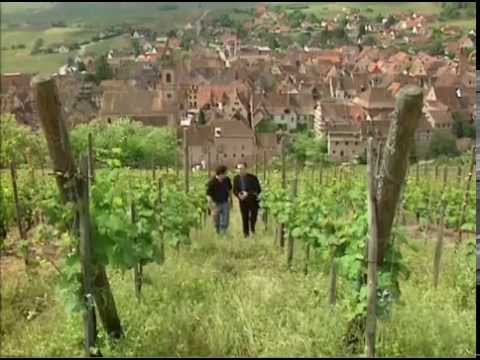
Nestled between the Vosges Mountains and the Rhine River, Alsace is a picturesque landscape of quilted vineyards and quaint medieval villages. Join our host Michael Fagan, as we travel through this little corner of France and discover its wines, indulge in its cuisine and revel in its natural beauty. Produced in 2002
The dawn breaks in Northeastern France. Here between the Rhine river and the Vosges mountains lies the sunniest region in the country, a patchwork of scenic towns, rolling hills and ancient vineyards, which produced some of the finest white wines in the world. Caught between Latin and Germanic civilizations for more than
2 000 years, the journey through here is like a walk back through history this is Alsace Hi, I’m Michael Fagan. In this episode we’re going to travel over the Vosges Mountains and into the Valleys of Alsace, to learn about the wonderful white wines of the area,
An area that continues to attract wine enthusiasts from around the world. The term gastronomy, the art of food and drink, was first used here in Alsace and it has developed to such a degree that today there are more Michelin star rated restaurants here than anywhere else in France.
Now it’s tempting to think of the region as just a series of villages and towns dotting them countryside but just a short ride from the wine route, lies the home of the European Parliament in Alsace’s capital, Strasbourg. Here, one begins to appreciate the Franco-Germanic influences in the people and the architecture.
Although the region has been occupied as a German province three times in the last 200 years, the soul of Alsace is French. Just West of Strasbourg, lies the famous Route des Vins, originally mapped and planted by the Romans over two thousand years ago, to take advantage of ideal growing conditions.
The people of Alsace, see themselves as distinct which is reflected in the gastronomy that is an integral part of their day-to-day life. Only the freshest produce and finest ingredients will do. Even in the smallest village wine and food vendors from traveling markets cater to a discriminating and educated public.
Here people are very knowledgeable, always willing to talk about their favorite subject wines. The wines of this region share particular qualities of freshness, purity and fruitiness. These wines are sometimes called the white wines, for those who love reds rich, complex, enticing.
With its long dry seasons and varied soil, Alsace offers up seven distinct wines named for those grapes. Pinot Blanc, Gewürztraminer, Pinot Noir, Riesling, Tokay Pinot Gris, Sylvaner and Muscat. In most wine producing areas of France, the wines are labeled geographically
And many are made by blending various grape varieties. However in Alsace, the wines are clearly labeled by the single grape variety from which they were made. But in the early 90’s, the Hugel family revived an old traditional style of wine. A blended wine, they call Gentil.
By the middle ages, the Alsatian industry was in full bloom shipping wines as far off as Denmark and England and today many of the wineries are family run and have existed for at least three centuries.
Here, in the antique town of Riquewihr, the Hugel winery has been producing since the 17th century. Etienne Hugel is a 12th generation member of this long-established family winery. “And this is actually one of our oldest cellars, this was build in…” Hugel makes wines from all seven varieties
But we came here to learn about the blend, Gentil. “Now we’re coming to the famous Saint Catherine cask. You can see she’s beautifully, richly decorated..” The Hugel winery has the world’s oldest oak cask still in use, dating back to 1715. It’s been in the family since the French revolution.
So you’re still using this today? “Absolutely. Actually it’s full. Full of, by coincidence, Gentil” Tell me a little bit about Gentil. “So Gentil is actually an old name that was used until the 1920s, that meant ‘Blend of Noble grapes’
And then this tradition of blending grapes slowly disappeared in Alsace and we had the idea in 1992 to revive that concept of top quality blends, so we came back with the name Gentil and more or less the old recipe, so it’s really a return to tradition”.
The area’s historical links to Germany are reflected here in the wines, each region uses the distinctive Rhine-shaped bottle and cultivates some of the same grape varieties But the wines of Alsace are unique. “Our wines are dry wines, aromatic, full of flavor but dry. So wines too match with food, so obviously
A very different style for most German wines, which are made in a sweeter style, which may be better more enjoyable outside a meal. So first and foremost Alsace is French, despite our complicated history”. The historic town of Riquewihr seems to have remained unchanged from the Franco-German wars
That have ravaged the countryside over the last few centuries. It remains a popular tourist attraction, as much for its spectacular views as for its wines. Down the street in Riquewihr, is the home of another of Alsace’s premier producers.
In the 1940s, two families, Dopff & Irion, merged their common interests and became a force in the wine industry “Everything is done by hand… Come on Michael, I’ve got something very special to to show you, we are ..”
In the cellar of Château de Riquewihr, export manager Pascal Schiele, showed us one of the company’s historic Vintages. “Riesling, Vintage 1945”. Wow.. and me without a corkscrew. Among other varietals, top Venetian make a wonderful Sylvaner, light and dry, it’s a simple wine that matches well with fish and salads.
The grape is relatively easy to produce which in turn, makes the wine affordable. And there are some differences in how one drinks the Sylvaner, as opposed to the other wines produced in Alsace. “To really enjoy your Sylvaner, you need to drink it within one year, it’s definitely not the type of wine
To lay down and and which will be even better after, you know, a few years. Either you’re just taking it by itself or just, you know, sharing a glass of white wines with friends and it’s a great introduction to Alsace wines. “Oh! look at this beautiful view here” This is fantastic!
“And here you’ve got this wonderful Grand Cru which is called Schoenenbourg. Best Riesling of the world are coming from this side, you see” In the world of French vintage wines, the term Grand Cru is the name given to the most celebrated vineyards. When all the variables come together perfectly,
These vineyards produce spectacular results. Each of the 50 designated Grand Cru sites, in the Alsace Region is renowned for producing wine of the very highest quality. Now that’s really quite steep. Does everything have to be done by hand? “Yeah, everything is picked by hand, of course”.
This is the Rangen vineyard. It’s one of the steepest and hardest to work vineyards in all of Alsace. There was a trend in the 1960s and 70s to move away from these areas to the lowlands, which are easier to work. But it’s from these Grand Cru vineyards that you get the best fruit,
Fruit that, in the hands of the right winemaker, produce the best wines in the region. But one has to wonder why. Why does the hardest landscape to work produce the finest fruit? “The late 70s and early 80’s…” At the Zind-Humbrecht winery we consulted an expert, Olivier Humbrecht, he winemaker here
Uses Biodynamics, an organic method of cultivation. What’s the advantage of such a steep slope? “Well, you expose more, less surface of soil to the sun, so automatically the soil is able to absorb much more sun energy, warms up much quicker and helps the grapes to ripen also. The color of the soil is very dark
Mostly made of small rocks and those also take the energy of the sun during the day and release them slowly during the night, which helps to keep a much warmer microclimate around the vine”. But what we also came here to learn about was the legendary Gewürztraminer grape of Alsace.
Here with the right soil compositions and appropriate sunshine this difficult grape can approach perfection. “Gewürztraminer is a tricky grape. Gewürztraminer is good when it’s ripe, when you have lots of flavor and the ripe acidity and you choose a climate which is not too hot, you choose a cool climate but, with sometimes,
A little peak of heat, like in September, just to finish off the ripening of the Gewürztraminer”. This is really something. “This is our cellar..” With Olivier’s organic approach in the field, the fermentation process is left at nature to take its course. “A 2001 vintage. It was racked about two
Months ago, so it’s not completely clear at the moment. It should be getting there. So it’s young wine, just barely finished to ferment and it has to spend another six months, eight months in the cask, to settle down..” The Gewürztraminer is a very aromatic white wine.
When it’s young, it has tropical aromas with strong rose and jasmine and lychee fruit in its scent and as it ages the spiciness comes through with pepper and hints of saffron. Now given the complexity of its aroma and flavor, Gewürztraminer matches exceptionally well with spicy foods like, Thai and Chinese.
“We have a terroir philosophy, we believe that the ultimate difference, the ultimate complexity a wine can have can only come from its soil”. In the spring, under the auspices of Saint Urban the patron saint of the vine, the livelihood of the people is celebrated with the ritual blessing of the vines.
Every generation takes part in the procession that begins on the edge of town and proceeds on foot through the vineyards. The vine has traditionally been at the very heart of the community, not only for the wineries but for the local farmers who sell their grapes to the cooperatives.
This is a tender stage in the season and everyone offers up prayers for the continuing health of the land and thanks for the bounty of the earth. The village of Eguisheim, which also dates back to the middle ages, is often cited as the cradle of wine making in Alsace.
We came here to learn about the attributes of Pinot Gris, the noble grape, that best defines the gastronomic tradition. Michelin rated, the Caveau d’Eguisheim has been ranked as one of France’s top 50 restaurants for its culinary expertise. Pinot Gris is perhaps the most underappreciated of the noble
Varieties of Alsace, with the versatility and food matching that is second to none. “Pinot Gris is a grape which brings a lot of body. Traditional dry Pinot Gris not too heavy will be a superb wine for seafood, fish but Pinot Gris is also a superb wine for white meat”.
The Léon Beyer winery, another family business since 1580, is among the most distinguished producers of all types of wine in the region, including Pinot Gris. “As I was a kid I was with my father and when I was a child, you know, a kid
I started to visit some of the best restaurant in France…” Marc Beyer is a 13th generation winemaker, an accomplished chef in his own right and president of several gastronomic associations and an authority on Pinot Gris.
“Pinot Gris is a grape which, when you go to a too warm climat it loses too much his acidity and his freshness. Here we keep the balance of acidity because the climat is different, because we have cool nights and a long summer
And we have full maturity and good balance and that’s why the Pinot Gris of Alsace is unique. I’m sure you’ll discover something because it’s quite unique here in Alsace..” Although white wines can generally be drunk shortly after bottling, in Alsace, portions of the best vintages are often held back.
Marc believes that his best vintages to drink today are from the 1934, the 1945 and 1947 vintage. Marc this is really unique for Alsace, isn’t it? “Well yes. You know deep cellars in Alsace just doesn’t exist, out of this one.
In fact they were, it was built by brawlers not by the wine people, you know, the brawlers built that cellar to store natural ice in the wintertime and to get iced all over the year” 71. That was a great year. “Some of the best dry Trimbach we ever made here”
86.. That’s the year I was married… This is fantastic! “And this was digged in clay, as you may see here you know, and clay is really the best for a cellar like that because it keeps very high humidity and humidity..” That’s the roots, you see growing through.
“Yeah, you see? Even these little roots coming out of the ceiling here, comes from the vineyard, the vines which are planted 10 meters higher you know”. The vineyards above have nurtured the Bayer family for over 400 years.
And Marc Beyer is passionate about his wine and the gastronomy to which he’s dedicated his life, believing that “Dry white wine. That’s the expression of Alsace”. There are times when a sense of the occasion calls for a little bubbly. One of the most popular drinks in the Region is the sparkling jewel of Alsace.
Crémant d’Alsace. Bernard Sparr is a 9th generation producer for Domain Pierre Sparr et ses Fils which has been making wine in the quaint small town of Sigolsheim since 1680. What’s the process to make good sparkling wine?
“Well, number one quality of the grapes, no doubt, where you look for high acidity, some fruit but not too much fruit. Pressing process, we only take during the pressing process the middle of the juice was that is the best juice, we call this the head of the cuvée
And afterwards of course a very nice smooth fermentation under low temperature control, we do the blend, blend very important the different grapes which will be blend, let’s say during the winter, early spring, and then the second fermentation, into the bottle”.
Crémant d’Alsace, made in the Champagne method, is blended only with grapes from the Region. “Here in Europe, in the old world, we enjoy bubbles every time, anytime for any occasion, we don’t need even a specific occasion to drink a bottle of sparkling wine.
Crémant is so refreshing, so fruity, so easy to drink and to enjoy, sip by sip, that there’s no specific time or event to enjoy it”. Sophisticated equipment and rigorous fruit selection has allowed Sparr to consistently craft distinctive sparkling wines. Crémant d’Alsace is perhaps the most overlooked quality sparkling wine in the world.
“Alsace’s wines are famous for the great, great way of matching with different style of food, worldwide food. Could be Asian, Asian fusion, French Italian”. Here is a dish originally from Alsace that tends to exemplify all that is graceful and stylish about French cuisine. “Le foie gras d’oie”
Which most naturally is served for two with a carafe of white wine from the region. And for heartier appetites there is, of course, Alsace’s traditional dish Choucroute. This is a meeting of the Confrérie Saint Etienne or the Brotherhood of Saint Stephen, an organization of wine makers
Dedicated to the promotion of Alsace wine and cuisine. Meetings are held on a monthly basis to evaluate new wines produced by the membership for inclusion into the Confrérie cellar, which is held to be quite an honor. The Confrérie was founded in the 14th century its objective being to make Alsace’s wines better known
And more widely appreciated. The cellars are filled with history of past glories each of which is carefully noted within official journals. And other ancient customs also persist. “When the people are here and eating they discover combinations that are astonishing which most of the people wouldn’t imagine even”.
Today the Confrérie influences the entire gastronomy of Alsace encouraging and reviewing experimentation and celebrating their successes. And on evenings like this, even the descent into the wine cellar is performed with ceremony. “So in this cellar we keep more of the older wines, leftovers from the chapters like this 98.
The oldest wine of the collection is a wine of 1837” 1837? “Yes” Fantastic “But only the Grand Master is allowed to decide if one of these bottles can be opened” How can I become Grand Master? “It’s a long trip”. Our journey through the vinelands of Alsace is coming to an end,
There’s just one more stop to make. We have yet to discover the majesty of the Riesling grape which is perhaps the pinnacle of Alsace wine. The Trimbach winery established in 1626 is located in the town of Ribeauville. Low yields and the use of old vines, gives Trimbach wines complexity and depth.
Trimbach range is extensive but the firm is best known for its stellar Rieslings and Jean Trimbach, another 12th generation member of the family winery, may be their biggest fan. “Sun, sun, sun. There is no other way”. Now this looks like a really old vine, all gnarly. Is that a good thing?
“A great wine start in the vineyard and the older the vines, the better the wine. So we get better concentration, better flavor, better dry extract, better minerality. That’s all about complexity of the wine. We know that these vines give us wine that can age easily 20 years” That’s amazing.
Trimbach Rieslings are held back from sale for at least three years and in the case of their Premium label Frédéric Emile, the absolute minimum is five years. The reward for this extra effort gives them a chance to develop and mature with palatable results.
“Lots of depth, lots of fruitiness, layers of fruit, complexity and long finish” Very long finish but it still has that backbone of acidity that .. “This is the Trimbach style, this is the signature of my brother Pierre and it was the signature
Of our father Bernard. When you talk about the best in Alsace we all have a different style, that’s us, focused, bright, pure, clean, perfect for food” What would you serve with this style of wine? “Oh I could see a beautiful piece of fish here, so anything from sea bass to John Dory
To salmon and also white meat, go very well with Riesling, because Riesling has everything in terms of fruitiness, in terms of acidity, structure, it can handle a lot of food” I don’t think a lot of people realize just how rich and delicious Riesling can be.
“Again, thanks to our climate we can produce wine that are fantastic with food, wine which all reach 12 to 14 percent natural alcohol. Very, very few people in the rest of the world grow grapes like we grow them in Alsace so we are unique. So see Michael, where we are here..” The Trimbach Family
Considers themselves the guardians of the traditional Alsace style. “We want to preserve the freshness, the fruitiness, the aromas into the bottle and this is all what Alsace is about”. It was a glass of Alsace wine more than 20 years ago that inspired
Me to learn more about this region and as we’ve seen wine and Alsace has a long history and one that is well linked to fine foods. The wines of Alsace integrate the traditions of years gone by in a style that is sure to please wine lovers and gourmands alike.
If you have comments on this program or ideas for future episodes write to us. Our email address is discover@lcbo.com
50 Comments
Thank you for publishing this wine series on YouTube else I would have never known about it.
I know and enjoy cabernet sauvignon, red wines some Merlot but never even heard of pinot gris.
I could not imagine that Alsace's cellars still have wines that was produced in the 1830s, that was 30 years before the civil war !
I have learned so much about wines and the video was produced back in 2002.
Michael Fagan is a nice narrator, I wish to see him in future productions.
Thankyou very much !! those videos are very helpful to study more abt vine (y) 🙂
j'adore Alsace…histoire, culture, vin, et bien sur les gens…salutation de la Serbie
I have learned so much about Riesling.
Riesling is great and I'm enjoying it right now. But I still can not forget the first impression of of Gewurztraminer. That is the true divine magic of Alsace. Great intro thanks!
alcohol wine brandhe vallaku theliyakunda bandhu cheyadam ela
Discover them, hell I'll drink them all. Check it out on hillbilly wine 101.
excellent
Amazing, Merci
Thanks to showing for world 🌎 the wine ways!!!
Excelente 👍🏻
Great video.
these are great but the commentary voice is a little hard to listen to… very lazy, boring tone. People who are into wine are interested in a good time. The music and the content are good.
I love reds and have started to dip into the wines of Alsace like Willm and wow, lots going on there
https://www.youtube.com/watch?v=8y51nuvsLN8
https://www.youtube.com/watch?v=8y51nuvsLN8
Anyone know the song at 24:04?
The Wine Trail through Alsace is still relatively unknown …. and thank goodness. The combination of wine and food is stunning.
Had a Trimbach Gewurztraminer last night. Very complex, smooth, with a long finish. Had it with Chile Colorado, and it was superb.
Is there a Boone's Farm trail?
Great vid. Creepy side note…21:09, that is the hotel where Anthony Bourdain died.
I love the earthy sophistication of combination….wine and food ……
must be a very old film look at cars
Thanks heaps for the video. 👍
I was visiting the town of Kaiserberg and a gentleman said to me "Do you like wine?" And he invited me to the cellar. I told him I wasn't looking to purchase. He said to me "I don't want you to buy, I want you to taste our wine!" And taste we did. God that stuff is good.
My suitcase was filled with it. I declared it all at cdn customs and they let me keep it all no hassles 🤩😍
Muscat d'Alsace is to die for , if you like intensely fruited wines, but Riesling is more diverse and even better in Germany.
Sunniest wine regions of France are actually Corsica and Provence.
Add a patron saint and the wine will be better… involved the apostles and will be the best wine ever 😆
Alsace produces some of my favorite wines. Great show – I learned a lot.
Wait, I did not know muslims drink wine!
Smashing tour-what does LCBO mean? Who pays for this? Here in Pennsylvania, PLCB is the Pennsylvania Liquor Control Board. Who is Michael Fagan?
Awesome
MY FIRST VISIT WAS IN 1965 TO VIGNERON PIERRE HERTZ IN EGUISHEIM.
IT IS STRICTLY FORBIDDEN TO KNOCK ON A WINECASQUE.
Thank you for watching video
Thanks a lot
Gratitude to you for the effort you make people educate about beautiful Alsace wine.
Alsace-Lorraine sunnier than southern France? I would have never thought that.
porto wine the best
Classic wine documentary worth watching again and again! Cheers to the solid work of LCBO!!!
Highly enjoyable, thank you!
Does anyone can tell me who built the cellars in here 17:13 . Thanks
I'll be biking with friends in Alsace later this month. Perfect video. I shared it with everyone in our group. Merci.
Beautiful region…great wines!!!
My friend I love your videos, will you consider making a video about fruit wines from South America? Not all regions can grow grapes, but there are plenty of fruits that make excellent wines. Just a suggestion, live well buddy!
Nice I’ll go there sometime it’s close from where I live Luxembourg
Hello, the music in your video Musette Waltz Georges Gasquy, which site did you find it on? on sounddogs or BMG Production Music?
So glad my teacher shared this wine documentary with us in 2022.
I feel fertilized after watching this series!
Thanks, LCBO for spreading wine knowledge!
So, being from close to Strasbourg, but still the german side, I have to correct 2 things. You should get better information before doing a video…
1. Alsace has not just being occupied by Germans. The first 1000 years Alsace was part of the Holy Roman Empire of German Nation. After the 30 years war it was first annexed by Louis XIV. In 1871 and 1940 Alsace was occupied by Germans afterwards. But the first people in Alsace where still Germans (nothing against our French broders, I totally agree that it is French nowadays).
Landau, a german City on the border, was occupied 200 years by France, French solidere destroyed almost the whole west of Germany, but that has passed and doesn’t matter anymore. The only thing about that is that people always want to show Germans as the bad occupiers. Get proper information please!
2. Alsace the sunniest region in France ? Bullshit 😅 it’s the driest and also one of the sunniest, but still 800 hours less than the Mediterranean.
That being said there is some good material in the documental. I feel at home on both sides of the Upper Rhine and am very happy to have this border less friendship with France! 🇩🇪🇫🇷✊
These are incredible. Absolute gems.
Gracias, soy recien sommelier recien egresada, radico en Cancún, sigo estudiando pir mi cuenta y quiero agradecerte este magnífico video! Muy bien elaborado se nota la pasion con que lo elsboraste. Aprendí mucho