
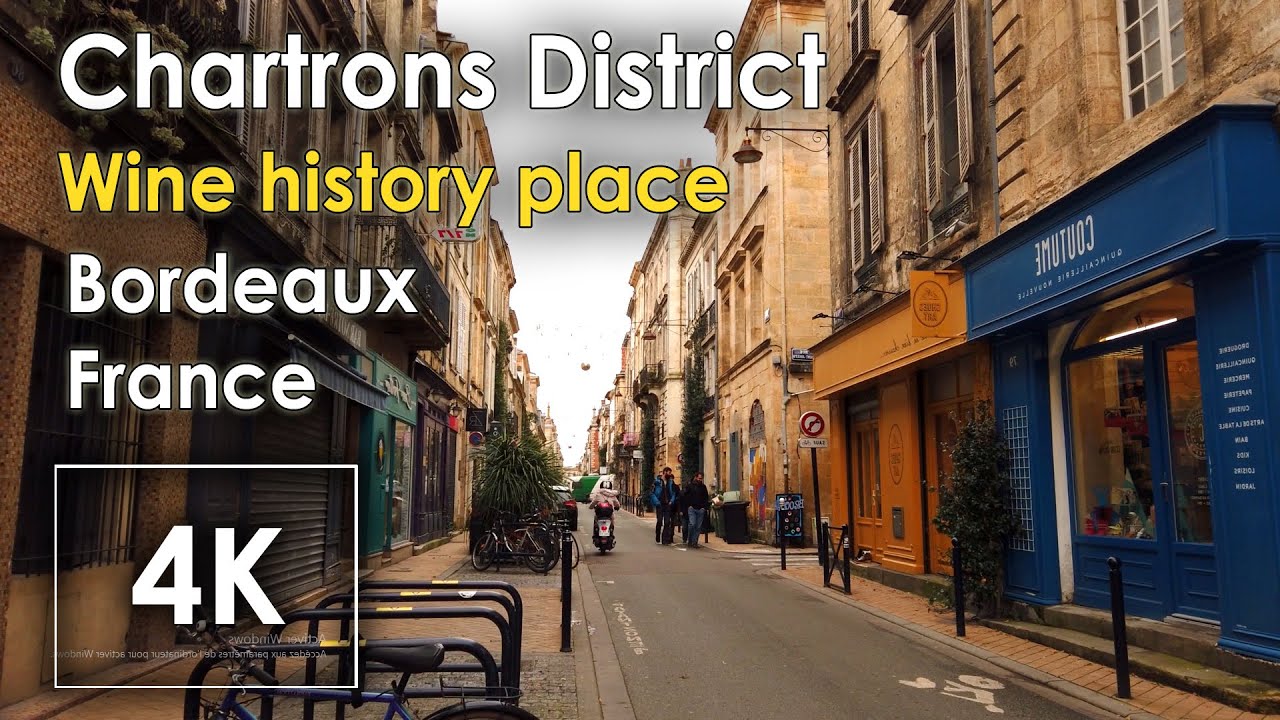
Chartrons district
Google maps location :
Between the Quai des Chartrons and the Cours de Verdun, Portal and Saint-Louis, this quarter is named after the Carthusians who once lived here, leaving in the 15C to make way for an enormous wine depot. In the 18C, Bordeaux merchants built some beautiful private residences here. In the 19C, small working-class houses known as échoppes were built here; these buildings are now a typical feature of the outlying districts of the city.
In 13812, a convent of Carthusian brothers was founded outside the walls. A suburb develops around the monastery.
The development of this former drained swamp begins with the installation in the seventeenth century of English, Flemish and Irish merchants. Obliged to settle outside the walls, they create an influential wine aristocracy, known in derision as “Aristocratie du Bouchon”, and their proximity to the monastery makes them nicknamed chartrons by the people of Bordeaux. Broker and merchant, they founded companies that sold wine in their country of origin. Little by little, vast aging and storage warehouses are being built along the Garonne. They were intended to receive the wine which arrived in gabarre of the wines of the high country of the vineyard of the southwest and to prepare the wines for the expeditions towards Northern Europe. The Irishman Pierre Mitchell installed the first Bordeaux glassworks there in 1723 which became the main bottle factory in France and facilitated the marketing and export of wine.
Pastor Antoine Vermeil worked in the Chartrons district from 1824 to 1840. In 1829 he created a “Protestant charity office” and a charitable society. He opened a primary school and an asylum room. He is the main craftsman of the Chartrons temple and a Protestant cemetery.
The families of the big merchants were strongly influenced by the first of Anglo-Saxon origin. Even families from Alsace or the Rhône valley took on a connotation across the Channel. Commercial and matrimonial alliances were the basis of a self-sufficient community until the 1970s. This influence is always notable in the name of the castles of the Médoc vineyard: family from Tom Barton to Langoa Barton or Léoville Barton, Rothschild family to Lafite chateaux and Mouton, John Lynch, founder of the castles of Lynch-Bages and Lynch-Moussas, Boyd family in Boyd-Cantenac … Château Prieuré-Lichine confirms the internationalization of trading with the arrival of the Russian Alexis Lichine.
During the years 1993 to 2007, the former Colbert cruiser of the national navy was moored at the quays of Chartrons to become a museum. The need for renovation of the ship, including the painting, required 1.5 million euros that the defense association could not raise. Still owned by the navy, it joined Brest in 2007 to be dismantled there.
In the post-war years, the district was gradually deserted by traders. The reputation of the district suffers, between empty warehouses abandoned.
At the dawn of the 2000s, this area close to the city center, with typical old architecture and the Garonne front prompted decision makers to undertake its rehabilitation. Extensive programs create modern homes and offices while preserving the facades steeped in history. Badly famed, the district becomes trendy and is colonized by antique dealers and second-hand dealers. The restaurants and bistros on the Garonne front give day and night life to the trendy district.
The district is home to the Cité du Vin and the INAO center in Bordeaux and the ONIVINS regional delegation, which has since become VINIFLHOR and then FranceAgriMer.
Rue Borie, the Chartrons museum traces the rich past of the district linked to wine trading and trade.
This district was mentioned by the writer François Mauriac in his work
My gear :
Cemera Osmo pocket –
Osmo pocket + Must Have Accessories –
Extension Rod –
Memorys –
Charge kit
Expansion Kit
Audio adapter
Backpack Clip Holder