
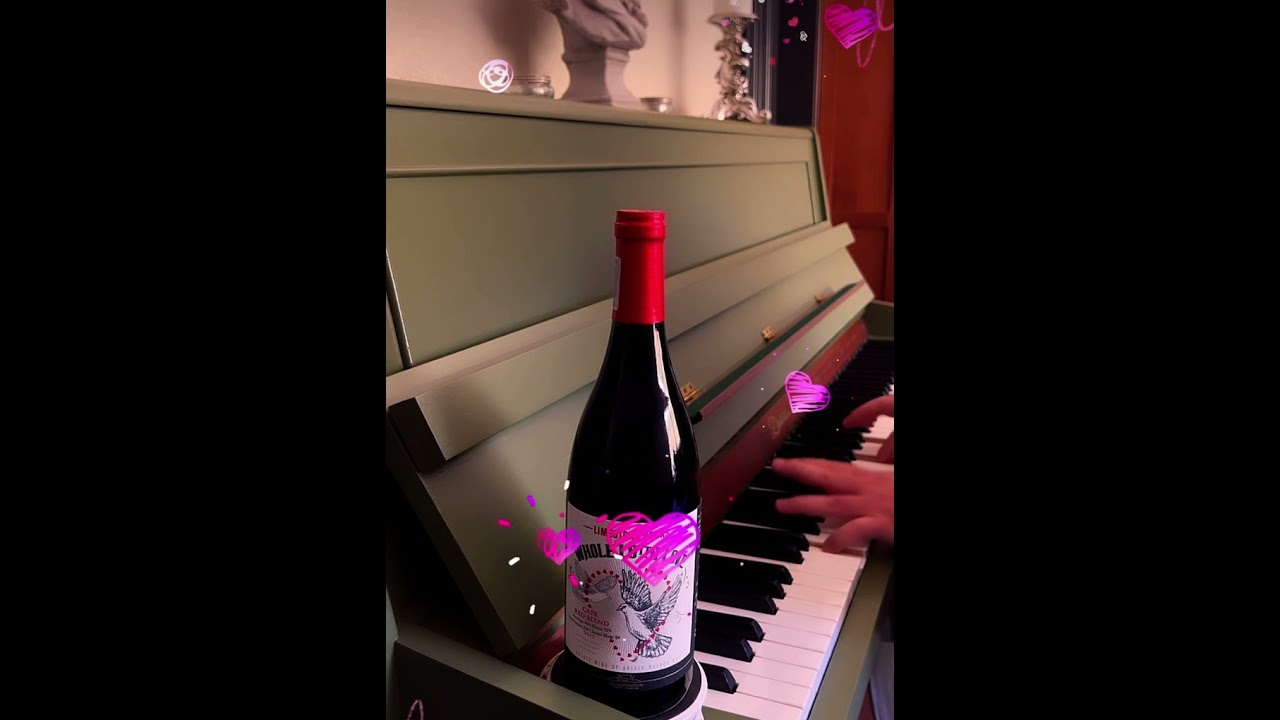
🎹 Piano & Wine 🍷 Whole lotta love!
If you have a good idea about a song combined with a wine, please leave your comment behind here below. Maybe I can follow up your idea here with my version 😉
Springfontein’s soil is full of limestone rocks, and the roots of our vines thrust deep into the earth to suck in the water and minerals captured there. Like the vintage songs of rock and roll legends, limestone has been the baseline for a myriad of iconic wines.
All of them Pinotage cuvées, the “Limestone Rocks” are rather fleshy and voluminous and bursting with power without missing the minerality that characterizes our terroir. They are created with a maximum of manual work, mature for a long time in barriques before bottling and then, once filled, for many more months in our cellar before we finally release them.
The Pinotage was cold-macerated for 6 days and fermented with indigenous yeast in open 100 % new American oak barriques. The Petit Verdot was cold-macerated for 4 days and fermented with indigenous yeast in open 100 % new French oak barriques. The Shiraz grapes ripened on the vine by breaking bunches and leaving them hanging for 10 days. It was fermented in whole bunches in open 100 % new French and Hungarian oak barriques. All three varieties were fermented with light punch downs every 2 hour for 7 days, to optimize extraction of color, aroma, and tannins. After fermentation, the wine was pressed off skins, and put back into the same barrels for malolactic fermentation. All cultivars were matured for 19 months before blending.
Layered with complex aromas of berry fruit and oak spice both on the nose and through to the palate. The rich mineral characteristic of the terroir gives this blend rich and intense but soft textured velvety tannins. A true Cape blend with great potential to develop for many years to come.
“Whole Lotta Love” is a song by British rock band Led Zeppelin. It is the opening track on the band’s second album, Led Zeppelin II, and was released as a single in 1969 in several countries; as with other Led Zeppelin songs, no single was released in the United Kingdom. In the United States, it became their first hit and was certified gold. Parts of the song’s lyrics were adapted from Willie Dixon’s “You Need Love”, recorded by Muddy Waters in 1962; originally uncredited to Dixon, a lawsuit in 1985 was settled with a payment to Dixon and credit on subsequent releases.
In 2004, the song was ranked number 75 on Rolling Stone magazine’s list of the 500 Greatest Songs of All Time, and in March 2005, Q placed “Whole Lotta Love” at number three in its list of the 100 Greatest Guitar Tracks. It was placed 11 on a similar list by Rolling Stone. In 2009 it was named the third greatest hard rock song of all time by VH1. In 2014, listeners to BBC Radio 2 voted “Whole Lotta Love” as containing the greatest guitar riff of all time.
Jimmy Page came up with the guitar riff for “Whole Lotta Love” in the summer of 1968, on his houseboat on the River Thames at Pangbourne, Berkshire, England. However, John Paul Jones stated that it probably was developed from a live improvisation during performances of “Dazed and Confused”. Page denied that the song originated onstage and that he had the riff and the rest took it from there.
Notation for the song indicates the key of E major and a tempo of 92 beats per minute in a compound AABA form. During the two day mix of the Led Zeppelin II album, audio engineer Eddie Kramer discovered that some bleed though occurred on Plant’s vocals on the “Whole Lotta Love” track, which could not be removed, so he put some echo on it, and Page liked the sound. Page also employed a backwards echo production technique.
On 7 November 1969, “Whole Lotta Love” was released as a single in several countries, with “Living Loving Maid (She’s Just a Woman)” as the B-side. In the US, Atlantic provided an edited 3:12 version as the flipside for radio stations. Billboard described the single as a “powerful, commercial swinger that should have no trouble putting [Led Zeppelin] up the Hot 100.” Cash Box described it as “a mixture of rock and blues with special production touches and a rousing lead vocal performance.” In the UK, Atlantic Records expected to issue an edited version, and pressed initial copies for release on 5 December 1969, but this was cancelled by request of manager Peter Grant.