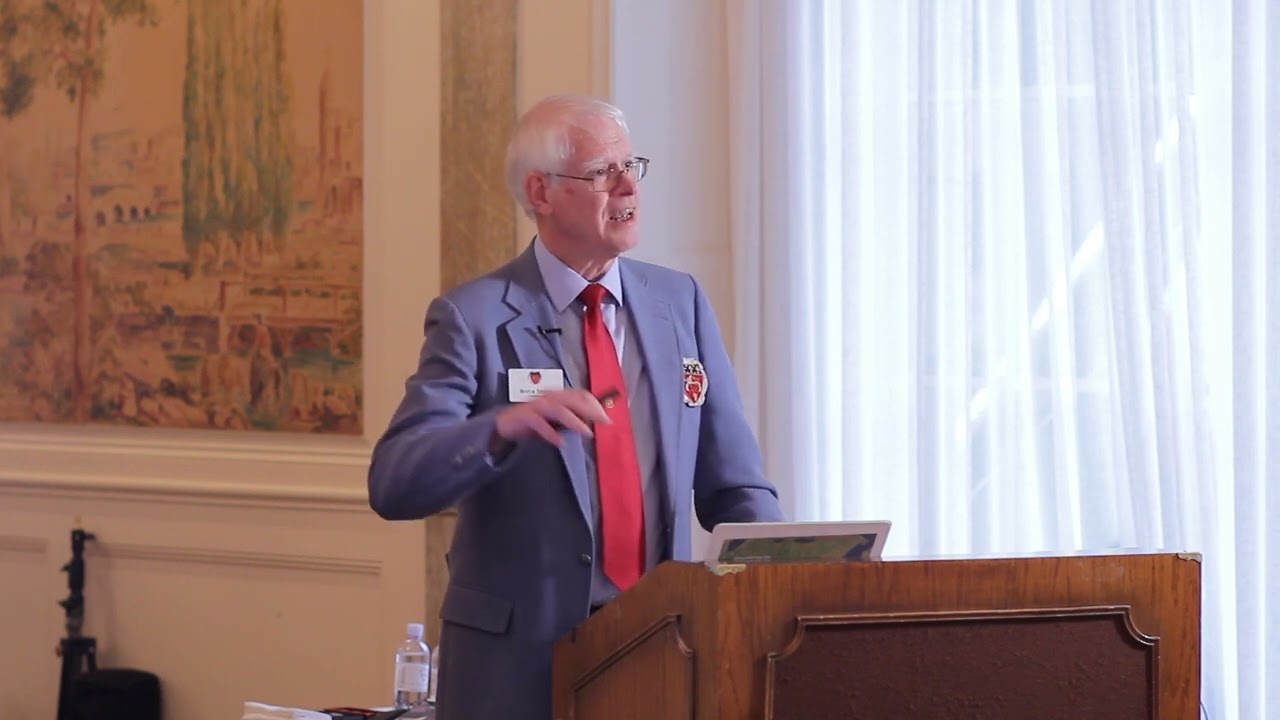
At the 2022 CdB Educateurs’ Forum, Bruce Taylor discussed the history of the wine trade on both banks of the Gironde, emphasizing the rise and fall of regional reputations over the centuries, the consequences to local economies and political clout, and the key reasons for these shifts. In typical engaging fashion, he starts in the early 1800s, quoting from various contemporaneous writings. The wines of Bordeaux were divided into only three types based on terrain (Cotes, Palus and Graves), with Graves most highly esteemed and the Libournais ignored altogether. More modern divisions are based on regions such as the Medoc, Entre-Deux-Mers, Libournais etc. Following heavy English and Dutch influence from the Middle Ages to 1700, the Medoc took off in the 17th and 18th centuries due to the successful drainage of marshes, as well as the development of a fine wine market in France and overseas. In contrast, there was no investment in the Libournais by the aristocracy, at the same time that Dutch trade with Libourne fell off. In the 19th C, the reputation of Graves also declined (the wines were said to be “hard, even harsh”), without the support of negociants who invested in vineyards and, more importantly, controlled the export market. This led to the 1855 Classification which included only the Medoc and Sauternes, excepting only Ch. Haut Brion. Even in the 1950s, writers such as Alexis Lichine said very little about St. Emilion, and Pomerol was least-mentioned in his review of Bordeaux. Taylor noted that British wine writers in the 1970s, while praising the white wines of Graves, downplayed the reds. Not until recent times have writers such as Jane Anson rediscovered the excellent red wines of Graves, and also given relative prominence to Pomerol. Taylor gives several reasons for this shift: the classifications of Graves in 1953 and of St. Emilion in 1955; the involvement of dynamic individuals, for example Jean-Pierre Moueix, who almost single-handedly put Pomerol on the wine map; the rise in popularity of certain wine critics who changed consumer tastes, while the influence of the wine trade itself declined; the severe frost of 1956, which led to replanting with a higher percentage of merlot in the Libournais and subsequent production of softer, earlier-drinking wines in concert with market demand. Reputations and prices on the Right Bank have risen accordingly, especially in an age of mass communication. As Taylor reminds us, change itself has always been the great constant in Bordeaux.
Tasting suggestion: 2016s from Bourg and Blaye (before the prices go up).