
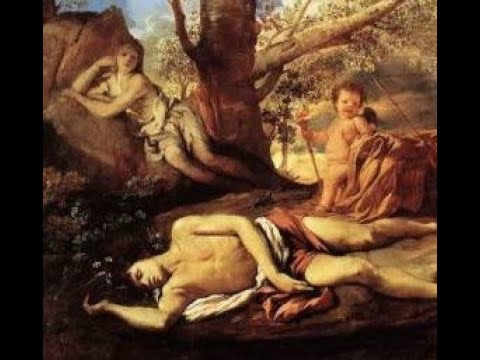
Nicolas Poussin June 1594 – 19 November 1665) was the leading painter of the classical French Baroque style, although he spent most of his working life in Rome. Most of his works were on religious and mythological subjects painted for a small group of Italian and French collectors. He returned to Paris for a brief period to serve as First Painter to the King under Louis XIII and Cardinal Richelieu, but soon returned to Rome and resumed his more traditional themes. In his later years he gave growing prominence to the landscape in his paintings. His work is characterized by clarity, logic, and order, and favors line over color. Until the 20th century he remained a major inspiration for such classically-oriented artists as Jacques-Louis David, Jean-Auguste-Dominique Ingres and Paul Cézanne.
Details of Poussin’s artistic training are somewhat obscure. Around 1612 he traveled to Paris, where he studied under minor masters and completed his earliest surviving works. His enthusiasm for the Italian works he saw in the royal collections in Paris motivated him to travel to Rome in 1624, where he studied the works of Renaissance and Baroque pain-ters—especially Raphael, who had a powerful influence on his style. He befriended a number of artists who shared his classicizing tendencies, and met important patrons, such as Cardinal Francesco Barberini and the antiquarian Cassiano dal Pozzo. The commissions Poussin received for modestly scaled paintings of religious, mythological, and historical subjects allowed him to develop his individual style in works such as The Death of Germa-nicus, The Massacre of the Innocents, and the first of his two series of the Seven Sacra-ments.
He was persuaded to return to France in 1640 to be First Painter to the King but, dissatisfied with the overwhelming workload and the court intrigues, returned permanently to Rome after a little more than a year. Among the important works from his later years are Orion Blinded Searching for the Sun, Landscape with Hercules and Cacus, and The Seasons.
Classical Greek and Roman mythology, history and literature provided the subjects for many of his paintings, particularly during his early years in Rome. His first successful pain-ting in Rome, The Death of Germanicus, was based upon a story in the Annals of Tacitus. In his early years he devoted a series of paintings, full of color, movement and sensuality, to the Bacchanals, colorful portrayals of ceremonies devoted to the god of wine Bacchus, and celebrating the goddesses Venus and Flore. He also created The Birth of Ve-nus (1635), telling the story of the Roman goddess through an elaborate composition full of dynamic figures for the French patron, Cardinal Richelieu, who had also commissioned the Bacchanals.[38] Many of his mythological paintings featured gardens and floral themes; his first Roman patrons, the Barberini family, had one of largest and most famous gardens in Rome. Another of his early major themes was the Rape of the Sabine Women, recounting how the King of Rome, Romulus, wanting wives for his soldiers, invited the members of the neighboring Sabine tribe for a festival, and then, on his signal, kidnapped all of the women. He painted two versions, one in 1634, now in the Metropolitan Museum, and the other in 1637, now in the Louvre. He also painted two versions illustrating a story of Ovid in the Metamorphoses in which Venus mourning the death of Adonis after a hunting accident, transforms his blood into the color of the anemone flower.
Throughout his career, Poussin frequently achieved what the art historian Willibald Sauer-länder terms a “consonance … between the pagan and the Christian world”.[39] An example is The Four Seasons (1660–64), in which Christian and pagan themes are mingled: Spring, traditionally personified by the Roman goddess Flora, instead features Adam and Eve in the garden of Eden; Summer is symbolized not by Ceres but by the biblical Ruth.[39]
In his later years, his mythological paintings became more somber, and often introduced the symbols of mortality and death. The last painting he was working on before his death was Apollo in love with Daphne, which he presented to his patron, the future Cardinal Massimi, in 1665. The figures on the left of the canvas, around Apollo, largely represented vitality and life, while those on the right, around Daphne, were symbols of sterility and death. He was unable to complete the painting because of the trembling of his hand, and the figures on the right are unfinished.