
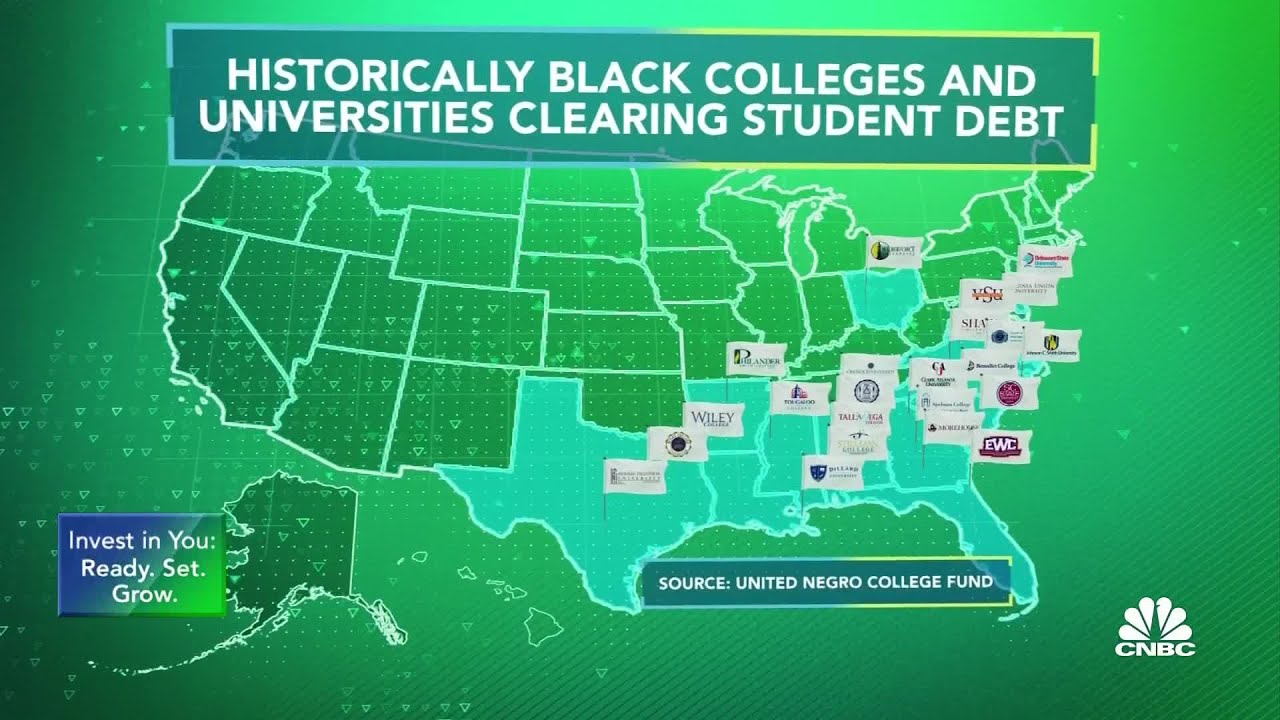
Sharon Epperson joins Closing Bell to discuss a new policy at some Historically Black Colleges & Universities (HBCUs) that pay off portions of what students owe in tuition and fees. More than 20 HBCUs are using pandemic stimulus funds to help alleviate some students’ costs of going to school. For access to live and exclusive video from CNBC subscribe to CNBC PRO:
The Covid-19 pandemic has disproportionately impacted the finances of many Black Americans, including student loan borrowers. Black college graduates owe an average of $25,000 more in student loan debt than white college grads, and over 50% of Black borrowers say their net worth is less than what they owe on student loans.
Now, a number of historically black colleges and universities (HBCUs) are stepping in to help alleviate that financial burden. With federal funding and private donations, these schools are wiping out current students’ account balances — including tuition and fees — and giving them a fresh start.
“We’re committing $5 million, assisting nearly 2,000 students with account balances,” said Clark Atlanta University President George T. French Jr. “The impetus, of course, was to help our students — and to make sure from a business, from a financial implication posture to make sure that we reduce our student debt, so that they could matriculate and graduate.”
Clark Atlanta University in Atlanta, Georgia, which has nearly 4,000 students in total, was one of the first HBCUs in the nation to use federal pandemic relief aid to clear balances for some of its students.
The school is not only cancelling outstanding tuition balances. Also, starting with the 2020 spring term through the current semester, “if you have a dining or a residence hall balance, it will cover that,” French said. “So whatever balances that you have that would restrict you from coming to school, we are removing those restrictions.”
“We are reinventing the college experience,” he said, “so that our students can graduate nearly debt free.”
During the pandemic, federal stimulus funds have enabled the U.S. Department of Education to make significant investments in under-resourced colleges and universities through the Higher Education Emergency Relief Fund, including more than $2.6 billion to HBCUs.
Autymn Epps, a 20-year-old junior at Clark Atlanta majoring in business administration, said she and her fellow undergrads were stunned when they heard the school had wiped out their unpaid student balances thanks to federal stimulus money.
“When I found out I was speechless,” said Epps, who is also student government president. “We were all surprised. We were like, ‘is this real? Is this happening?’ We were all just talking about how it was such a blessing.”
Clark Atlanta and other schools, including Ohio’s Wilberforce University, Hampton University in Virginia and Louisiana’s Grambling State University, have sparked a movement that is currently sweeping across the U.S. More than 20 historically black colleges and universities have cleared all or part of money owed for tuition and fees — and experts say that number could grow.
“HBCUs provide these wraparound services, this culture of caring about their students, not just treating them like a number or bill payers, and because of that history and that culture, when the finances occurred from Congress in the Coronavirus stimulus packages that allow institutions the ability to pay off student debt and student fees, HBCUs stepped up to the plate,” said Lodriguez Murray, senior vice president for public policy and government affairs at the United Negro College Fund [UNCF], which helps fund scholarships for Black students.
» Subscribe to CNBC TV:
» Subscribe to CNBC:
» Subscribe to CNBC Classic:
Turn to CNBC TV for the latest stock market news and analysis. From market futures to live price updates CNBC is the leader in business news worldwide.
The News with Shepard Smith is CNBC’s daily news podcast providing deep, non-partisan coverage and perspective on the day’s most important stories. Available to listen by 8:30pm ET / 5:30pm PT daily beginning September 30:
Connect with CNBC News Online
Get the latest news:
Follow CNBC on LinkedIn:
Follow CNBC News on Facebook:
Follow CNBC News on Twitter:
Follow CNBC News on Instagram:
#CNBC
#CNBCTV