
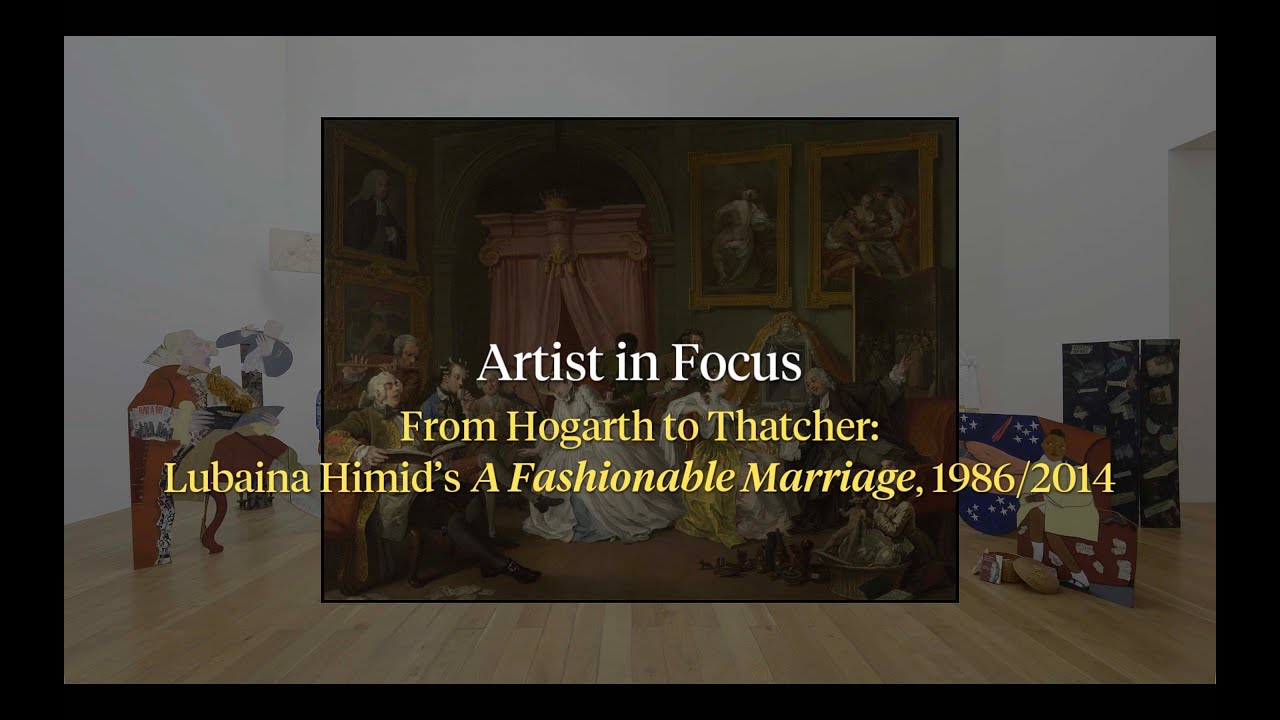
In this lecture, Elizabeth Robles investigates Hogarth’s enduring legacy through the lens of Turner-prize winner Lubaina Himid’s “A Fashionable Marriage” (1986). A re-staging of The Toilette, the fourth of six scenes that comprise Hogarth’s “Marriage-a-la-Mode” (1743–5), here Himid cuts Hogarth’s painted figures away from the canvas to create a plastic tableau vivant of the London scene in the 1980s. She negotiates an engagement with Hogarth as a fellow artist, a satirist and a proponent of a myth of Britishness and the art histories that accrue to it.
William Hogarth was an English painter and printmaker. Born in London in 1697, Hogarth went on to undertake an apprenticeship as an engraver, which he later abandoned. He is most noted for his serialised works satirising society and morality. His works became hugely popular due to the mass production and distribution of his etchings. In this series, Mark Hallett (Director of Studies, Paul Mellon Centre), Meredith Gamer (Assistant Professor, Columbia University), and Elizabeth Robles (Lecturer, University of Bristol) will introduce you to Hogarth and his most noted works.
Shot and edited by Jonathan Law
Music by Daniel Birch, ‘Sustained Light’, 2021, CC BY 4.0