
Thanks to your feedback, I rebuilt the entire fermentation system. Grand Cru — a Bordeaux winemaking sim — launches on Steam March 12th.
A few weeks ago I posted here about Grand Cru, a solo-dev Bordeaux winemaking tycoon. You all tore my fermentation model apart — and I'm grateful for it. Real winemakers told me my oak tolerance was wrong, sommeliers pointed out my MLF slider made no sense, and someone linked actual geological surveys of Pauillac's gravel beds. I went back and rewrote the core systems from scratch.
March 12th, the game goes live on Steam Early Access. This post is a thank-you to r/wine and a deep dive into what changed because of you.
The Blind Tasting Duel
This is the feature I'm most proud of, and the one I think this community will geek out over the hardest.
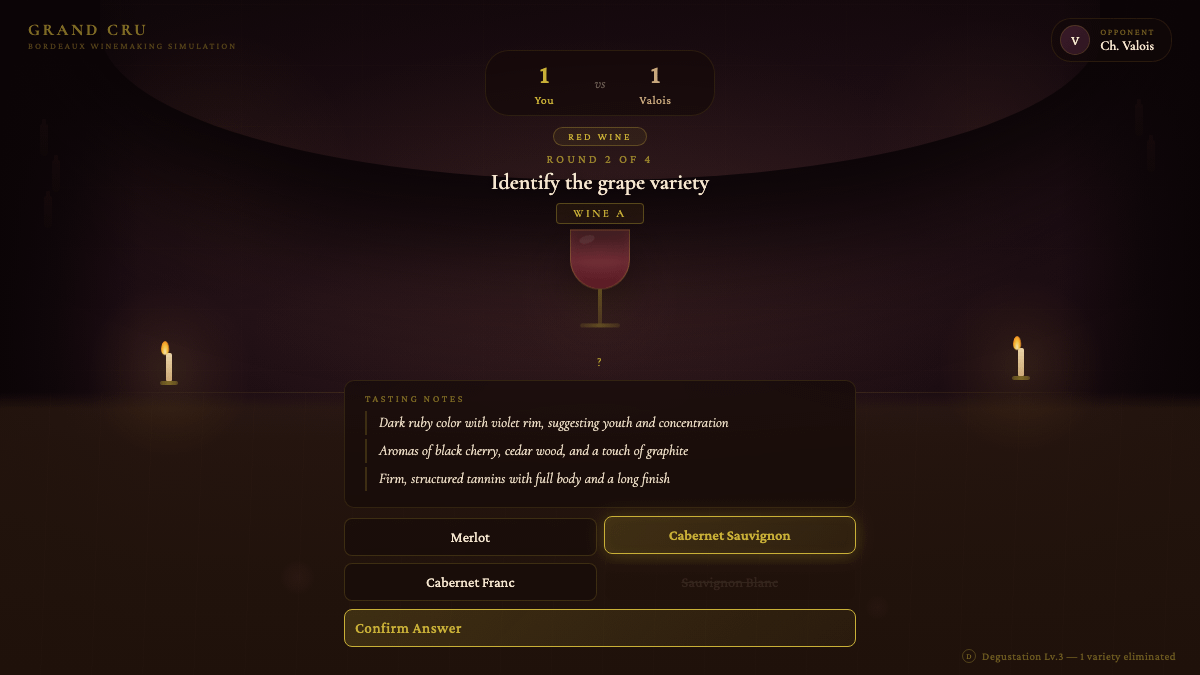
You sit down across from a rival winemaker. Two mystery wines. Six rounds. For Wine A, you get four rounds: identify the grape variety, the commune, the vintage year, and the quality tier. Then Wine B arrives — two more rounds, randomly chosen categories. Whoever gets more right wins.
Here's where it gets interesting. Your degustation skill level determines what tasting notes you can perceive. At level 1, you might get: "I sense the ocean breeze… cool gravel terroir. Must be Médoc." By level 3, the hints narrow down: "Gentle extraction, restrained oak… precision winemaking. Refined." At level 4, you're reading the wine like a book: "Violets, silky tannins… this elegance can only be Margaux."
The commune identification uses a 4-layer hint system: bank (left vs right), climate profile, soil type, then winemaking tradition. So you might work through: Right Bank → continental climate → clay over gravel → meticulous micro-production care… and land on Pomerol. Or you catch deep gravel drainage with ocean-influenced gravel terroir and long maceration with heavy new oak — that's Pauillac.
The wines themselves are pulled from actual NPC winery inventories. If Château Valois made a 2003 Merlot from Saint-Émilion that scored 88, that exact wine might show up in your blind tasting. The vintage character (warm/balanced/cool) is derived from real vintage chart data for left bank red, left bank white, right bank red, and right bank white separately.
Quality tiers map to the Bordeaux classification: Vin de Table (<70), Cru Bourgeois (70-79), Cru Classé (80-89), Premier Cru (90+).
7 Fermentation Sliders with a Shifting Golden Zone
Every harvest, you set seven sliders for each lot:
- Fermentation vessel (stainless steel → oak vat)
- Fermentation temperature (cold → hot)
- Extraction intensity (light → heavy)
- Fermentation duration (1 week → 4 weeks)
- Malolactic fermentation intensity (suppressed → full)
- New oak ratio (0% → 100%)
- Toasting level (light → heavy)
Each grape variety has a base ideal profile. Cabernet Sauvignon wants high extraction (70), long maceration (72), full MLF (80) to soften those harsh tannins, and 70% new oak. Sauvignon Blanc wants the opposite — stainless steel (15), cold ferment (25), minimal extraction (20), suppressed MLF (15) to preserve acidity, and barely any oak (10).
But here's the thing wine people will appreciate: the golden zone shifts based on grape condition at harvest. If your grapes came in with unusually high sugar (say, a hot vintage), the ideal fermentation temperature drops and extraction intensity decreases — because over-extracting already concentrated fruit would make an unbalanced monster. High tannin readings? The ideal oak ratio and extraction both shift down. High acidity? Temperature target moves up slightly.
The formula: shift = (value - 60) × coefficient. Sugar affects temp (-0.3) and extraction (-0.3). Acidity affects temp (+0.25). Tannin affects extraction (-0.25) and oak (-0.2).
Your degustation skill determines how much guidance you get. At level 2, you get directional hints ("too high" / "too low"). At level 3, you know when you're close or perfect. At level 4, you get the actual target range (±10).
The Scoring Pipeline: Structure, Typicity, Finish, Complexity
Wine scores aren't just a single number. Every wine is evaluated on four pillars:
Structure (30%) — For reds, it's a triangle balance between sugar, acidity, and tannin. The game calculates variance across all three; a standard deviation under 5 is considered balanced (forgiving zone), but beyond that, each point costs you 2.5 points of balance score. For whites, it's sugar-acidity balance with a ±5 deadzone.
Typicity (20%) — How well does your wine express its grape variety and terroir? Each variety has an ideal profile (CS wants sugar 85, acidity 70, tannin 85; Sauvignon Blanc wants sugar 65, acidity 80, tannin 0). The game measures Euclidean distance from the ideal, with an asymmetric penalty — exceeding the ideal is penalized at half rate (overripe fruit is less offensive than underripe). Terroir score contributes 30%, soil match 20%.
Finish (25%) — Combines your slider accuracy (60%) with aging appropriateness (40%). Cabernet Sauvignon wants 18-24 months in barrel. Sauvignon Blanc? 0-3 months — get it in bottle fast. Barrel type matters: French oak gives +12 finish bonus, Hungarian +8, American +5. But only if the barrels are fresh — second-year barrels drop to 60% effectiveness, third-year to 30%.
Complexity (25%) — This one has a terroir ceiling. Even if you nail everything else, bad terroir caps your complexity score: terroirMultiplier = terroir / 100 (floored at 0.4). A great oak program on mediocre land will never produce a truly complex wine. Blending adds up to +10 bonus here.
Then there's the disgust system. Every grape has an oak tolerance threshold and an MLF threshold. Push Sauvignon Blanc past its oak disgust threshold and you'll get a review that says "severe oak disgust" — the public score takes up to a 25-point hit. But hit the public sweet spot (the amount of oak/MLF the average drinker loves for that variety) and you get a +5 bonus. Critics and the public score wines differently: critics weight structure and typicity higher, while public scores favor accessibility and fruit-forwardness.
Bordeaux Authenticity
Nine communes: Pauillac, Margaux, Saint-Julien, Pessac-Léognan, Haut-Médoc on the Left Bank. Saint-Émilion, Pomerol, Fronsac, Castillon on the Right Bank. Each has a distinct soil profile — Pauillac's deep gravel drainage versus Pomerol's clay-over-gravel, Margaux's fine gravel and limestone versus Castillon's clay-sand mix.
Five AOC varietals: Cabernet Sauvignon, Merlot, Cabernet Franc, Sauvignon Blanc, Sémillon. The blending system lets you create classic Bordeaux assemblages — a Left Bank blend dominated by Cab Sauv with Merlot and Cab Franc for complexity, or a Right Bank Merlot-dominant blend.
The local market simulation has all wineries — yours and seven NPCs — competing in the same Bordeaux price tier pools. Value attractiveness is calculated as (quality / price × 20) × repFactor × agingBonus × hype. So a 92-point wine priced at $40 will outsell a 93-point wine at $120 in lower tiers. Just like real Bordeaux.
The Story
You inherit a small estate and 300 bottles of your late father's wine — a legendary vintage that nobody can quite explain. The main storyline is about recreating that wine through clues discovered via events, NPC conversations, and your own tasting skill development. A mysterious neighbor named Marcel Duboscq, who knew your father, appears in visual novel scenes woven into the gameplay. The story unfolds over years as you build your reputation from newcomer to (hopefully) legendary winemaker.
What r/wine changed
I want to be specific, because you all earned the credit:
- Concentration-based oak tolerance — A comment about how fruit concentration determines oak absorption became a core mechanic. Now
concentration = structure×0.5 + terroir×0.3 + weather×0.2gates how much new oak a wine can handle before it becomes an over-oaked mess. - MLF as a spectrum, not a toggle — Someone explained that MLF isn't "more = better," it's about matching the grape's natural profile. Sauvignon Blanc's ideal MLF is 15 (barely any). Cabernet Sauvignon's is 80. Push past the threshold and you lose the varietal character.
- Commune soil profiles — Checked against geological surveys several of you linked. Pauillac's deep gravel drainage, Pomerol's clay-over-gravel, Margaux's fine gravel and limestone — each plays differently in the terroir score.
- Dual critic/public scoring — Inspired by the eternal r/wine debate: Parker scores vs. what people actually enjoy drinking. A heavily oaked, high-extraction Cab Sauv might score 90 with critics but get a "disgust" flag from public tasters. Sound familiar?
March 12th — Steam Early Access
Solo dev. 18 days of crunch. ~60,000 lines of code. Built by someone who loves wine and happens to know how to code.
This is Early Access — the father's wine mystery storyline is still being written, and I have 28 more late-game events planned. But the core winemaking simulation is complete, and I think it's the most authentic digital winemaking experience that exists right now.
$9.99 on Steam, March 12th. If you're the kind of person who argues about maceration length at dinner parties, I made this for you.
https://store.steampowered.com/app/4451370/Grand_Cru_The_Wine_Maker/
Happy to answer any questions about the winemaking mechanics. And yes, I did agonize over whether Sémillon's ideal MLF intensity should be 45 or 50. It's 45.
by Grand_Cru_Dev