
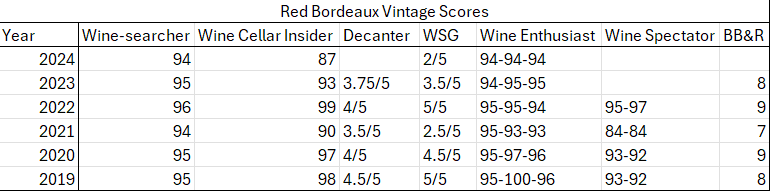
Note:
WSG = Wine Scholars Guild, BB&R = Berry Bros. & Rudd
Wine enthusiast breaks Bordeaux down to Pomerol/Saint-Émilion, Médoc , Graves (red). Wine Spectator breaks it down to left and right bank.
If the cell is blank, the publication has not yet reviewed the vintage.
by Uptons_BJs
9 Comments
A big part of wine discourse is vintage – which vintages are good, which vintages are bad. This is stuff that we’d argue back and forth, it decides prices, and so much “conventional wisdom” is built off of vintage ratings (IE: “On good vintages, you can buy from anybody, but in bad vintages, you can only buy from the top producers”)
But what is good and what is bad? Surely as a regular customer, you cannot be expected to drink so much wine to be able to determine whether a vintage is good or bad yourself? Besides, if vintage ratings are intended to serve as a purchasing guide, what is the point if you’ve bought so much wine you can come up with your own vintage ratings?
So of course, for most of us, we try to understand what is good and what is bad by reading wine publications. But here’s the thing – nobody can agree which vintages are good, and which vintages are bad. Look at this chart – I compiled the ratings from a few different publications’ vintage charts, and as we can see, the different publications have wildly different views on which vintage is good, and which vintage is bad. And this is for Red Bordeaux, probably the appellation with the most attention paid to.
Consider this:
* Wine-searcher says pretty much every vintage is decent and more or less the same
* 2 of the publications consider 2024 disastrous and terrible, while 2 others consider it more or less OK
* 2023 is the only vintage where there is a bit of consensus, where everyone says “its pretty good” (but note that the different publications rank 2023 among other vintages differently).
* Wine Cellar Insider and Wine Scholars Guild considers 2022 GOATed, while the others are significantly more muted in their praise
* WSG and Wine Spectator considers 2021 really bad, the others consider it more or less OK.
* Almost everyone considers 2020 great, as good as or better than 2022, except Wine Spectator who ranked it on the lower end.
* WSG and Decanter considers 2019 the best vintage of the bunch, but BB&R and Wine Spectator were more reserved. Wine Enthusiast considers 2019 GOATed for right bank, but not the best for left bank.
**Now I’m NOT saying that vintage variations don’t impact taste**. Obviously it does, the weather impacts grape growth, which impacts how the wine tastes. But, what I am saying is, the idea that there are consensus good and bad vintages is probably not true outside of the obvious best and worst vintages, and even then there’s a lot of controversy. After all, you’d think 2024 is a terrible vintage, but both Wine-searcher and Wine Enthusiast gave it OK scores.
I actually don’t know what my conclusion here should be. Don’t put so much weight on vintage perhaps? And if a sales person or piece of marketing material tells you that you should buy something because it came from a great vintage, understand that they probably cherry picked a good score (and you can probably cherry pick a bad score too).
Perhaps the better lesson is that if you’re looking to buy a lot of wine from a particular vintage, especially to lay down and age, you might as well read the manufacturer’s tasting notes and tech sheet and see if it is something you’d like to drink. It is a far more reliable way to decide on what to buy than a vintage report.
I usually only look at vintage ratings when buying older wine so I can tell whether it has a high chance of still being good but I’ve found that vintages are generally overrated within the first couple years and then SOME consensus is achieved after about 5 years.
That doesn’t mean that a 90 point vintage is that much worse than a 94 point vintage but it seems like a lot of the consensus comes from seeing how the wine is aging
i can’t even get willamette valley producers to agree which of the last five years were best
I mean, they all for example agree that 2021 is worse than the surrounding years. So there is somewhat of an overall agreement. The absolute numbers are different, but I usually just ignore those. When buying wine, you can just look at the available vintages and see how they stack up relative to each other. Whether it’s 92 vs 90 points or 87 vs 85 points, the former is better.
Hot take : talking about vintages for such young years makes no sense. But drink a 2008 and a 2009, or a 2004 and 2005, and you’ll see it’s not just marketing
(I’m referring to France wines here, where there is a real vintage effect. Might be very diff to null for other regions)
I don’t care about vintage scores at all, but I take issue with the idea that you can’t say whether a vintage is good or bad. Vintage reports are incredibly useful if you read enough and synthesize the data. Especially in this era of many too-hot vintages, it is imperative for me to know the overall vintage conditions. I’m focused on Piedmont and while there are good wines made in most vintages, there are also stark differences. 2016, epic, 2017 and 2018 hot and drought impacted respectively, 2019 classic, 2020 unusually forward and easy, 2021 epic, 2022 too hot, 2023, a bit too hot but likely better. Understanding of vintage shapes my buying immensely. I’ll buy a good producer’s wines from an off vintage if I truly trust them, but I certainly won’t pay as much and won’t buy as much as I don’t trust the aging.
All of that said, one issue I have is that critics seem to be loath to call out overripe wines and vintages.
Modern farming practices in most areas mean the floor in challenging vintages is infinitely higher than it was 50 years ago. The fact that wine reviewers still regularly put “Do Not Drink” on vintages into the 70s and 80s reflected the fact that people just had less tools, and understood less, about how to coax ripeness, mitigate disease pressure, and manage weather than we do today.
What does that mean in practice? I agree with other commenters that knowing a particular producer/lieu dit is worth MUCH more than a general rating of a vintage, but as a gauge to know how a random 70s Bordeaux or Barolo vintage might be doing from an unknown-to-you producer? Worth it. In a modern vintage, the value to me comes more in vintage style and does that suit your preferred producers, rather than a blanket “was it good?”, since many producers in known areas have ample tools to make good wine in pretty much any year.
As an aside, while we gripe about mediocre/generic wines today, it really is worth remembering that our parents had WAY more blatantly flawed/undrinkable options on their shelves than we do. Just because that $10 Chilean cab is boring, generic, lightly structured, and fruity, doesn’t mean that it isn’t consistently quaffable in a way that rando cheap Bordeaux wasn’t 40 years ago.
Vintage differences are definitely real. I agree that people way too often become fixated on what the ruling discourse from wine critics and the like is. I definitely recognize that from myself falling prey to that line of thinking. And then you go and drink a stunning Loire Chenin or Rheingau Riesling from the supposedly mediocre vintages of 2021. And you realize that yes, some vintages are likely to overall producer higher quality, but also that wow, they way too often get applied in a generalising way that does not account for how individual domains actually fared or how they match your palate. Personally, I look at vintage ratings, but I increasingly look at descriptions. Is it a cool vintage or a hot one? Phenolic ripeness and acidity levels? How did the domain fare, and off course tasting notes of the individual wine over the vintages in question. Sometimes I pick the “correct” vintage, but I quite often end up with the aforementioned 2021 in Loire or Germany, since cooler wines suit my palate and some weinguts/vignerons actually produced high quality fruit.
An important topic that should get more attention!
Those might not make sense on an absolute basis but within each company they seem pretty logical. I don’t see the issue here.